Property Managers: 7 Point Checklist to Stop Pressure Washing Overspray
Checklist for property managers to prevent pressure washing overspray, comply with washwater rules, and fix damage. Includes containment steps and drone...
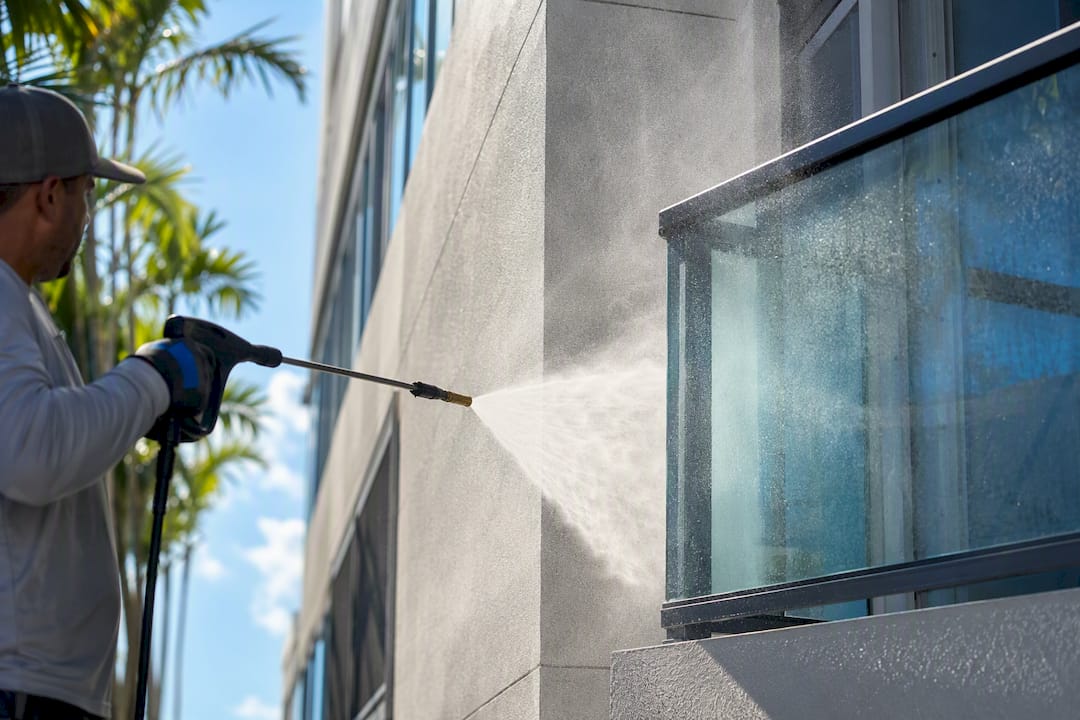
The fastest way to stop pressure washing overspray is to shut off the wand, isolate the work zone, and reassess your setup before you touch the trigger again. Property managers in Miami and Fort Lauderdale lose thousands to overspray damage every year on painted railings, glass storage-front windows, and landscaping. The fix is almost always the same: wider-angle tips, lower PSI, correct standoff distance, and physical barriers between the nozzle and anything you can’t afford to ruin. On multistory facades where ground crews struggle to control drift, drone cleaning removes the guesswork entirely.
TL; DR:
- Using wider-angle nozzles, lower PSI, and maintaining proper standoff distance significantly reduces overspray and drift risks during pressure washing.
- Environmental factors like wind and heat can carry chemical mist hundreds of feet onto unintended surfaces, increasing damage and liability.
- Implementing a written standard operating procedure for site assessment, containment, equipment settings, and inspection cuts down on overspray disputes and property damage.
- Most effective prevention relies on controlling pressure, nozzle angle, and distance rather than increasing water force, especially on delicate surfaces.
- Drone cleaning offers a controlled, risk-free alternative for high-rise buildings, eliminating overspray concerns and speeding up project timelines.
Table of Contents
- What Causes Pressure Washing Overspray?
- Prevention Checklist Every Property Manager Should Require
- What PSI, Nozzle, and Distance Actually Prevent Overspray?
- How Do You Manage Runoff and Comply With Washwater Rules?
- Removing Overspray Once It’s Already There
- When Does Drone Cleaning Eliminate Overspray Risk Entirely?
- What Crews Get Wrong About Overspray, and What Actually Fixes It
- Get an Accurate Quote for Drone Exterior Cleaning
- Where to Find BMP and SOP Guidance
- Sources
- FAQ
What Causes Pressure Washing Overspray?
Overspray is not one problem. It’s three separate failure points that compound each other on a real jobsite, and diagnosing which one bit you determine how you fix it.
Mechanical causes sit at the top of the list. A nozzle tip with too narrow an angle concentrates water into a tight, high-velocity stream that atomizes on contact and drifts on any air movement. Pair that with a pressure washer running well above what the surface needs, and you get misting that travels 10 to 15 feet past the intended target. Wand motion matters too: crews who sweep too fast or hold the tip too close create turbulence that throws droplets sideways instead of down.
Environmental causes are the ones most crews underestimate. Coastal wind in South Florida rarely sits still. A 10 mph gust off Biscayne Bay or the Intracoastal can carry a fine chemical mist 20 or 30 feet onto a neighboring balcony, a parked car, or a hedge that has nothing to do with the job. Heat accelerates the problem because fast-drying overspray bonds to paint and glass before anyone notices it landed.
Chemical causes round out the picture. Volatile detergents and degreasers aerosolize more readily than plain water, and that aerosolized mist is what actually kills landscaping and stains stucco. Vendor guidance on overspray reduction points out that chemical drift carries both a plant-damage risk and an inhalation risk for anyone standing downwind, including tenants and pedestrians who never signed up to be part of the job.
The real-world consequences show up fast:
- Etched or stained window glass from acidic detergents drying unevenly on the surface
- Dead or scorched shrubs and turf along the cleaning perimeter
- Paint discoloration on trim, doors, and railings hit with concentrated chemical mist
- Vehicle paint damage in adjacent parking areas, a common source of property manager liability claims
- Slip hazards on walkways from runoff that pooled instead of draining
None of these are rare. They’re the predictable result of the same three causes repeating on job after job when nobody adjusts for them.
Prevention Checklist Every Property Manager Should Require
A written checklist beats verbal instructions every time, and it gives you something to point to if a contractor disputes what went wrong. A documented SOP that requires mix ratios, containment steps, and photo sign-off measurably cuts down on overspray disputes because everyone agrees, in writing, what “done correctly” looks like before the first trigger pull.
Here’s the sequence property managers should demand from any crew, in-house or contracted, before work begins:
- Walk the site first. Identify sensitive surfaces (glass, painted trim, landscaping), storm drain locations, wind direction, and pedestrian traffic patterns before any equipment gets unloaded.
- Set up containment. Tarps and drop cloths go over plants, HVAC units, and outdoor furniture. Temporary barriers or shields block splash zones near vehicles and windows.
- Confirm equipment settings. Match tip angle and PSI to the substrate. Concrete tolerates more aggression than painted aluminum or vinyl siding.
- Work with the wind, not against it. Start on the upwind side of the building and move downwind so drift lands on already-cleaned surfaces rather than untreated ones.
- Rinse plants immediately if any chemical mist reaches them, rather than waiting until the end of the job.
- Inspect before leaving. Walk the perimeter looking for missed drift, pooled runoff, or residue on glass and metal.
- Document everything. Before-and-after photos, the chemical mix ratio used, and a customer or manager sign-off close out the job with a paper trail.
Pro Tip: Ask any contractor bidding on your building to show you their written SOP before you sign a contract. If they don’t have one, that’s a signal they’re improvising on your property, not following a repeatable process.
Property managers who require this sequence in writing, rather than trusting a verbal walkthrough, catch far more issues before they become claims. A quick reference on safe building washing practices for property managers covers additional asset-protection steps worth folding into your vendor requirements.
What PSI, Nozzle, and Distance Actually Prevent Overspray?
Settings matter more than brute force. Most commercial exterior cleaning does not need maximum pressure, and cranking it up is one of the fastest ways to create drift instead of clean surfaces.
Tip angle is your first control. A 40 to 65 degree fan tip spreads water pressure across a wider area at lower velocity per square inch, which dramatically reduces the fine misting that a 0 or 15 degree tip produces. Narrow tips belong on stubborn stains at close range, not on general facade or window work where drift is the enemy.
PSI and flow rate need to match the substrate, not the equipment’s maximum output. Industry standards for commercial exterior cleaning put most building exteriors in the 1,500 to 3,000 PSI range, with flow rates of 3 to 5 GPM doing the actual work of lifting dirt rather than pressure alone. Higher PSI does not clean faster in any meaningful way on painted stucco, EIFS, or glass. It just increases the odds of atomized mist traveling somewhere it shouldn’t.
Standoff distance is the variable crews skip most often under time pressure. Holding the wand too close concentrates force into a small area and increases bounce-back mist. A minimum standoff of around 12 inches is a reasonable baseline for many removal tasks, adjusted wider on delicate coatings and narrower only for isolated, tested stains.
Settings to check before every job:
- Fan tip angle appropriate to substrate (wider for glass and painted surfaces, narrower only for isolated stains)
- PSI dialed to the least aggressive setting that still lifts the target soil
- GPM sufficient for coverage speed without needing higher PSI to compensate
- Standoff distance held consistently, not eyeballed and drifting closer as the operator tires
- Detergent use minimized or eliminated once mechanical rinsing accomplishes the goal
On facades with biological growth like algae or mildew, a soft-wash approach using low-pressure detergent application followed by a gentle rinse gets better results than blasting, and it cuts overspray risk substantially on sensitive coatings. More detail on that approach lives in this breakdown of low-pressure washing for high-rise exteriors.
How Do You Manage Runoff and Comply With Washwater Rules?
Overspray and washwater runoff are legally connected, and treating them as separate problems is how property managers end up with a municipal violation on top of a property damage claim.
Best management practices from municipal environmental guidance require that washwater and detergents never reach a storm drain. That’s not a suggestion. It’s the baseline standard behind BMP guidance for pressure washing and mobile cleaning, which most South Florida municipalities reference when setting local expectations for commercial cleaning contractors.
The equipment that makes compliance realistic on an active jobsite includes:
- Berms and containment booms placed around the perimeter to redirect flow away from drains
- Drain covers fitted directly over storm inlets in the immediate work zone
- Portable containment pools for smaller, contained washing tasks
- Vacuum booms and pumps that actively recover washwater before it can spread
- Holding tanks for temporary storage until proper disposal, whether that’s sanitary sewer discharge with utility permission or licensed hauling
Detergent choice matters just as much as containment hardware. Biodegradable, low-toxicity cleaners reduce the environmental and liability stakes if any washwater does escape containment, and they cut the plant-damage risk that comes with harsher chemistry.
Documentation closes the loop. Keep records of containment steps taken, disposal method used, and any municipal permission obtained for sewer discharge. Storm drain contamination cases increasingly hinge on whether a contractor can prove due diligence, and a folder of dated photos and disposal receipts is often the difference between a warning and a fine.
Removing Overspray Once It’s Already There
Prevention fails sometimes. Wind shifts, a tip clogs, or a new hire holds the wand too close. When overspray lands where it shouldn’t, the removal method depends entirely on the surface.
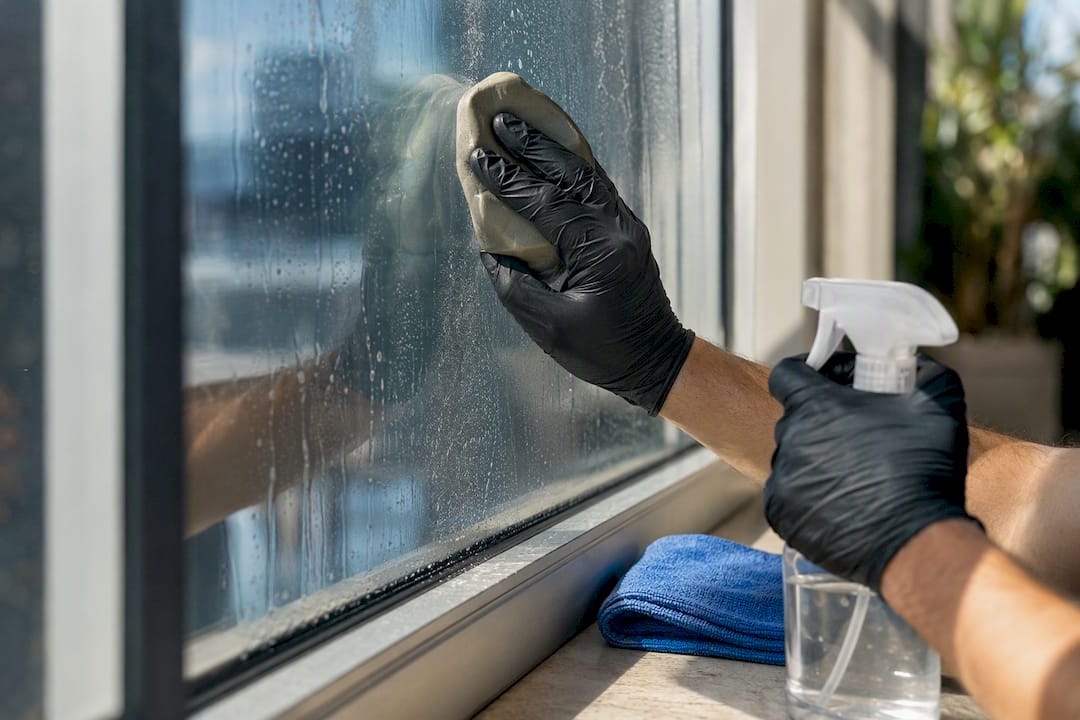
Glass and metal respond well to a clay bar and lubricant method, the same technique used to lift bonded contaminants off automotive paint. Overspray on glass or aluminum frames sits on the surface rather than absorbing into it, so continuous lubrication while working the clay bar prevents scratching the surface as you lift the residue. Dry scraping is the single most common DIY mistake here, and it’s how homeowners and untrained maintenance staff turn a removable mist stain into a permanent scratch.
Painted and coated surfaces need a test patch first, always. Apply a mild cleaner to a hidden section, wait, and check for discoloration before treating the visible area. Low-pressure rinsing handles fresh, light overspray. Cured or heavy chemical staining on paint sometimes requires full stripping and recoating, which is a different budget conversation than a quick cleanup.
Concrete and masonry tolerate more aggressive treatment, but wide-angle nozzles at a safe standoff still outperform narrow, close-range blasting for lifting residue without etching the surface. Detergents formulated specifically for masonry lift embedded stains better than general-purpose cleaners, and for deep chemical or rust staining, a poultice application (a paste that draws the stain out over hours or days) often succeeds where pressure alone fails.
- Identify the substrate before choosing any solvent or method.
- Test in a hidden area first, especially on painted or coated surfaces.
- Use the gentlest method that actually lifts the residue.
- Escalate to a restoration professional when staining is set, extensive, or on a surface you can’t safely reach with ground equipment.
Pro Tip: Never mix removal chemicals without confirming compatibility first. A degreaser and a masonry cleaner used together can react and create a worse stain than the original overspray.
For sticky residue overlap, like adhesive tape marks combined with chemical drift, a specialized resource on adhesive and wax removal techniques covers methods that go beyond standard pressure washing chemistry. And for glass specifically, this guide on removing silicone residue from South Florida glass walks through techniques that avoid the scratching risk common to DIY attempts.
When Does Drone Cleaning Eliminate Overspray Risk Entirely?
Ground-based pressure washing on a 10-story or 20-story facade has a structural problem no checklist fully solves: wind speed increases with height, and the higher the reach, the harder it is to control drift with a hose and a lift. Drone cleaning removes that variable by keeping the equipment, and the operator, close to the surface at every elevation.
Vista Drone Cleaning operates tethered industrial drones piloted by FAA Part 107-certified operators, using controlled soft-wash and pure-water rinse techniques that put far less volume of water and detergent into the air than a ground rig aimed 150 feet up. Crews stay on the ground the entire time. There’s no scaffolding, no boom lift, and no rigging crew standing near a chemical spray pattern they can’t fully see from below.
For property managers weighing this against traditional methods, here’s what typically changes:
- Most facade or window projects finish in 1 to 3 days instead of the extended timelines scaffolding requires
- No permits or road closures for lift equipment, which means less tenant and pedestrian disruption
- $2 million liability insurance backs every project
- Before-and-after 4K documentation replaces guesswork about what was actually cleaned and how
Ask any drone cleaning provider for their FAA certification details, insurance coverage, and a sample of before-and-after documentation before requesting a quote. A side-by-side look at drone cleaning versus traditional pressure washing covers the cost and damage-risk trade-offs in more depth.
What Crews Get Wrong About Overspray, and What Actually Fixes It
The overspray mistakes that cost property managers the most money are rarely dramatic. They’re small, boring oversights: a crew skips the site walk because they’ve cleaned the building before, someone eyeballs standoff distance instead of holding it steady, or nobody rinses a hedge until the job is already wrapped up.
Photos and a sign-off sheet fix more of this than any piece of equipment. When a crew has to document the containment setup before starting and the finished result before leaving, the sloppy shortcuts mostly disappear on their own, because nobody wants their name on a photo of a scorched flower bed.
The cost gap is real. Reactive remediation, replacing dead landscaping, repainting a stained railing, negotiating with an angry tenant, almost always runs higher than the ten minutes it takes to lay down a drop cloth and check the wind direction first. Proactive containment is cheap. Cleanup after the fact rarely is.
, Eliot
Get an Accurate Quote for Drone Exterior Cleaning
If overspray risk on a tall building is the reason you’re reading this, Vista Drone Cleaning gives South Florida property managers a way to skip the risk entirely rather than manage around it. Instead of scaffolding, boom lifts, or rope access crews working near sensitive glass and painted surfaces at height, tethered drones handle the job from a controlled position with FAA Part 107-certified pilots on the ground the entire time.

Vista Drone Cleaning serves commercial buildings across Miami-Dade and Broward counties, including high-rises, condominiums, hotels, and office towers up to 200 feet tall and beyond. Services include drone facade and building cleaning, high-rise window cleaning, roof soft-wash cleaning, and solar panel pure-water cleaning. Most projects wrap up quickly at lower cost than traditional access methods, with liability insurance backing every job.
To get an accurate free quote, have building height, square footage, current facade condition, and a few photos ready. Request your quote through the facade cleaning page and expect a response within 24 hours.
Where to Find BMP and SOP Guidance
For compliance and operational planning, start with the Best Management Practices for Pressure Washing and Mobile Cleaning for washwater containment rules, and the Pressure Washing SOP & Safety Checklist for a documented, disputes-reducing job process. Both cover the operational backbone behind the checklist in this guide.
Sources
- Commercial Pressure Washing Standards and Best Practices | CleanQuote
- How To Reduce Pressure Washer Overspray | APW
FAQ
Will a Pressure Washer Remove Spray Paint?
A pressure washer can loosen fresh, unset spray paint on hard surfaces like concrete or metal, but cured paint usually resists water pressure alone. For cured paint on delicate substrates like glass or coated aluminum, a solvent-based approach or professional stripping is typically needed instead of higher PSI.
What Happens if You Get Sprayed With a Pressure Washer?
Direct contact with a pressure washer stream at close range can cause skin lacerations, bruising, or eye injury, even from water alone, because commercial units often run at 1,500 to 3,000 PSI. Chemical overspray adds an inhalation risk and skin irritation risk on top of the mechanical force.
What Are the Most Common Causes of Overspray?
The most common causes are a nozzle tip angle that’s too narrow, PSI set higher than the surface needs, wind carrying mist off target, and volatile detergents that aerosolize easily. Standoff distance held too close to the surface compounds all three.
Can You Buff Out Overspray?
Overspray on glass and metal often lifts with a clay bar and lubricant technique rather than buffing, since buffing can grind residue into the surface instead of removing it. On painted or coated surfaces, a test patch and low-pressure rinse work better than mechanical buffing, which risks removing the coating itself.
Does Vista Drone Cleaning Reduce Overspray Risk on High-Rises?
Yes. Vista Drone Cleaning uses tethered drones with controlled soft-wash and pure-water rinse techniques, piloted by FAA Part 107-certified operators who stay on the ground throughout the job. This limits the drift risk that comes with ground-based equipment aimed at upper floors, particularly on windy South Florida high-rises.