
South Florida: Tethered Drones Cut Tower Window Costs 30–60%
Budget office tower window cleaning in South Florida. See per square foot and per pane pricing, and when tethered drones cut costs 30–60%.
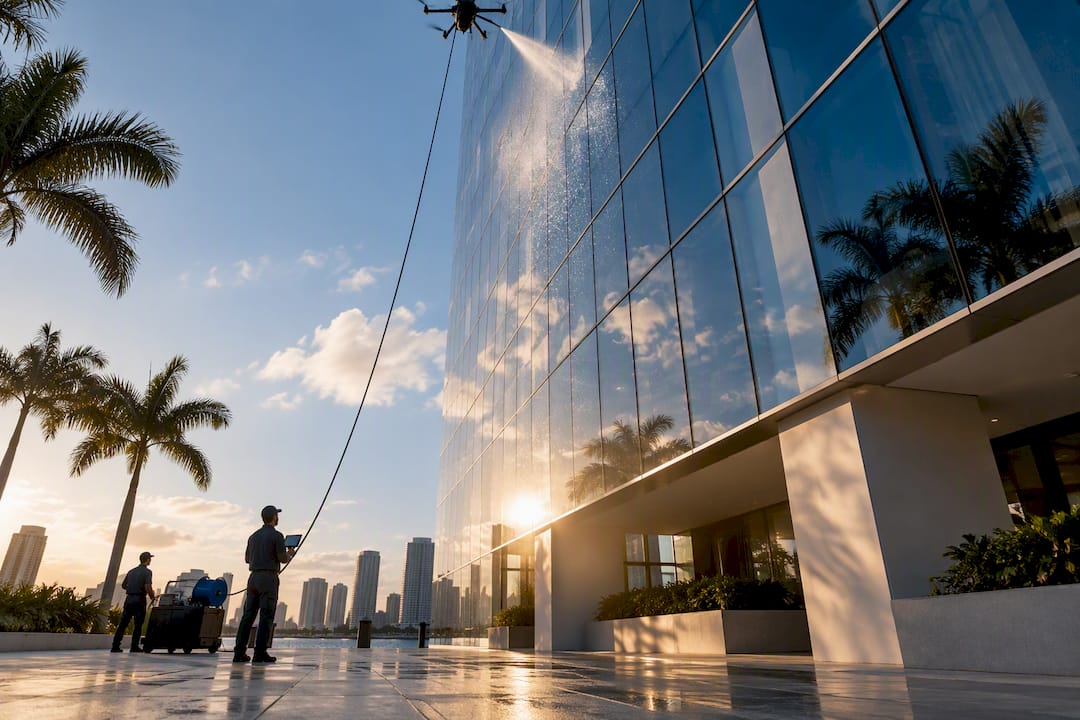
Most South Florida office towers pay between a low and high per square foot range for professional window cleaning, or a varying per pane rate, depending on height and access method. Height and access drive the price more than anything else. Buildings requiring rope access or suspended scaffolds pay toward the top of that range; ground-based methods, including tethered drones on eligible facades, often land at the bottom. Before requesting quotes, have your window counts and façade photos ready.
TL; DR:
- Most South Florida office towers pay between $0.07 and $0.75 per square foot for window cleaning, with higher costs for taller buildings requiring specialized access.
- High-rise buildings over 20 stories often cost $15,000 to $40,000 per cleaning cycle, though tethered drone cleaning can reduce expenses by 30 to 60 percent.
- Accurate estimates require detailed building information, including window count, façade photos, rooftop access, tenant restrictions, and safety compliance proof.
- Safety regulations like OSHA standards increase bid prices due to necessary engineering, stabilization, and safety monitoring, especially for powered platforms and rope access.
- Drone cleaning is a cost-effective and faster option for eligible buildings, with prices typically ranging from $0.12 to $0.25 per square foot.
Table of Contents
- What Does Office Tower Window Cleaning Cost?
- How Building Height and Access Method Change the Price
- What’s Included in a Standard Window Cleaning Quote?
- Sample Cost Ranges for South Florida Office Towers
- How Can You Get an Accurate Window Cleaning Estimate?
- Why Safety Regulations Affect Your Quote
- When Does Drone Cleaning Make Sense for High-Rises?
- What Property Managers Get Wrong About Budgeting
- How Vista Drone Cleaning Helps You Budget Smarter
- Sources
- FAQ
What Does Office Tower Window Cleaning Cost?
Pricing for office tower window cleaning cost isn’t a single number. It’s a set of models, and which one a vendor uses depends on your building’s size, glass count, and how crews will reach the upper floors. Understanding the model behind a bid is the only way to compare two proposals that look nothing alike on paper.
Per-square-foot pricing shows up most often on large commercial contracts, where counting individual panes would take longer than the cleaning itself. Industry pricing guides put commercial rates roughly between $0.07 and $0.75 or more per square foot, with height and rigging complexity pushing the number toward the top of that band, according to GetJobber’s pricing academy. A 20-story office tower with a mostly glass curtain wall will sit well above a five-story building with punched windows, even at the same square footage.
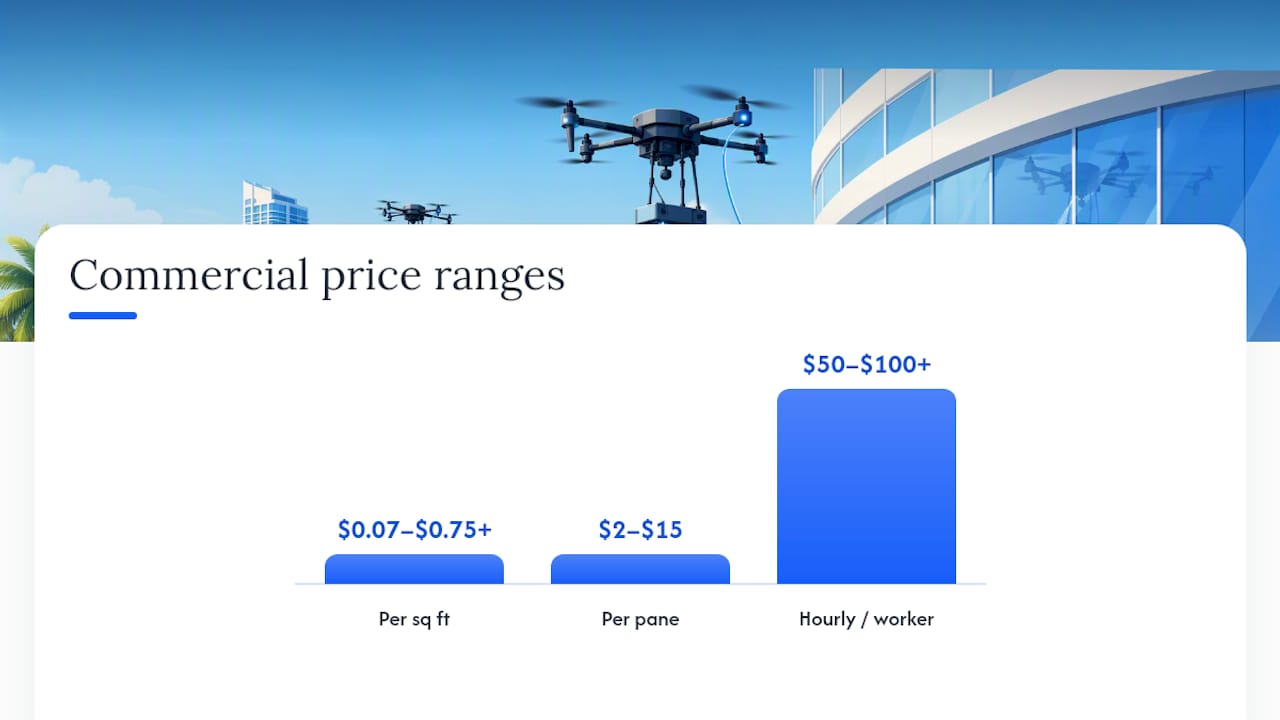
Per-pane and per-window pricing still dominates mid-rise buildings and properties with irregular fenestration. Commercial per-pane rates commonly fall between $2 and $15 depending on access difficulty, per Cultivate HD’s commercial pricing breakdown. A tower with double-hung or multi-lite windows racks up pane counts fast, so two buildings with identical square footage can produce very different invoices.
Hourly and per-worker pricing appears on jobs where scope is unpredictable, like a first-time deep clean on a neglected façade. Expect $50 to $100 or more per cleaner per hour once you factor in access equipment and crew size.
Common pricing structures include:
- Per square foot: best for large, uniform glass façades and bulk contracts
- Per pane or window: best for buildings with varied window sizes or lower total glass area
- Hourly: best for one-off jobs with unknown soil levels or unusual access needs
- Flat contract or maintenance plan: best for recurring service, often discounted 10 to 20 percent versus one-off pricing
- Job minimums: many vendors set a floor charge, regardless of building size, to cover mobilization
How Building Height and Access Method Change the Price
Height doesn’t scale cost in a straight line. It scales it in tiers, because each tier requires different equipment, staffing, and paperwork.
- Ground-level and low-rise (1 to 4 stories): standard poles, ladders, or lifts handle most of this work, keeping labor costs and equipment rental low.
- Mid-rise (5 to 12 stories): this is where boom lifts, powered platforms, or drone access typically enter the picture, and per-unit pricing starts climbing.
- High-rise (13+ stories): suspended scaffolds or rope access become standard, bringing engineering review, rigging time, and specialized crews into the quote.
- Complex façades: curtain wall systems, frit patterns, recessed windows, and metal louvers all add cleaning time per unit, since crews can’t move at a flat rate across uneven surfaces.
Access method matters as much as height. Powered platforms and suspended scaffolds require mounted anchors, stabilization systems, and trained operators. Rope access crews cost less to mobilize but move slower on large glass runs. Boom lifts work well up to a certain height but need ground clearance and often close a lane of traffic. Tethered drones can clean many façades from the ground with no rigging at all, though eligibility depends on the building’s geometry and surrounding airspace. Site constraints like tight setbacks, adjacent traffic, or HOA-restricted hours can add mobilization time and, occasionally, permit costs that show up as a separate line item on the bid.
What’s Included in a Standard Window Cleaning Quote?
Most base quotes cover exterior glass only. Interior cleaning, when tenants require it, typically adds a separate charge because it needs coordinated building access and often after-hours scheduling, though exact pricing varies.
What’s usually included in a base exterior quote:
- Glass cleaning on accessible exterior windows
- Basic frame wipe-down where reachable during the pane cleaning
What commonly gets added as an extra line item:
- Window sills, tracks, and screen removal or reinstallation
- Skylights and glass doors, especially at ground-level entries
- Mineral deposit or hard-water stain removal, common on South Florida towers exposed to salt air and sprinkler overspray
- Restoration cleaning for long-neglected glass, which takes more labor than routine maintenance
- Pressure washing of adjacent stone, metal, or stucco surfaces
Frequency changes per-visit pricing too. A quarterly maintenance contract usually costs less per visit than a one-off clean, since crews aren’t dealing with months of accumulated grime and vendors can plan staffing further in advance.
Sample Cost Ranges for South Florida Office Towers
Real numbers help more than ranges alone. Here’s how the math tends to work out for a few common South Florida scenarios, based on the pricing patterns above.
- Small mid-rise office tower (8 stories, roughly 40,000 sq ft of glass, boom lift access): expect somewhere between $4,000 and $12,000 for a single exterior clean, depending on frame condition and pane count.
- Full-glass curtain-wall high-rise (20+ stories, rope access or suspended scaffold required): budgets commonly run $15,000 to $40,000 or more per full exterior cleaning cycle, largely because of rigging and engineering time.
- Quarterly maintenance contract: a mid-rise building on a recurring schedule might pay $16,000 to $36,000 annually across four visits, often at a 10 to 20 percent discount off one-off pricing.
- Deferred maintenance jobs: a tower that hasn’t been cleaned in over a year, particularly one near the coast dealing with salt residue, should expect the first clean to run higher than subsequent maintenance visits, according to GlassAct Cleaning’s estimator guidance.
Traffic control requirements near busy corridors in Brickell, downtown Fort Lauderdale, or West Palm Beach can push these figures higher still, since lane closures sometimes require permits and off-duty police coordination.
How Can You Get an Accurate Window Cleaning Estimate?
Vague requests get vague quotes. The more documentation you hand a vendor upfront, the tighter and more comparable their numbers will be.
- Count your windows and measure your glass. Even a rough count by floor helps estimators skip guesswork.
- Photograph the façade, especially any recessed windows, louvers, or unusual architectural features.
- Note rooftop access and staging areas. Vendors need to know if there’s room for equipment or if they’ll need to close a lane.
- List tenant schedules and access restrictions. Off-hours work often costs more but avoids tenant complaints.
- Ask every bidder the same set of questions: proof of OSHA compliance, insurance limits, equipment list, permit needs, and their weather and wind delay policy.
- Read the fine print: scope inclusions and exclusions, per-unit rates, mobilization fees, contract minimums, and cancellation terms.
Pro Tip: Bundle window cleaning with facade and roof service in one contract when possible. Vendors often price mobilization once instead of twice, and you get one inspection checkpoint instead of three separate ones.
Preparing a site inspection checklist before the walkthrough saves everyone time and produces quotes you can actually compare side by side.
Why Safety Regulations Affect Your Quote
Compliance isn’t optional, and it isn’t free. Federal rules govern how contractors access your building, and that shapes the number on every serious bid.
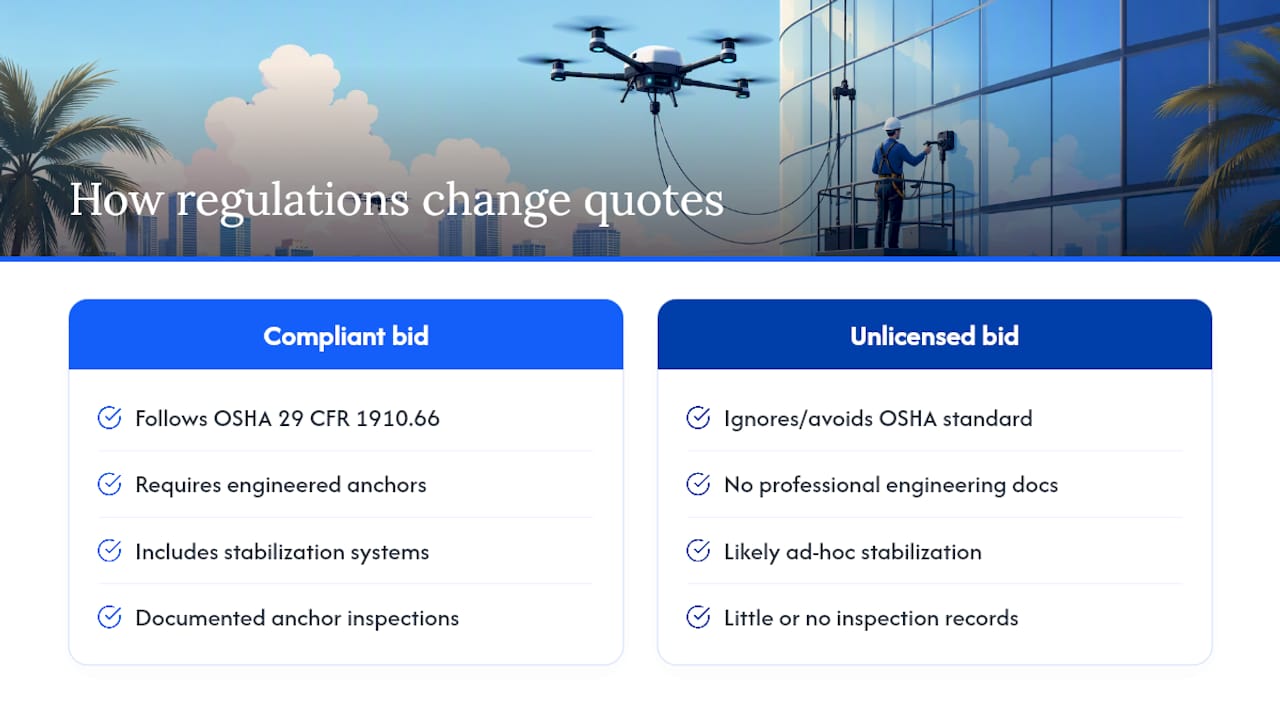
29 CFR 1910.66, OSHA’s powered platforms standard, sets mandatory requirements for any permanent or temporary powered platform used in building maintenance, including engineering specs for anchors and fall-arrest systems. Vendors following this standard build stabilization systems, intermittent tie-ins, and documented engineering review into their pricing, according to OSHA’s powered platforms fact sheet.
Employers must maintain safe access systems that go beyond a single checklist. Alternative or intermittent stabilization setups require professional engineering documentation before they’re approved for use.
That guidance comes from OSHA’s own interpretive letters on exterior building work platforms, and it explains why a properly compliant bid often costs more than a handshake deal from an unlicensed crew. Trained safety monitors, documented anchor inspections, and wind-limit protocols aren’t padding. They’re what keeps a crew off the ground and off the news.
When Does Drone Cleaning Make Sense for High-Rises?
Tethered industrial drones skip the rigging entirely. Because crews operate from the ground, there’s no scaffold to build, no rope access certification to verify, and often no lane closure to permit, which can shorten project timelines considerably compared to traditional access methods.
Vista Drone Cleaning uses FAA Part 107-certified pilots and tethered drones to clean glass, facades, and rooftops up to 200 feet, with 4K before-and-after documentation and $2 million in liability insurance backing every project. Most projects finish in 1 to 3 days, and the company states that eligible buildings see 30 to 60 percent lower costs than scaffold or lift-based methods.
Eligibility matters, though. Before assuming a tower qualifies, check:
- Building geometry: setbacks, overhangs, and recessed sections can limit drone reach
- Rooftop access for tether anchoring and equipment staging
- Nearby airspace restrictions, especially close to airports or heliports
- Whether certain sections still require traditional rope or platform access due to structural obstructions
Not every façade is a fit. Buildings with heavy architectural complexity may still need a hybrid approach pairing drones with limited rope work.
What Property Managers Get Wrong About Budgeting
The lowest bid on a stack of proposals almost never accounts for engineering documentation, safety monitors, or wind delays, and that gap surfaces later as a change order. Set aside budget for infrequent deep cleans and the mobilization costs that come with them, not just routine visits.
Vet vendors on proof, not promises: ask for OSHA compliance documentation, current insurance certificates, and a scope that spells out exactly what’s excluded. A contract that looks cheap on page one and vague on page three usually costs more by the time the project wraps.
, Eliot
How Vista Drone Cleaning Helps You Budget Smarter
Vista Drone Cleaning is the alternative to scaffold and rope-access crews for office towers across Miami-Dade, Broward, and Palm Beach counties. Instead of paying for rigging, engineering review, and multi-day mobilization, eligible buildings get ground-based service that finishes faster and typically runs 30 to 60 percent lower than traditional methods.
Here’s what that looks like in practice: FAA Part 107-certified pilots operate tethered drones on glass, facades, and even solar arrays up to 200 feet, with 4K documentation on every job and $2 million in liability coverage protecting your property. Pricing on drone window cleaning runs $0.12 to $0.25 per square foot of glass, and drone facade cleaning falls in that same $0.12 to $0.25 per square foot range for the full building envelope. Not every tower qualifies for full drone coverage, and an on-site assessment will tell you exactly where your building falls.
Request a free quote within 24 hours and find out whether your building qualifies for a faster, lower-cost cleaning cycle this year.
Sources
This guide draws on federal safety standards and established industry pricing references, including OSHA’s powered platforms standard, the OSHA fact sheet on stabilization and engineering requirements, and commercial pricing guidance from GetJobber and Cultivate HD. For broader access-method context, see this safety training guide for high-elevation work.
- 29 CFR 1910.66: Powered platforms for building maintenance
- How to price window cleaning (GetJobber academy)
- How to price commercial window cleaning jobs
FAQ
What Is the Going Rate for Commercial Window Cleaning?
Commercial rates typically fall between $0.07 and $0.75 or more per square foot, or $2 to $15 per pane, depending on building height and access method, according to GetJobber’s pricing guidance. High-rise towers requiring rope access or suspended scaffolds land toward the top of that range.
What Does a Skyscraper Window Cleaner Get Paid?
Skyscraper window cleaners are typically billed out at $50 to $100 or more per hour per worker on labor-based jobs, with rates climbing when rigging, engineering review, and specialized certifications are involved. That hourly figure covers labor, not the vendor’s equipment, insurance, and mobilization costs baked into a full bid.
How Much Does It Cost to Clean the Windows of a Skyscraper?
A full-glass high-rise with 20 or more stories commonly costs $15,000 to $40,000 or more per exterior cleaning cycle when rope access or suspended scaffolds are required. Buildings eligible for tethered drone cleaning can often see 30 to 60 percent lower costs, since there’s no rigging or staging to fund.
What Are the Typical Prices for Window Cleaning?
Prices vary by pricing model: per square foot for large commercial jobs, per pane or window for smaller or irregular buildings, and hourly for one-off or unpredictable jobs. Maintenance contracts on a recurring schedule often cost 10 to 20 percent less per visit than a one-time clean.
Does Vista Drone Cleaning Offer Free Quotes?
Yes, Vista Drone Cleaning provides free quotes within 24 hours for commercial properties across Miami-Dade, Broward, and Palm Beach counties. An on-site or photo-based assessment determines whether your building qualifies for drone access at the published per-square-foot rate.