
Save 40–60% on Hard Water Glass Restoration for South Florida HOAs
South Florida HOAs and managers: learn when drone delivered 0 PPM deionized water and soft wash can restore hard water stained glass in 1–3 days and often...

The fastest, safest way to clear hard-water staining from high-rise glass is professional restoration with deionized water and manufacturer-safe soft-wash chemistry, often delivered by tethered drone on upper elevations. This works well above roughly three stories, where scaffolding gets expensive fast, though etched glass may not respond to any chemistry. If your facade shows chalky white deposits or spotting near sprinkler lines, schedule a site survey and a test patch before committing to full restoration.
TL; DR:
- Drones are cost-effective for high-rise glass cleaning above three stories, but impact-rated or Low-E glass may require specialized knowledge to avoid damage.
- A proper restoration involves a test patch, acid-free mineral remover, soft agitation, and pure water rinsing, with photographic documentation to prevent rework.
- Fresh mineral buildup responds well to cleaning, while years of staining may cause permanent etching, necessitating resurfacing or replacement instead.
- Verify vendor credentials, including FAA Part 107 certification, $2 million liability coverage, use of 0 PPM deionized water, and mandatory test patches before contracting services.
- Regular maintenance, including quarterly cleaning at lower elevations and semiannual at upper floors, prevents recurrence of mineral deposits, saving costs over time.
Table of Contents
- What Counts as Hard Water Stain Removal on Glass for High-Rises?
- How Does Professional Hard Water Stain Removal Work?
- Can Hard Water Stains Be Removed, or Is the Glass Etched?
- What Should You Ask Before Hiring a Vendor?
- How Much Does Hard Water Stain Removal Cost, and How Long Does It Take?
- How Often Should South Florida Buildings Clean Glass to Prevent Recurrence?
- What South Florida Property Managers Get Wrong About These Jobs
- Vista Drone Cleaning: A Local Option for High-Rise Glass Restoration
- Sources
- FAQ
What Counts as Hard Water Stain Removal on Glass for High-Rises?
Not every building is a strong candidate for drone-delivered restoration, and knowing the threshold saves you from paying for access technology you don’t need.
Height is the biggest factor. On a one or two-story retail strip, a ladder and a squeegee crew still make financial sense. Once you’re above three stories, though, drone cleaning starts reducing cost and time because it eliminates rigging, lift rentals, and the crew size a rope-access job demands. Repetitive curtain-wall panels are ideal drone targets. Ornate stonework or heavily detailed storefronts often still need hand finishing.
Glass type matters just as much as height. Impact-resistant and Low-E coated glass, common across Miami-Dade and Broward high-rises, reacts poorly to aggressive scrubbing or acidic overkill, so any vendor you consider should already know the difference between standard annealed glass and a coated laminate system.
Before signing off on drone service, confirm:
- The building’s height and panel layout actually favor aerial access over ground-fed poles
- Airspace and visual-line-of-sight requirements can be met without disrupting tenants or street traffic
- Neighboring properties, pools, or outdoor seating areas won’t be in the drone’s operating footprint
- The glass type (impact-rated, Low-E, standard) is confirmed before chemistry is chosen
How Does Professional Hard Water Stain Removal Work?
Mineral scale on glass isn’t dirt. It’s calcium and silica bonded to the surface, which is why dish soap and a squeegee barely touch it and why the wrong method can permanently scar an expensive facade.
A competent restoration follows a sequence, not a single spray-and-wipe pass:
- Survey the elevation and identify which panels show staining, sprinkler overspray, or salt residue.
- Run a test patch on an inconspicuous panel to gauge how the glass responds before touching the whole building.
- Apply an acid-free mineral remover paired with 0 PPM deionized water, which lifts mineral crystals without leaving the surfactant film that later attracts dust and pollen.
- Agitate mechanically with soft-bristle tools rather than blades or abrasive pads, breaking up scale without scratching coatings.
- Rinse with pure water so no mineral-laden residue re-deposits as it dries, which is the actual cause of streaking on most high-rises.
- Document the result with before-and-after 4K photos for the property file.
Abrasive scrapers, steel wool, or big-box “rust and lime” removers show up constantly in DIY advice, and they’re exactly wrong for architectural glass. They can dull coatings, cloud tempered panels, and turn a fixable stain into a permanent one. Our own streak-free cleaning process walks through why pure-water rinsing outperforms soap-based methods on coated glass specifically.
Pro Tip: Ask any vendor to photograph the test patch panel both wet and fully dry. Stains sometimes look gone while wet and reappear once the glass dries, which is the whole point of waiting before green-lighting the full elevation.
Can Hard Water Stains Be Removed, or Is the Glass Etched?
This is the question every board member actually wants answered, and it depends entirely on how long the mineral deposit sat before treatment.
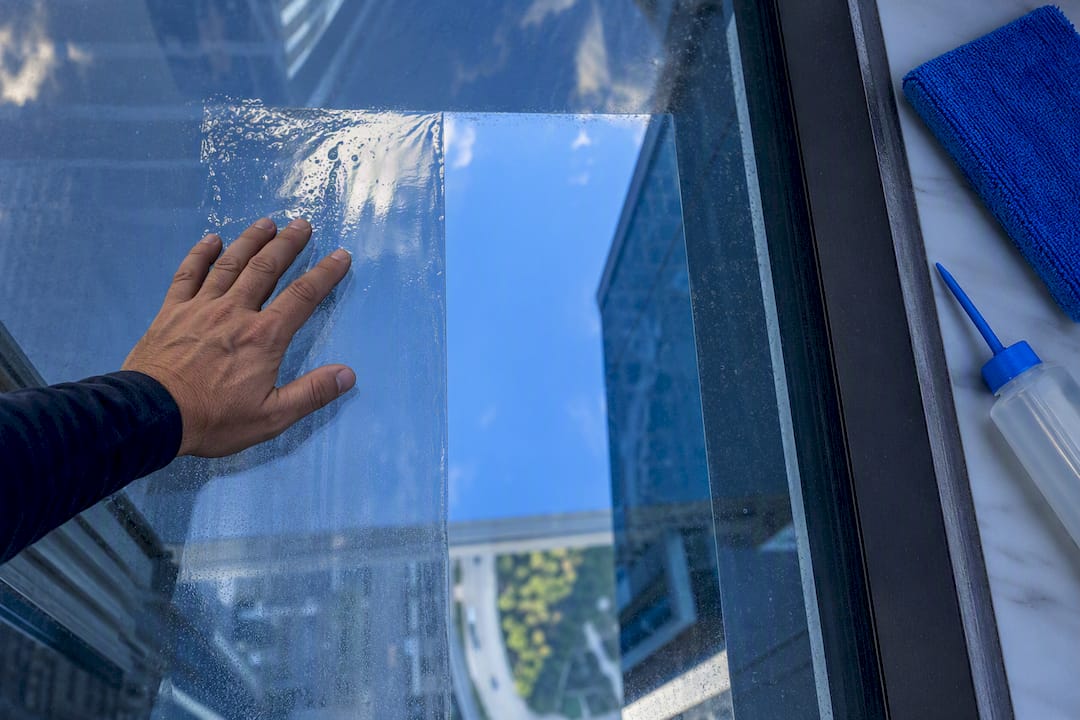
Fresh to moderate staining, the kind that’s built up over a season or two of sprinkler overspray, usually responds well to DI water and soft-wash chemistry. You’ll see the haze lift within the test patch and the surface return to a clear, uniform finish. Deposits that have sat for years, particularly where irrigation hits the same pane daily, can etch into the glass surface itself. At that point no chemistry restores clarity because the damage isn’t a coating, it’s a texture change in the glass.
Signs that point toward restoration success:
- The stain wipes noticeably lighter after the test patch, even if not 100% gone on the first pass
- The haze looks uniform rather than pitted or cloudy under close inspection
- The affected panels are relatively new or have a documented cleaning history
Signs pointing toward etching:
- The test patch shows little to no improvement after proper DI treatment
- The surface feels rough or pitted to the touch, not just visually cloudy
- Some commercial glass restoration specialists offer buffing or resurfacing for moderately etched panes, which can be worth exploring before assuming full replacement is the only option
For HOA presentations, photograph the test patch panel before, during, and 24 to 72 hours after treatment, then attach a one-page summary showing which elevations tested clear versus which showed etching. That’s a far easier ask for a board vote than a verbal description.
What Should You Ask Before Hiring a Vendor?
Vetting a commercial glass restoration vendor is different from hiring a residential window washer, and the paperwork gap is where most property managers get burned.
Start with credentials. Any company operating drones commercially needs an FAA Part 107 certification for its pilots, plus a valid certificate of insurance naming your property, and $2 million in liability coverage is a reasonable minimum for a high-rise job given the exposure involved.
Then verify method, not just marketing language:
- Ask specifically whether they use 0 PPM deionized water, not just “purified” or “filtered” water, since those terms get used loosely.
- Confirm their soft-wash chemistry is acid-free and safe for impact-rated and Low-E glass.
- Ask whether they perform a mandatory test patch before full mobilization.
- Request before-and-after 4K documentation as a standard deliverable, not an add-on.
- Ask how they manage pedestrian and vehicle traffic during the job.
- Get warranty terms in writing: what’s covered, what voids it, and for how long.
- Request two references from comparable South Florida properties, ideally similar height and glass type.
Pro Tip: If a vendor can’t answer what “0 PPM” means without checking, that’s a red flag. It’s a basic term in this trade, and hesitation usually means they’re subcontracting the technical work.
A maintenance agreement option is worth asking about upfront too, since it’s often cheaper to negotiate as part of the initial contract than to bolt on later.
How Much Does Hard Water Stain Removal Cost, and How Long Does It Take?
Pricing on these jobs swings on a handful of variables, and understanding them helps you compare bids that otherwise look wildly different.
Square footage and height set the baseline, but stain severity moves the number more than most managers expect. A light haze from a few months of sprinkler overspray costs far less to correct than years of baked-on mineral scale requiring multiple treatment passes. Access complexity plays in too. A flat curtain wall is simpler than a facade with balconies, overhangs, or mixed materials that limit line-of-sight for the drone.
On buildings above three or four stories, drone-delivered cleaning has been reported to cut costs 40 to 60% compared with scaffold or lift methods, largely from eliminating rigging, reducing crew size, and shortening job duration.
Typical schedule phases look like this:
- Site survey and glass assessment (often same week as inquiry)
- Test patch and 24 to 72-hour evaluation window
- Mobilization and equipment staging (minimal for drone jobs, no permits or road closures)
- On-site cleaning, usually 1 to 3 days for most mid-rise and high-rise buildings
- Post-job inspection and documentation handoff
For a side-by-side breakdown of where drones save time versus where traditional rope access still wins, our drone versus traditional window cleaning comparison covers the tradeoffs in more depth.
How Often Should South Florida Buildings Clean Glass to Prevent Recurrence?
Restoration solves today’s problem. Preventing a repeat is a maintenance question, and South Florida’s environment makes that answer more aggressive than it would be almost anywhere else.
Irrigation and lawn sprinklers rank among the leading causes of hard-water staining on exterior glass in this region, and salt air accelerates mineral buildup on top of that. For ground-floor and lower-elevation glass exposed to sprinkler overspray, a quarterly cleaning schedule keeps deposits from ever hardening into a restoration job. Upper elevations exposed mainly to salt air and rain can often stretch to semiannual.
Simple site adjustments help more than people expect: see homeowner cleaning outdoor security camera for maintenance guidance relevant to exterior equipment.
- Redirect or lower sprinkler heads that spray onto glass or facade panels
- Add landscaping setbacks so irrigation zones stay clear of the building line
- Extend awnings or drip edges where feasible to reduce direct spray contact
A maintenance contract with periodic pure-water passes costs far less over a few years than repeated restoration jobs, and it’s the single most effective lever a property manager has against this recurring line item.
What South Florida Property Managers Get Wrong About These Jobs
The biggest misconception in this business is that hard-water staining is a cleaning problem. It’s usually an irrigation problem that shows up as a cleaning bill. Boards approve landscaping changes and sprinkler timers without ever connecting them to the glass line item three budget cycles later.
The second thing people underestimate is how much a test patch actually protects them. Skipping it to save a day on the schedule is the single most common mistake I see leading to disputes, because once a vendor has treated an entire elevation, there’s no controlled comparison left if something goes wrong. On upper floors, drones tend to win decisively. On ground-level storefronts with heavy sprinkler contact, sometimes a simple site fix does more good than another restoration cycle. Miami-Dade, Broward, and and Palm Beach jobs each carry their own quirks, mostly tied to how close a building sits to irrigated landscaping or open water, and scheduling around afternoon storm patterns matters more here than in drier climates.
, Eliot
Vista Drone Cleaning: A Local Option for High-Rise Glass Restoration
Vistadronecleaning gives South Florida property managers a faster path to restored glass than the scaffold-and-lift model most vendors still default to. Our FAA Part 107-certified pilots operate tethered industrial drones on buildings up to 200 feet, using 0 PPM deionized water and soft-wash chemistry matched to impact-rated and Low-E glass, all backed by $2 million in liability insurance.
A free survey typically includes a test patch on your most affected elevation, full before-and-after 4K documentation, and a fixed-price proposal within 24 hours. Most restoration and cleaning projects wrap in one to three days, with crews staying on the ground the entire time, no permits, no road closures, no scaffolding footprint disrupting tenants or guests. If your building in Miami, Fort Lauderdale, Boca Raton, or anywhere in between is showing sprinkler haze or salt-air buildup, request a site survey and quote and get a clear answer on whether your glass is a restoration candidate before your next board meeting.
Sources
FAQ
Can Hard Water Stains Always Be Removed From Glass?
No. Fresh to moderate mineral deposits usually respond to deionized water and soft-wash chemistry, but staining left untreated for years can etch the glass surface, and etched panes may need buffing, resurfacing, or replacement instead.
Is Drone Cleaning Safe for Impact-Resistant and Low-E Glass?
Yes, when the vendor uses non-abrasive soft-wash methods and pure-water rinsing matched to the coating type. Aggressive scrubbing or acidic products, drone-delivered or not, can damage coated glass regardless of the access method.
How Long Does a Commercial Hard Water Stain Removal Project Take?
Most projects run 1 to 3 days on-site after the survey and test-patch phase, though timeline depends on building height, stain severity, and access complexity.
How Much Does Drone-Delivered Glass Restoration Cost Compared to Scaffolding?
Costs vary by square footage and stain severity, but drone-delivered cleaning has been reported to cut expenses 40 to 60% versus scaffold or lift methods on buildings above three or four stories, mainly by reducing rigging and crew size.
How Often Should High-Rise Glass Be Cleaned to Prevent Hard Water Stains?
Lower elevations exposed to sprinkler overspray benefit from quarterly cleaning, while upper elevations facing mainly salt air can often go semiannual, since irrigation and salt exposure are the two leading causes of recurring mineral buildup, in South Florida.