
Budget $0.12–$0.25 per sq ft for South Florida condo facade cleaning
Estimate South Florida condo facade cleaning at $0.12–$0.25 per sq ft. See how drones, salt air, hurricane timing, and a 6‑item vendor checklist affect...
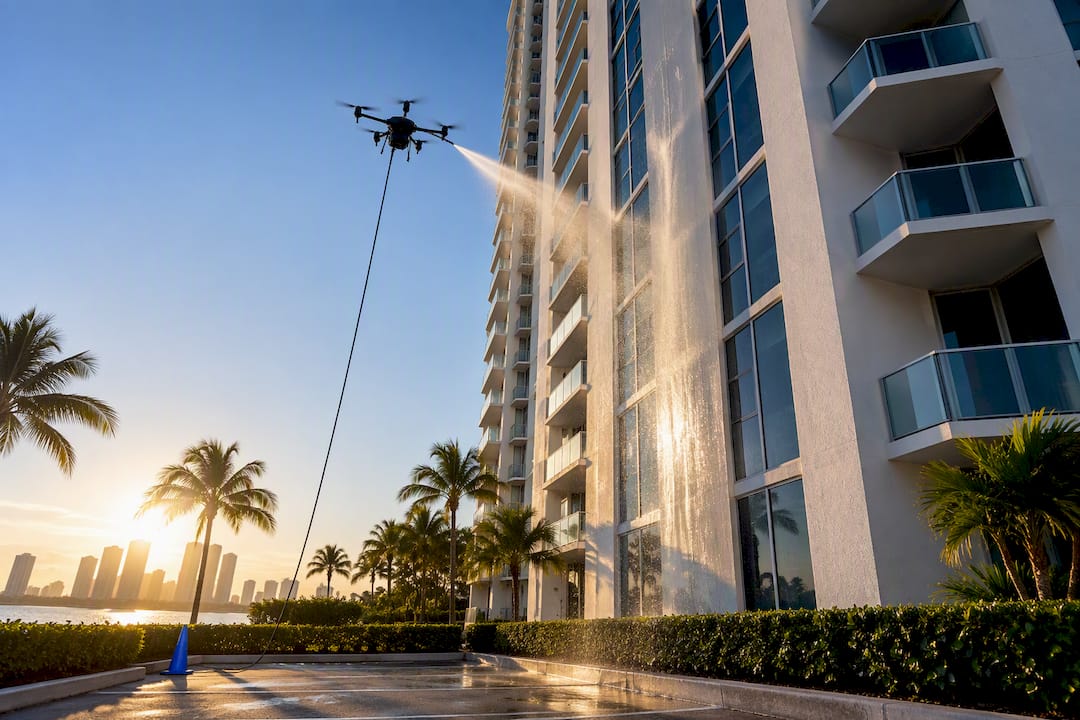
Expect drone-based condo facade cleaning in South Florida to run roughly $0.12 to $0.25 per square foot, or several thousand dollars per project, depending on building height and surface condition. Traditional scaffold or lift-based cleaning often costs significantly more for the same square footage. The biggest swing factors are building height, facade material, and how much salt buildup or organic growth has accumulated since the last wash.
TL; DR:
- Drone facade cleaning in South Florida costs between $0.12 and $0.25 per square foot, with coastal buildings often reaching the higher end of this range.
- Buildings with heavy salt buildup or irregular architecture can significantly increase the cost or require fixed project quotes due to complex surfaces.
- Drone cleaning is typically faster, safer, and more cost-effective than traditional scaffold or lift methods, especially for mid- and high-rise buildings.
- A detailed vendor checklist should include insurance, FAA certification, a scope of work, wastewater protocols, and before-and-after documentation for project approval.
- Most buildings should plan for annual or semi-annual cleaning, with coastal properties needing more frequent attention due to salt spray and humidity effects.
Table of Contents
- How Much Does Condo Facade Cleaning Cost Per Square Foot?
- What Factors Change Your Facade Cleaning Quote?
- Does Drone Cleaning Really Cost Less Than Scaffolding?
- What Should You Ask Vendors Before Signing a Contract?
- How Long Does a Facade Cleaning Project Actually Take?
- How Should a Board Budget for This?
- Why Drone Cleaning Matters for South Florida Condos
- Get an Itemized Quote From Vista Drone Cleaning
- Sources
- FAQ
How Much Does Condo Facade Cleaning Cost Per Square Foot?
Local commercial exterior cleaning in the Miami area typically runs $0.12 to $0.25 per square foot, with the low end reserved for smooth glass and stucco on easy-access low-rises and the high end applying to heavily contaminated, textured, or hard-to-reach surfaces. That range holds up reasonably well for drone-based cleaning too, though pricing structure often differs from a pressure-washing crew quoting an hourly rate.
South Florida carries what amounts to a climate premium. Salt aerosol drifting off Biscayne Bay and the Atlantic coats facades in a fine mineral film that regular rainfall does not fully rinse away, and humidity accelerates mold and mildew growth on north-facing and shaded walls. Buildings in Miami Beach, Fort Lauderdale beach corridors, or Boca Raton’s coastal strip generally need more frequent attention than inland properties in Coral Springs or Plantation.
A few sample scenarios show how the numbers actually shake out:
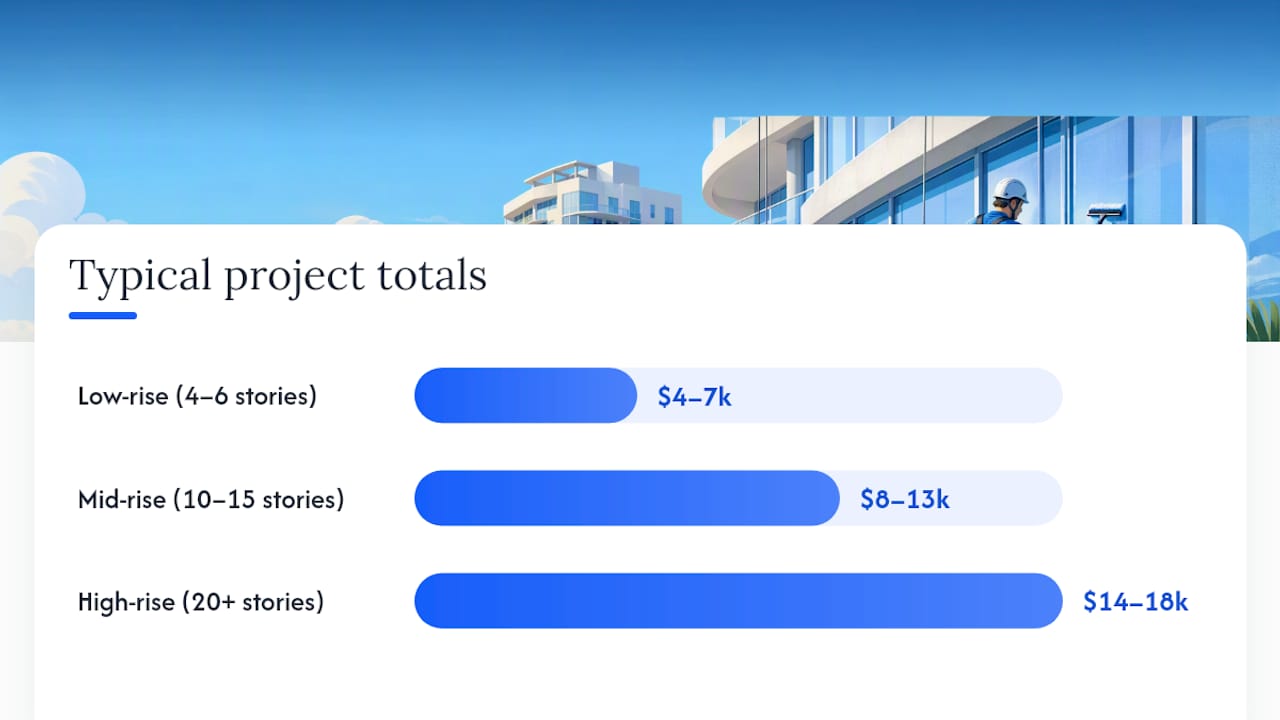
- Low-rise condo (4 to 6 stories, stucco and glass): roughly $4,000 to $7,000 for a full exterior wash, with drone crews typically finishing in a single day.
- Mid-rise building (10 to 15 stories, mixed EIFS and glass curtain wall): roughly $8,000 to $13,000, depending on how much of the facade is glass versus textured stucco.
- High-rise tower (20+ stories, glass and metal panel): $14,000 to $18,000 or more, driven by total surface area rather than height itself once a drone eliminates the vertical-access cost that scales so steeply with traditional methods.
Some vendors quote a flat per-project price once they’ve walked the site; others stick to a straight per-square-foot rate. Fixed quotes tend to show up when a building has unusual architectural features, like decorative louvers or a green wall, that make square footage a poor proxy for labor. Straight per-square-foot pricing is more common for standard rectangular towers with predictable glass-to-stucco ratios.
What Factors Change Your Facade Cleaning Quote?
Height and access method drive the biggest cost swings, but they’re far from the only variables. A quote can move substantially based on:
- Surface type. Glass curtain wall cleans faster than textured stucco or EIFS, which trap grime in surface pores.
- Contamination level: a building that hasn’t been washed in three years costs more than one on an annual schedule.
- Access complexity: setbacks, balconies, and architectural overhangs slow down any cleaning method, drone or traditional.
- Frequency: a maintenance contract with scheduled visits usually prices lower per visit than a one-off deep clean.
- Scheduling constraints: night work, resident notice periods, or restricted elevator access can add line items.
South Florida adds its own layer. Salt spray damage means coastal towers in Aventura or Delray Beach often need soft-wash chemistry that’s gentler on painted metal and anodized aluminum, which costs more than a generic detergent. Hurricane season, running June through November, compresses the scheduling calendar, since most boards want work finished before storm season and again after, once storm shutters and debris are cleared.
Permits, insurance verification, and local licensing checks rarely show up as their own line item, but they factor into overhead. A vendor without proper wastewater handling protocols may quote lower, then run into compliance issues mid-project.
Pro Tip: Ask every bidder whether their quote includes a re-clean guarantee if rain or wind undoes the work within 48 hours. Vendors who skip this detail are usually pricing thin on the front end.
Does Drone Cleaning Really Cost Less Than Scaffolding?
The numbers hold up well. On an eight-story building, a two-person drone crew finished the job in one day at $4,000 to $6,000, compared to a traditional crew that took three days and charged $8,000 to $12,000 for the same scope. That gap comes almost entirely from labor time and rigging setup, not the cleaning chemistry itself.
Beyond the sticker price, the comparison breaks down like this:
- Crew and time: drone teams run two to three people and often finish multi-story facades in one to three days; scaffold or lift crews need more workers and more calendar days for rigging alone.
- Safety and insurance: keeping operators on the ground reduces the injury exposure tied to lift and scaffold work, which tends to lower workers’ comp claims and insurance friction for the contractor.
- Tenant disruption: no scaffolding means no blocked balconies, no road closures, and no weeks-long rigging eyesore for residents.
Traditional access still earns its place when the job goes beyond cleaning. Deep substrate restoration, stucco repair, caulking replacement, or structural inspection work often requires a technician physically on the surface, which a drone can’t substitute for. For routine washing, though, the math favors keeping crews grounded.
What Should You Ask Vendors Before Signing a Contract?
A solid procurement checklist protects the board from surprises mid-project and from liability if something goes wrong. Before approving a bid, request:
- Certificate of insurance naming the association as an additional insured, plus proof of FAA Part 107 certification if the vendor is using drones.
- Written scope of work specifying cleaning method (soft-wash versus pressure), chemistry used, and substrate compatibility for glass, stucco, EIFS, metal, or tile.
- Wastewater handling protocol confirming runoff won’t hit storm drains or landscaping in violation of local rules.
- Before-and-after documentation, ideally 4K photo or video records for the association’s maintenance file.
- References from other South Florida properties, since coastal buildings behave differently than inland ones.
- Warranty or follow-up policy stating what happens if rain undoes the work within a short window.
Local commercial cleaners in the region routinely provide COI and wastewater protocols as part of a standard bid, so a vendor who resists sharing these should raise a flag.
How Long Does a Facade Cleaning Project Actually Take?
The timeline from first call to finished job usually follows a predictable arc:
- Site review and quote: most vendors turn around a written estimate within 24 to 48 hours of walking the property.
- Scheduling: boards should book coastal or high-exposure buildings before June, ahead of hurricane season, or in the calmer months after storm season wraps in late November.
- On-site work: drone-based projects on mid-rise and high-rise buildings typically wrap in one to three days.
- Resident coordination: because drone crews work from the ground, most jobs need no road closures and minimal notice beyond a courtesy heads-up about drone activity near windows.
How Should a Board Budget for This?
Present the cost to your board as two separate numbers: the one-off deep clean and the ongoing maintenance rate. A property washed annually costs less per visit than one that gets attention every three years, since accumulated salt film and mildew take longer to remove. Florida condominium law requires associations to maintain, repair, and replace common elements the association is responsible for, which gives boards legal grounding for allocating reserve funds toward facade upkeep rather than treating it as optional.
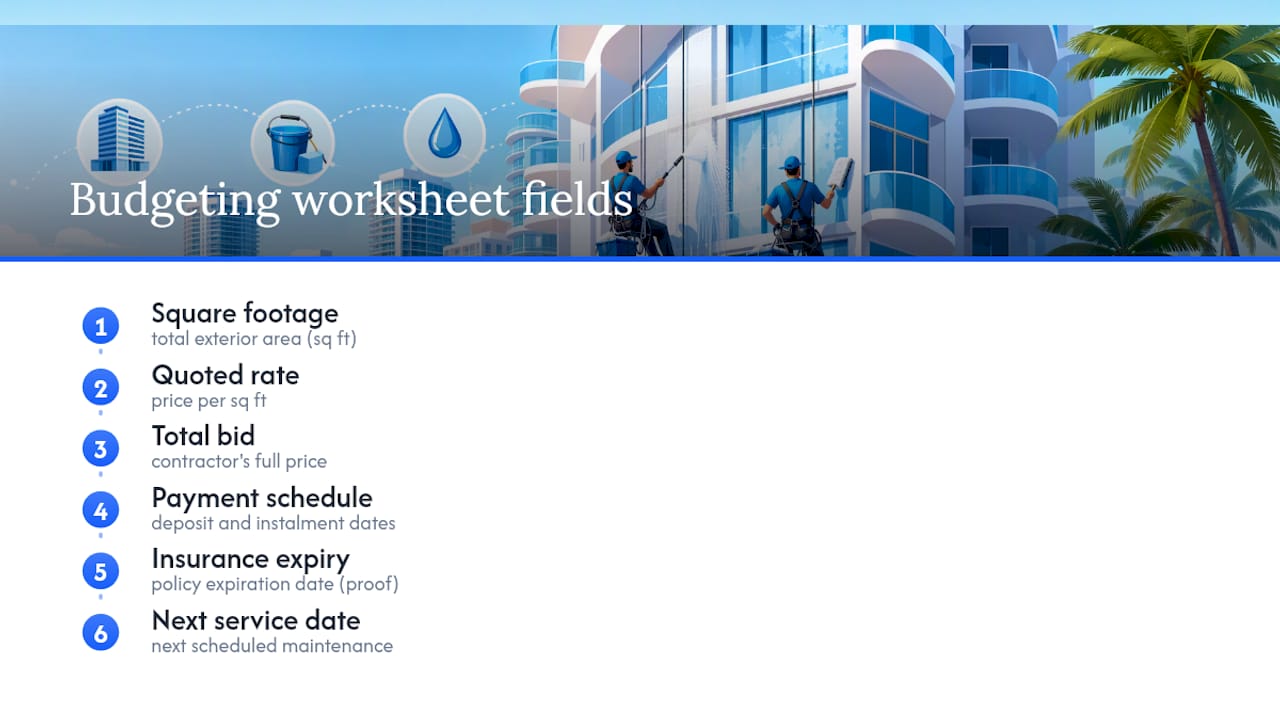
Before signing, confirm the contract includes indemnity language, a weather/storm delay clause, proof of current insurance, and a clearly written scope so nothing gets reinterpreted mid-project. A simple budgeting worksheet should track: square footage, quoted rate, total bid, payment schedule, insurance expiration date, and next scheduled service date.
Pro Tip: Build your reserve line item around the maintenance rate, not the one-off deep clean price. Boards that budget only for the first wash often get blindsided the following year.
Why Drone Cleaning Matters for South Florida Condos
FAA Part 107-certified pilots, tethered industrial drones, and $2 million in liability coverage aren’t just credentials on a page. They’re what let a crew finish a tower in one to three days without scaffolding on the sidewalk or a lift blocking the pool deck. Faster jobs mean fewer resident complaints and less schedule risk heading into hurricane season.
, Eliot
Get an Itemized Quote From Vista Drone Cleaning
Vista Drone Cleaning is the alternative to scaffolding and boom lifts for South Florida condo boards.
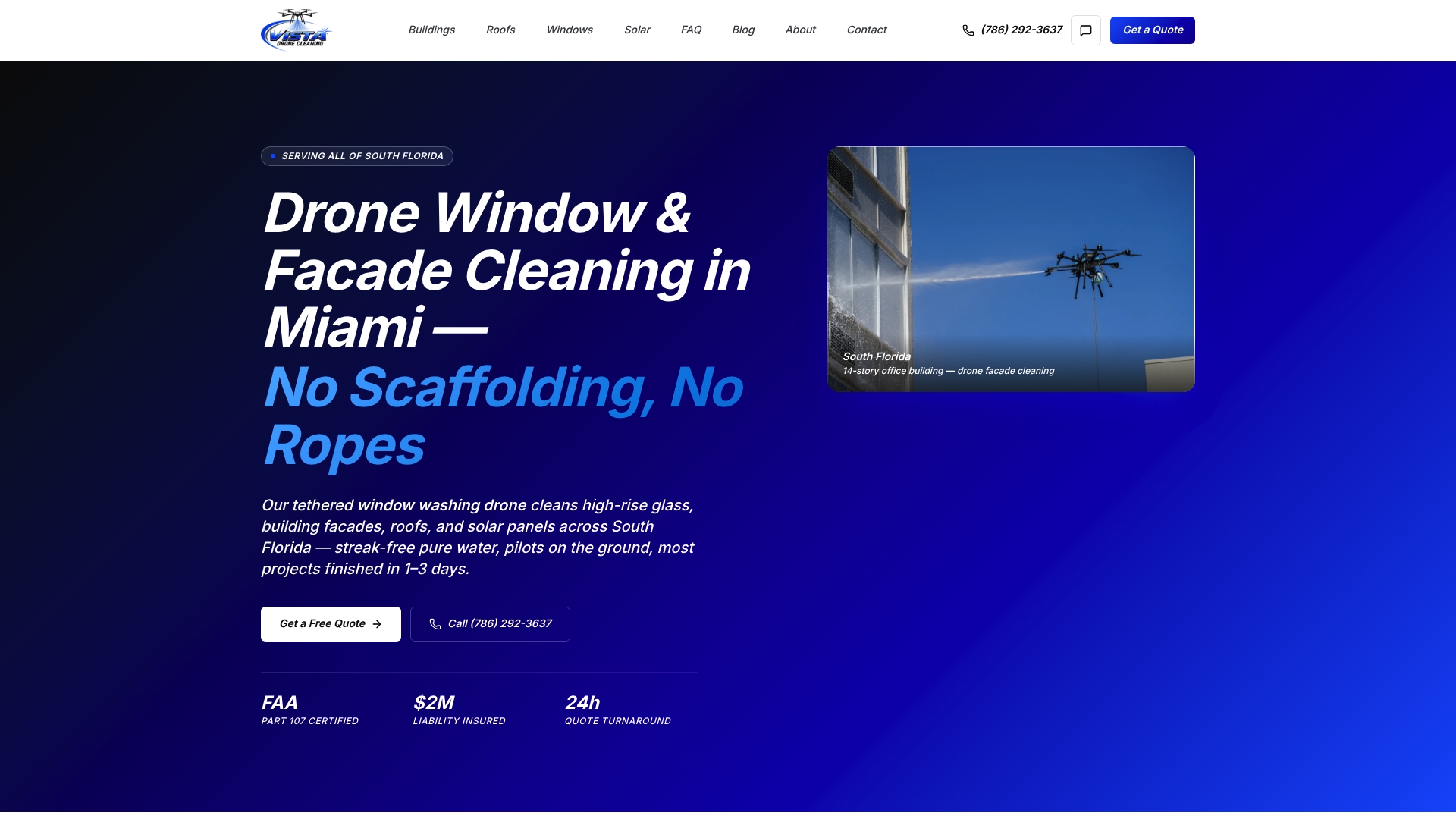
FAA Part 107-certified pilots handle every job with tethered industrial drones, backed by $2 million in liability insurance and streak-free pure de-ionized water rinses that leave no spotting on glass or metal. Every project includes 4K before-and-after documentation your board can file for maintenance records or insurance purposes. Coverage runs across Miami-Dade and Broward counties, including Miami, Brickell, Fort Lauderdale, and Boca Raton.
If your building needs facade work, request a free itemized quote within 24 hours, and ask for a certificate of insurance along with references from other South Florida associations. For buildings that also need window or roof attention, check pricing details to bundle services into one mobilization.
Sources
- Drone Cleaning vs Traditional Methods: Time, Safety, and Profit Compared
- Florida Statutes: Condominium law: maintenance of common elements (Online Sunshine)
- What Affects Commercial Building Cleaning Costs in Miami FL
FAQ
How Much Does Condo Facade Cleaning Cost in South Florida?
Most projects run $0.12 to $0.25 per square foot, or roughly $4,000 to $18,000 per project depending on building height and surface condition. Coastal buildings with heavy salt exposure often land toward the higher end of that range.
How Much Does Vista Drone Cleaning Charge for Facade Work?
Vista Drone Cleaning prices facade cleaning at $0.12 to $0.25 per square foot, with free quotes provided within 24 hours of a site review. Final pricing depends on height, surface type, and contamination level.
Is Drone Cleaning Actually Cheaper Than Scaffolding?
Yes, in most cases. An eight-story building comparison found a drone crew finishing in one day for $4,000 to $6,000, versus a traditional crew taking three days at $8,000 to $12,000 for the same scope.
How Often Should a South Florida Condo Get Its Facade Cleaned?
Most buildings benefit from an annual full exterior wash, with coastal or heavily shaded surfaces needing semi-annual attention due to salt spray and humidity buildup.
What Documents Should a Board Require Before Approving a Vendor?
Boards should request a certificate of insurance naming the association, proof of FAA Part 107 certification if drones are used, a written scope of work, and before-and-after documentation. Local vendors typically include these items as standard practice in a bid.