
South Florida Managers: 1–3 Day Drone Window Cleaning Cuts Noise
Learn why tethered drone cleaning usually finishes in 1–3 days, what indoor dB and psychoacoustics mean for tenant complaints, and how South Florida...
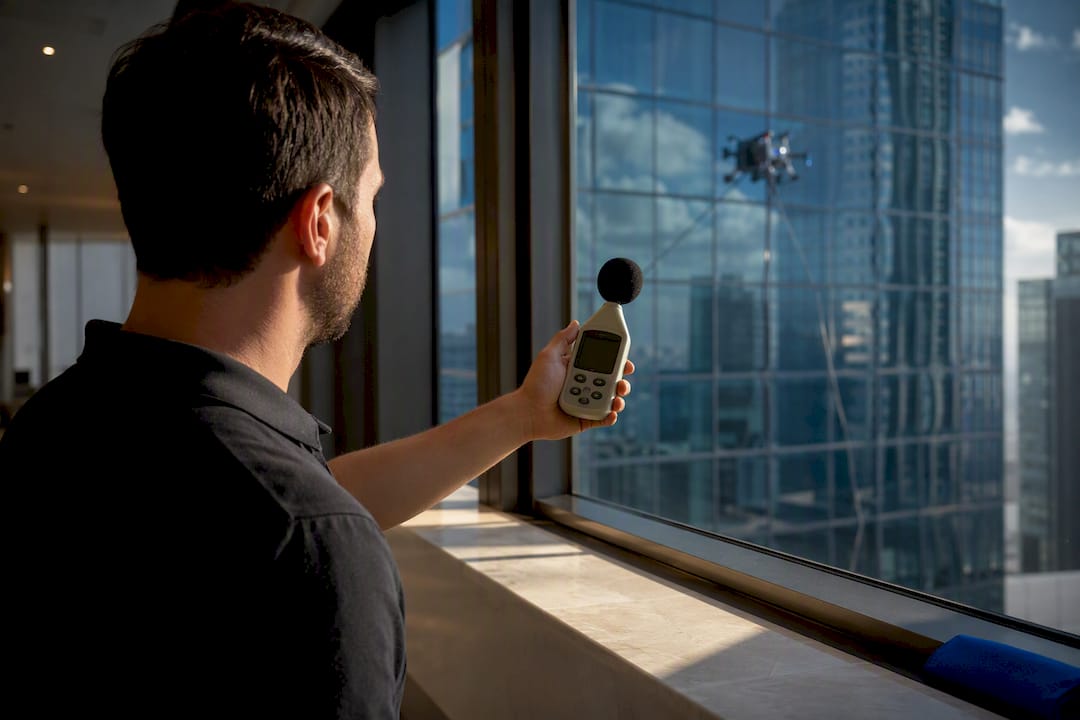
For most daytime commercial jobs, tethered industrial drone window cleaning produces lower total-site disturbance than scaffold erection, though it comes with short, sharp hover peaks. Scaffold and lift work spreads noise across days or weeks through rigging, generators, and trucks. Drone passes concentrate noise into a shorter timeline, often 1 to 3 days, with peaks that stand out precisely because they are brief. The takeaway for Miami-Dade, Broward, and Palm Beach properties: schedule work mid-day, ask vendors for a demo pass before signing, and request an indoor decibel reading with windows closed.
TL; DR:
- Tethered drone jobs typically take 1 to 3 days, significantly shorter than scaffold or lift projects that often span several weeks, reducing overall site disturbance.
- Indoor noise levels from tethered drones can be kept below 60 dB(A), but an open window can amplify sound by up to 30 dB, affecting how loud it feels inside.
- Drones produce concentrated noise during active passes, which can cause higher annoyance due to tonality and fluctuation, unlike the steady, lower-volume noise of traditional methods.
- Requesting a demo pass and specific drone-to-façade distance estimates beforehand helps verify actual indoor noise and minimizes tenant complaints.
- Using tethered industrial drones with stabilized ground power reduces erratic buzzing and often results in cost savings of 30 to 60 percent compared to scaffold or pressure washing.
Table of Contents
- Tethered Drones vs. Scaffolding: Comparing Window Cleaning Noise Levels
- What Determines How Loud a Cleaning Job Feels Indoors?
- How Is Window Cleaning Noise Actually Measured?
- How to Minimize Noise During a Commercial Window Cleaning Job
- Vista Drone Cleaning’s Local Track Record in South Florida
- How Do Water-Fed Poles and Other Traditional Methods Compare on Noise?
- What Noise Rules Apply to Commercial Window Cleaning in South Florida?
- How Does Cleaning Noise Affect Tenants and Neighbors?
- The Real Trade-off Managers Need to Weigh
- Get a Site-Specific Noise Plan From Vista Drone Cleaning
- Sources
- FAQ
Tethered Drones vs. Scaffolding: Comparing Window Cleaning Noise Levels
Scaffold and lift jobs create noise in waves that stack up over the length of a project. Rigging and erection alone can run for a full day before any actual cleaning starts, and that’s before generators, water trucks, and manual crews start their routine. A high-rise façade job with scaffolding often stretches across multiple weeks, which means tenants hear metal clanging, engine idling, and foot traffic on a near-daily basis.
Tethered drone systems work differently. Ground-based power stabilizes motor RPM, which cuts down on the erratic buzzing you’d get from a battery-powered hobby drone. That stability matters for both sound quality and duration. A tethered system case documented for glass curtain wall cleaning lists operating noise at or below 60 dB(A), a level closer to a normal conversation than a construction site.
Total site disturbance comes down to three factors:
- Duration on site. Drone projects typically wrap in 1 to 3 days versus the multi-week timeline common to scaffold and traditional lift work.
- Noise consistency. Scaffolding produces intermittent but recurring noise across many days. Drones produce concentrated noise during active passes, then go quiet.
- Ground activity. Scaffold jobs need trucks, staging areas, and multiple crew members moving equipment. Tethered drone crews stay on the ground with minimal vehicle movement.
For a hotel or office tower trying to minimize tenant complaints over a project’s full lifespan, shorter total exposure time often outweighs the momentary intensity of a hover pass.
What Determines How Loud a Cleaning Job Feels Indoors?
Raw decibel numbers only tell part of the story. Distance between the drone and the façade, known as DFd (drone-to-façade distance), changes indoor exposure dramatically. Peer-reviewed modeling published in MDPI found that meeting a 42 dB indoor LAMax target, the WHO guideline for avoiding nighttime sleep disruption, required distances as short as 15.8 meters with windows closed but stretched past 179 meters with windows fully open, depending on drone type and speed.
Window state alone can shift indoor levels by roughly 30 dB in some configurations. That’s the difference between a barely noticeable hum and a sound loud enough to interrupt a phone call.
Statistic Callout: A closed window can cut indoor noise exposure enough to turn a borderline-annoying drone pass into background sound, according to façade transmission modeling in the MDPI research.
Then there’s psychoacoustics, the study of how humans perceive sound rather than just measure it. A systematic review published in PMC found drones are consistently rated more annoying than road traffic at the same decibel level. Tonality, sharpness, and fluctuation strength drive that perception gap.
- Tonal, whining frequencies register as more irritating than broadband noise at equal volume.
- Fluctuating RPM (common in untethered, battery-powered drones) amplifies annoyance.
- Tethered systems with stable ground power reduce that fluctuation, which is one reason vendor equipment choice matters as much as raw dB specs.
How Is Window Cleaning Noise Actually Measured?
Vendors and inspectors use a handful of standard metrics, and knowing them helps you write a useful RFI.
- LAeq averages sound energy over a set time period. Useful for describing a full work shift’s typical noise, not the peaks.
- LAFmax (or LAmax) captures the single loudest moment during a measurement window. This is the number that matters most for tenant complaints, since a brief spike is what people notice and remember.
- SEL (Sound Exposure Level) compresses a noise event’s total energy into a one-second equivalent. It’s how the FAA’s environmental assessment for Prime Air reports drone noise, showing SEL of 63.7 dB during cruise at 200 feet, but SELs climbing to 92.1 dB during closer delivery and hover phases.
- DNL (Day-Night Average Sound Level) weights nighttime noise more heavily. It matters if any work happens near hotel guest floors or residential towers during evening hours.
Statistic Callout: The FAA’s own testing data shows delivery and hover phases can spike substantially above cruise-altitude noise levels, which is why the distance a drone maintains from a façade matters far more than its average rated noise.
For a practical acceptance test, request readings at 25, 50, and 100 feet, plus a short demo pass with an indoor LAmax reading taken twice: once with windows open, once closed.
How to Minimize Noise During a Commercial Window Cleaning Job
Scheduling does more heavy lifting than any equipment spec. Mid-morning through late afternoon windows generally draw the fewest complaints, since early-morning and evening hours are when hotel guests and residents are most sensitive to sound. Clustering all façade work into consecutive days, rather than spreading it out, also limits how many separate disruption events tenants notice.
- Give tenants at least 48 hours’ notice with specifics: which façade, what hours, and how long the job will run.
- Request tethered ground power from your vendor rather than untethered battery drones, since stable RPM reduces the fluctuating whine that drives annoyance complaints.
- Set a target DFd based on the MDPI modeling and confirm it in writing before the project starts.
- Require a demonstration pass before the full job begins, so you can verify actual indoor sound rather than relying on spec sheets.
- Control staging noise: vehicle idling, generator placement, and crew foot traffic all add up, even on drone jobs.
Pro Tip: Run your demo pass during the same time of day the full job will happen, not during a quiet mid-morning slot chosen for convenience. A demo at 2 p.m. tells you nothing about what tenants will hear at 7 a.m. if the schedule slips.
After the job wraps, a short indoor LAmax reading and dated 4K documentation give you a record for lease disputes, HOA meeting minutes, or insurance files if a tenant complaint escalates.
Vista Drone Cleaning’s Local Track Record in South Florida
Vista Drone Cleaning operates across Miami-Dade, Broward, and and Palm Beach counties using FAA Part 107-certified pilots and tethered industrial drones capable of cleaning buildings up to 200 feet tall without scaffolding or rope access. That certification matters for any property manager who needs a paper trail for insurance or board approval.
The service list covers drone window washing, building facade cleaning, roof soft-wash cleaning, and solar panel pure-water cleaning, all finished with a streak-free deionized water rinse. According to the company’s own project data, this approach cuts costs by 30 to 60 percent compared to scaffold or lift methods and typically finishes in 1 to 3 days.
Vista carries $2 million in liability coverage and operates under FAA Part 107 rules for all commercial drone work. If you’re drafting an RFP for a South Florida high-rise, condo, or hotel, ask any vendor, including Vista, for these five items:
- A live demonstration pass before contract signing
- Their proposed drone-to-façade distance (DFd) for your building’s height and window configuration
- Noise readings taken at 25, 50, and 100 feet
- Planned working hours matched to your tenant population
- 4K before-and-after documentation for every façade section
How Do Water-Fed Poles and Other Traditional Methods Compare on Noise?
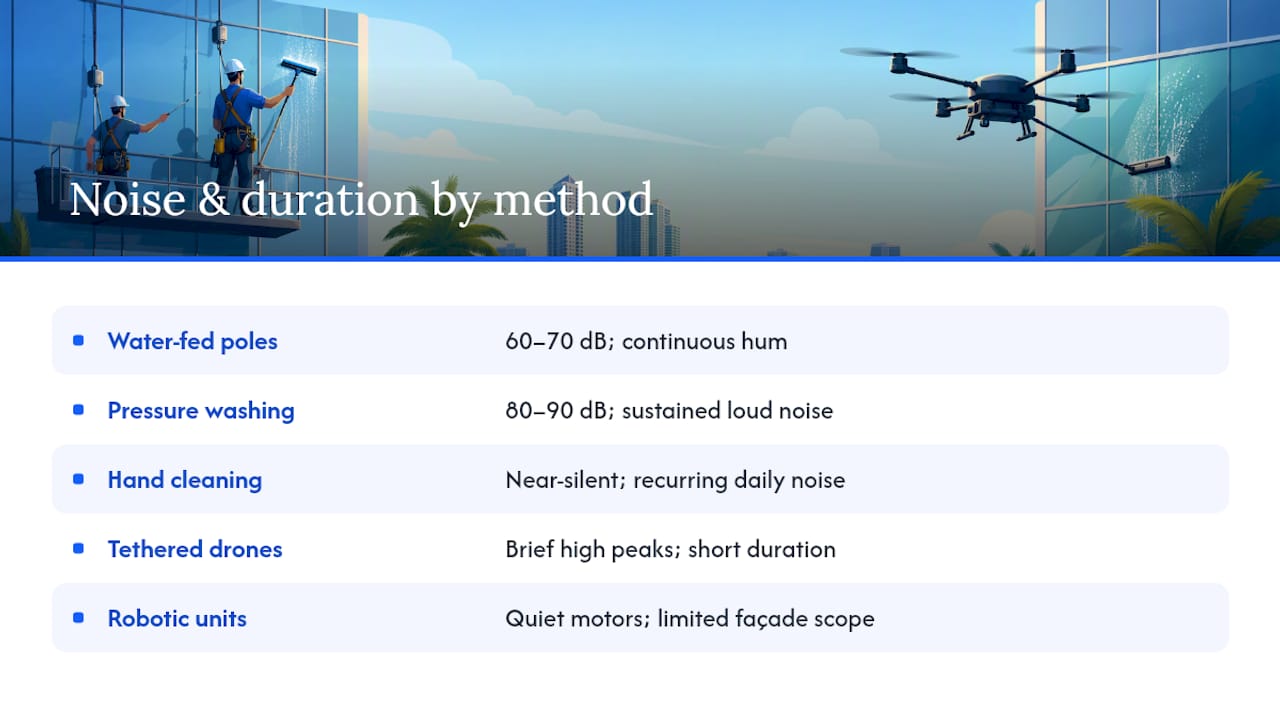
Water-fed pole systems, common for low-rise commercial buildings, run mostly on pump noise. A typical pump generates a steady hum in the 60 to 70 dB range at close range, quieter than most power tools but continuous for the duration of the job since the pump runs the whole shift.
Traditional hand cleaning with squeegees and buckets is close to silent mechanically, but it’s slow. A crew working floor by floor on a mid-rise building can stretch a job across several days, which means low-level ladder and equipment noise (talking, bucket movement, occasional scaffolding adjustments) recurs daily rather than concentrating into a short window.
Pressure washing is the loudest traditional option by a wide margin. Gas-powered pressure washers commonly produce 80 to 90 dB at the source, loud enough to require hearing protection for operators standing nearby. That noise is also continuous throughout active washing, not intermittent like drone hover passes.
Robotic window-cleaning units, magnetic or suction-based crawlers used mostly on flat glass sections, run relatively quiet motors but are limited to specific façade types and often need a human operator nearby running a control unit or generator. For most South Florida high-rises with mixed glass, stucco, and metal surfaces, robotic units cover a narrower scope than drone or scaffold methods.
Judged purely by continuous noise duration, tethered drone hover passes and pressure washing sit at opposite ends: drones deliver brief peaks, pressure washers deliver sustained volume for however long the job takes.
What Noise Rules Apply to Commercial Window Cleaning in South Florida?
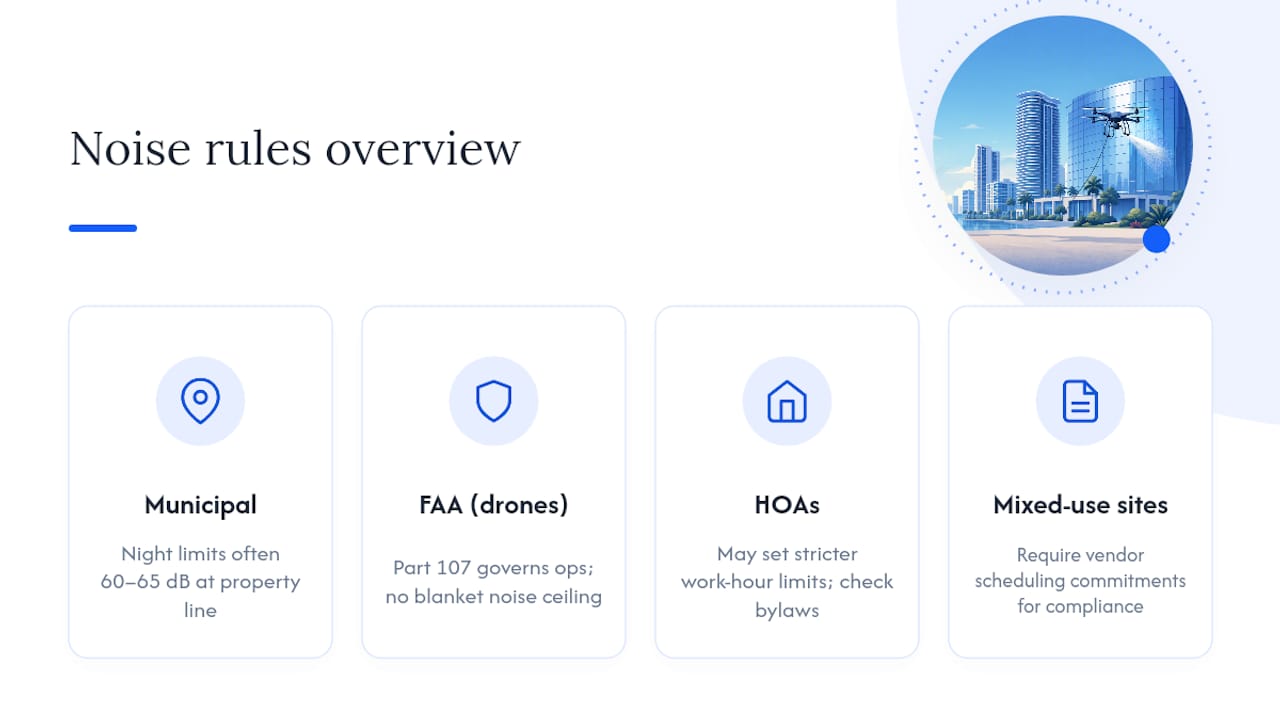
There’s no single federal decibel limit written specifically for commercial window cleaning. Instead, managers deal with a layered set of standards. Miami-Dade, Broward, and and Palm Beach counties each maintain municipal noise ordinances that typically set quieter limits during nighttime hours, often in the 60 to 65 dB range measured at a property line, though exact thresholds vary by municipality and zoning.
For drone operations specifically, the FAA governs airspace and operational rules under Part 107, but it doesn’t set a blanket noise ceiling for commercial drone work. The FAA’s own environmental assessment framework, built for Prime Air delivery operations, still gives facility managers a useful reference point: it uses SEL and DNL metrics to model cumulative community noise exposure, the same approach worth requesting from any commercial drone vendor.
HOA governing documents often layer on additional restrictions, sometimes specifying permitted work hours that are stricter than the municipal ordinance. Before any exterior cleaning contract, check your HOA’s declaration or bylaws for a noise or nuisance clause, since violating it can create liability separate from any municipal citation. Hotels and office towers with attached residential units face the added complication of matching commercial work hours to residential quiet-hour expectations, which is where written vendor commitments on scheduling become part of your compliance file, not just a courtesy.
How Does Cleaning Noise Affect Tenants and Neighbors?
Sleep disruption is the clearest, best-documented health impact tied to construction and cleaning noise. The WHO’s 42 dB indoor LAMax threshold exists because sound above that level measurably increases the odds of waking during sleep or having trouble falling back asleep. For hotels running overnight guests or residential towers with round-the-clock occupancy, that threshold should guide any nighttime or early-morning work window, not just theoretical modeling.
Daytime comfort matters differently. Office tenants dealing with client calls or focused work find intermittent sharp noise more disruptive than steady background sound, even at a lower average volume. This is the psychoacoustic annoyance factor again: a predictable hum from a water-fed pole pump fades into the background faster than an irregular drone hover whine, even when the drone measures quieter on paper.
Neighboring properties matter too, especially in dense corridors like Brickell or downtown Fort Lauderdale where towers sit close together. Noise doesn’t respect property lines, and a cleaning contractor working your façade can generate complaints from an adjacent building’s tenants who had no notice at all. Extending your tenant communication plan to immediate neighbors, not just your own building, heads off complaints before they reach code enforcement.
For sustainability-focused portfolios, reduced noise footprint pairs naturally with broader environmental goals. Facility teams already tracking sustainability standards like BREEAM for commercial buildings increasingly treat construction and maintenance noise as part of their occupant wellness scoring, not a separate concern.
The Real Trade-off Managers Need to Weigh
The debate over drone versus scaffold noise misses the point when it stays fixated on peak decibels. What actually drives tenant complaints is total exposure time and predictability, and drones usually win on both once you factor in a 1 to 3 day timeline against weeks of scaffold noise. The sharp hover peak that shows up in a drone noise report looks alarming on paper, but it’s gone in seconds, while a scaffold crew’s ambient noise recurs every single day of the job.
If you manage a South Florida property and you’re on the fence, don’t take a vendor’s spec sheet at face value. Schedule a daytime demonstration pass, take an indoor LAmax reading with windows both open and closed, and send tenants a short notice beforehand. Local experience with county permitting and staging logistics matters here too. A contractor who’s navigated Miami-Dade or Broward’s specific approval process before will move faster and generate fewer surprises than one learning the local rules on your job.
, Eliot
Get a Site-Specific Noise Plan From Vista Drone Cleaning
If the numbers above have you thinking about scheduling a job, the next step is getting a plan built around your actual building, not a generic estimate. Vista Drone Cleaning gives South Florida property managers a free site review that turns into a fixed-price quote, backed by FAA Part 107-certified pilots, tethered drone systems, and $2 million in liability coverage, with most façade and window projects wrapping in 1 to 3 days instead of the multi-week timeline scaffolding requires.
A proposal from Vista typically includes:
- A demonstration pass so you can hear actual noise levels before signing anything
- A proposed drone-to-façade distance tailored to your building’s height and glass configuration
- Noise estimates at multiple test distances
- Planned working hours built around your tenant or guest schedule
- 4K before-and-after documentation for every section cleaned
- A fixed-price quote with no scaffolding, permits, or road closures required
Whether you’re managing a Brickell office tower, a Fort Lauderdale hotel, or a Boca Raton condominium association, request a free quote for drone window and facade cleaning and get a noise plan built around your property before your next cleaning cycle.
Sources
- FAA Prime Air environmental assessment: Appendix E (noise measurement and SEL examples)
- MDPI: drone façade distance modeling and indoor LAMax predictions (2022)
- PMC systematic review on drone noise emissions and human annoyance
FAQ
Is Drone Window Cleaning Louder Than Traditional Methods?
Drone hover passes can register brief peaks up to 90+ dB at close range, but total site noise is often lower than scaffolding because drone jobs finish in 1 to 3 days versus weeks of sustained construction-style noise.
What Decibel Level Should Indoor Noise Stay Below at Night?
The WHO recommends an indoor LAMax of about 42 dB to avoid disrupting sleep, a target facility managers can request from any vendor performing early-morning or evening work.
Why Do Drones Sound More Annoying Than Their Decibel Rating Suggests?
Psychoacoustic factors like tonality, sharpness, and RPM fluctuation make drones seem louder than road traffic at the same measured dB level, according to peer-reviewed annoyance research.
Does Vista Drone Cleaning Use Tethered or Battery-Powered Drones?
Vista Drone Cleaning uses tethered industrial drones with ground-based power, which stabilizes motor RPM and reduces the erratic buzzing associated with untethered, battery-powered units.
How Much Does Drone Window Cleaning Cost in South Florida?
Vista Drone Cleaning’s drone window cleaning runs $0.12 to $0.25 per square foot of glass, with a free quote available after a site review.