
South Florida Commercial Window Cleaning Frequency & Drone Use
Actionable South Florida commercial window cleaning schedules: monthly storefronts, quarterly towers, 1–2/year industrial. When to use drones.
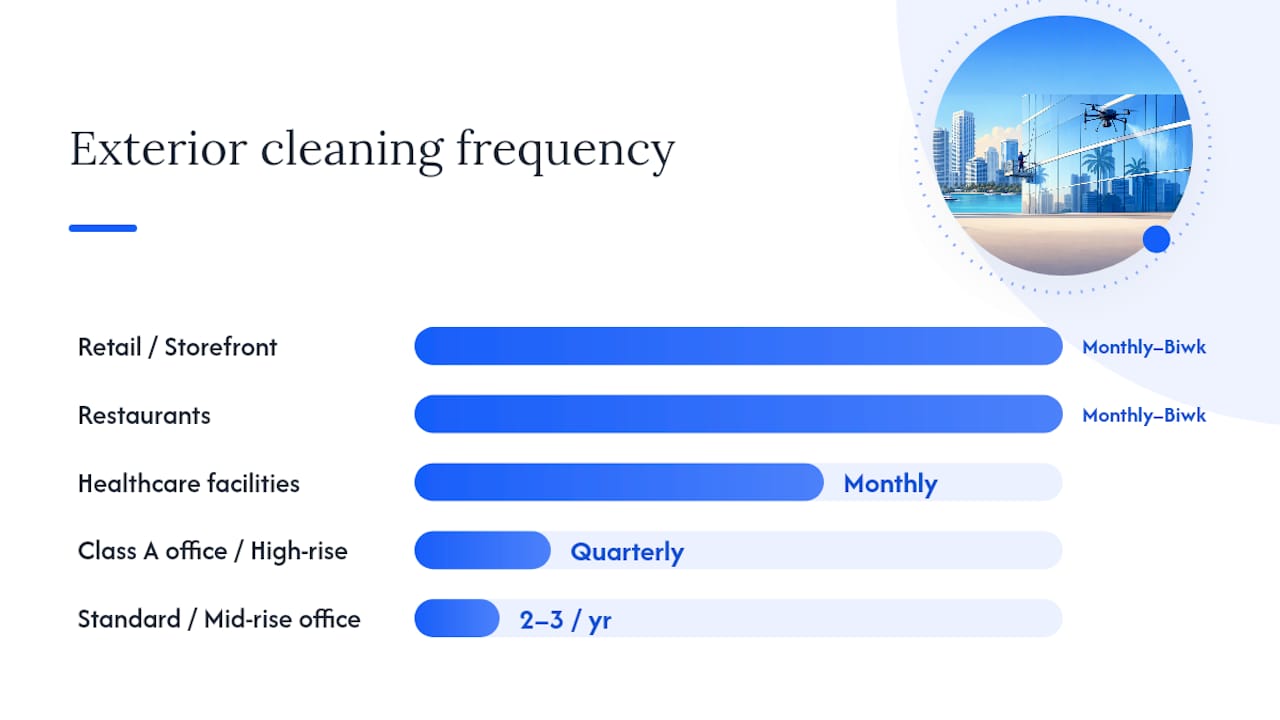
Storefronts need exterior cleaning on a monthly to bi-weekly basis, Class A office towers usually run on a quarterly baseline, and industrial buildings typically get by on one or two visits a year. Coastal exposure, urban grime, and heavy foot traffic push any of those baselines toward the higher end, while interior glass almost always runs on a separate, less frequent cycle than the exterior. Locking in a recurring contract instead of booking one-off cleans also tends to lower your cost per visit.
TL; DR:
- Coastal properties require cleaning at least twice as often as inland buildings due to salt spray, pollen, and storm debris accelerating grime buildup.
- High-traffic retail storefronts and restaurants often need cleaning monthly or bi-weekly to maintain curb appeal and attract customers.
- Industrial buildings and warehouses typically schedule exterior cleaning only once or twice a year, with more frequent attention to skylights and translucent panels.
- Drone cleaning offers a cost-effective alternative for high-rises above 100 feet and urban sites where traditional access is difficult or disruptive.
- Water quality issues, especially high mineral content, can cause persistent spotting, making water treatment and water source testing critical before establishing a cleaning schedule.
Table of Contents
- What Affects Commercial Window Cleaning Frequency?
- Recommended Cleaning Schedules by Property Type
- Turning Frequency Into a Real Maintenance Schedule
- Health and Safety Considerations Tied to Cleaning Frequency
- How Cleaning Frequency Shapes Tenant Perception
- Environmental Factors and Sustainable Cleaning Practices
- Mistakes Property Managers Make When Setting a Schedule
- When Drone Cleaning Fits the Schedule
- Get a Recurring Cleaning Schedule Built for Your Building
- Sources
- FAQ
What Affects Commercial Window Cleaning Frequency?
A quarterly schedule that works fine for an inland office park in Plantation will leave a beachfront condo tower in Sunny Isles looking chalky and streaked within six weeks. Six variables drive that gap, and property managers who ignore them end up either overpaying for cleans they don’t need or under-cleaning glass that’s degrading their building’s curb appeal.
- Location and exposure: Salt spray off the coast in Miami Beach, Fort Lauderdale, and Boca Raton accelerates mineral buildup on glass far faster than inland exposure, and heavy vehicle traffic near arterial roads like Federal Highway adds diesel film and brake dust.
- Occupancy and use: A retail storefront lives and dies by first impressions, while an industrial warehouse in Hialeah rarely has anyone looking at its windows at all.
- Facade and glass type: Low-E coatings, solar film, and anodized aluminum frames all react differently to hard water, and some manufacturer warranties actually specify a cleaning method or cadence.
- Height and access: A four-story medical office is a same-day job for a lift crew; a 200-foot condo tower in Brickell requires scaffolding, rope access, or a drone crew, and that access cost shapes how often ownership is willing to schedule service.
- Interior drivers: Restaurant kitchens, hospital infection-control zones, and lobby atriums generate grease film, fingerprints, and dust at a pace exterior glass never sees.
- Seasonal triggers: Pollen season, hurricane debris, and post-construction dust all justify an out-of-cycle clean regardless of what the calendar says.
The IWCA glass cleaning matrix draws a useful line here: routine cleaning methods like squeegee work and deionized water-fed poles handle everyday grime, but they don’t remove paint overspray, adhesive residue, or heavy mineral scale. That’s remediation work, and it belongs in a separate line item, not folded into your standard schedule.
Pro Tip: Ask any bidder to test your water source with a TDS meter before quoting a schedule. Hard water above roughly 30 parts per million leaves mineral spotting even on a freshly squeegeed pane, which means a “cleaning frequency problem” might actually be a water-treatment problem.

Recommended Cleaning Schedules by Property Type
Baselines exist because facility managers need a defensible starting point, not because any code or ordinance mandates a specific interval. Neither IFMA nor BOMA sets a binding rule here. What they offer, and what most South Florida service contracts are built around, is a baseline-plus-adjustment framework: pick your property type, then add cycles for exposure and use.
Retail storefronts and restaurants sit at the aggressive end. Glass appearance directly shapes how customers judge a business before they walk in, which is why monthly to bi-weekly exterior cleaning is standard for street-level retail on Lincoln Road or Las Olas Boulevard. Restaurant interiors, especially anything near an open kitchen, often need weekly attention on entry glass and monthly for the rest.
Class A office towers and high-rises typically run a quarterly exterior baseline. Lobby and atrium interiors typically get wiped monthly because that’s the space clients and tenants usually see. Push that exterior cycle to multiple times per year for coastal towers in Aventura or Fort Lauderdale Beach, where salt spray and humidity accelerate mineral deposits.
Standard and mid-rise office buildings away from the coast can usually stretch to two or three exterior cleans a year, with interiors on a quarterly rhythm. A suburban office park in Coral Springs or Plantation, set back from salt air and heavy traffic, is a reasonable candidate for the lower end of that range.
Healthcare facilities don’t get the luxury of stretching intervals. Monthly cleaning, interior and exterior, is generally considered a minimum, and accredited facilities or anything adjacent to food service or sterile processing often need more frequent attention to satisfy infection-control standards.
Industrial buildings and warehouses sit at the other extreme. Most schedule exterior cleaning about once or twice a year, since appearance rarely drives revenue. The exception is skylights and translucent roof panels, which need more frequent attention because grime buildup there cuts directly into natural light and can spike energy costs from added artificial lighting.
Schools and universities typically schedule exterior cleaning two to four times a year, timed around winter and summer breaks so crews aren’t working around active classrooms. Interior glass, especially in high-traffic corridors, usually gets monthly attention.
| Property type | Exterior baseline | Interior baseline | Coastal/high-exposure adjustment |
|---|---|---|---|
| Retail/storefront | Monthly to bi-weekly | Weekly to monthly | Bi-weekly minimum |
| Restaurants | Monthly to bi-weekly | Weekly | Bi-weekly |
| Class A office/high-rise | Quarterly | Monthly (lobby/atrium) | 3 to 4 times per year |
| Standard/mid-rise office | 2 to 3 times per year | Quarterly | Quarterly |
| Healthcare | Monthly minimum | Monthly minimum | Monthly, higher in food-service zones |
| Industrial/warehouse | 1 to 2 times per year | As needed | Skylights more frequent |
| Schools/universities | 2 to 4 times per year | Monthly | Aligned with pollen season |
Recurring pricing typically runs 20 to 40 percent below one-off cleaning rates, and locking in a schedule also shortens the time crews spend on each visit since they’re never fighting years of accumulated buildup.
Turning Frequency Into a Real Maintenance Schedule
A frequency number on its own doesn’t manage a building. It has to become a calendar with named dates, and a contract that spells out exactly what happens when a hurricane or a heavy pollen bloom throws the calendar off.
Start by building the annual structure:
- Set your baseline visits first (quarterly, monthly, semi-annual) based on property type.
- Layer in seasonal add-ons, like a post-pollen clean in spring or a post-storm callback after named tropical systems.
- Build in a buffer week around each scheduled visit for weather delays, since South Florida’s wet season regularly pushes exterior work by several days.
- Review the calendar annually against occupancy changes, lease turnovers, or new construction nearby that might kick up dust.
A well-built service contract should spell out:
- Explicit scope: which surfaces are included (exterior only, interior and exterior, skylights, solar panels).
- Access method and who provides it (lift, rope access, or drone).
- Insurance minimums and proof of coverage.
- Weather and rescheduling policy in writing, not verbal.
- A defined callback clause for missed spots or streaking within a set number of days.
Ask for photo or 4K video documentation before and after service. It’s the fastest way to confirm the crew actually met the agreed standard, not just that they showed up.
Health and Safety Considerations Tied to Cleaning Frequency
Windows that go too long between cleanings aren’t just an appearance problem. Mineral scale and organic film buildup on glass can mask early signs of seal failure or water intrusion around frames, issues that get more expensive the longer they sit hidden. In healthcare and food-service settings, infrequent cleaning near entry points and high-touch glass also lets grime and biofilm accumulate in ways that undercut infection-control protocols.
On the delivery side, frequency decisions carry their own safety weight. Every additional scaffold setup or lift mobilization adds fall-risk exposure for crews and disruption for tenants below. Traditional access methods on a building over 100 feet tall usually mean sidewalk closures, staging areas, and coordination with building security, all of which multiply the safety variables on every single visit. Fewer mobilizations, spaced correctly for the property’s exposure level, generally means fewer chances for something to go wrong on-site.
Chemical exposure is the other piece. Routine cleaning with squeegees and deionized water carries minimal risk, but remediation work, stripping old sealant residue or heavy mineral deposits, sometimes calls for stronger solutions that need proper ventilation and handling protocols. A contract that clearly separates routine cleaning from remediation, per the IWCA’s method categories, keeps that distinction from getting blurred in the field.
How Cleaning Frequency Shapes Tenant Perception
Tenants notice dirty glass faster than almost any other maintenance lapse, because it’s visible from both inside and outside the building every single day. A Class A office tower in downtown Miami competing for lease renewals loses ground fast if its facade looks tired next to a comparable building three blocks away with a tighter cleaning cycle.
Streaked or hazy glass reads as neglect even when every other system in the building is well maintained. Prospective tenants touring a space form an impression in the lobby before they’ve seen a single floor plan, and a grimy atrium skylight or smudged entry door undercuts that impression instantly. Retail tenants feel this even more acutely: a storefront window is effectively a 24-hour advertisement, and grime on that glass is lost foot traffic.
There’s a retention angle too. Buildings that maintain a visibly consistent cleaning cadence tend to see fewer complaints logged with property management about “the building looking run down, ” which matters when it’s time for lease renewal conversations. It’s a small line item on a maintenance budget with an outsized effect on how a building is perceived.
Environmental Factors and Sustainable Cleaning Practices
South Florida’s climate isn’t gentle on glass. Afternoon humidity, salt aerosols carried inland from the coast, and heavy pollen seasons in spring all accelerate the buildup that drives cleaning frequency upward. Storm season adds its own wrinkle: named systems deposit salt residue and debris that often justify an out-of-cycle clean regardless of where a building sits on its normal calendar.
Sustainability considerations increasingly shape how that cleaning gets done, not just how often. Deionized, pure-water rinse systems eliminate the need for detergent runoff entirely, which matters for buildings near waterways in areas like Coconut Grove or the Fort Lauderdale canal system, where chemical runoff into stormwater drains is a real concern. Buildings pursuing LEED certification or green operating standards often specify low-impact cleaning chemistry as part of their maintenance requirements, and that specification should show up in your service contract, not get treated as an afterthought.
Frequency and sustainability intersect in a less obvious way too: a tighter, well-planned schedule generally uses less water and fewer chemical treatments overall than sporadic, reactive cleaning that has to fight years of accumulated buildup. Consistent sustainable cleaning practices paired with the right cadence tend to outperform infrequent deep cleans on both cost and environmental impact.
Mistakes Property Managers Make When Setting a Schedule
The most common error is copying a neighbor’s schedule instead of building one around the property’s actual exposure. A building two blocks from the water needs a different cycle than one set back a mile inland, even if they’re the same height and class.
Treating interior and exterior glass as one line item is another frequent misstep. They accumulate grime at completely different rates, and bundling them into a single frequency almost always means over-cleaning one side and under-cleaning the other.
Skipping the water-quality check before locking in a contract term causes a lot of unnecessary disputes. If a facility’s water supply has high mineral content and nobody’s using deionized water or a filtration step, spotting will reappear within weeks no matter how often the crew shows up, and the property manager ends up blaming the vendor for a water problem.
Locking a rigid annual schedule without a weather or callback clause is the last big one. South Florida’s storm season doesn’t respect a calendar, and a contract without flexibility for rescheduling or a documented callback policy leaves managers stuck paying for a visit that gets rained out or a job that wasn’t done to standard. Reviewing real building washing examples before finalizing a schedule tends to surface these gaps before they become contract disputes. Tracking every scheduled and completed visit against the calendar, rather than trusting memory or a vendor’s word, is also worth building into your own maintenance tracking process.
When Drone Cleaning Fits the Schedule
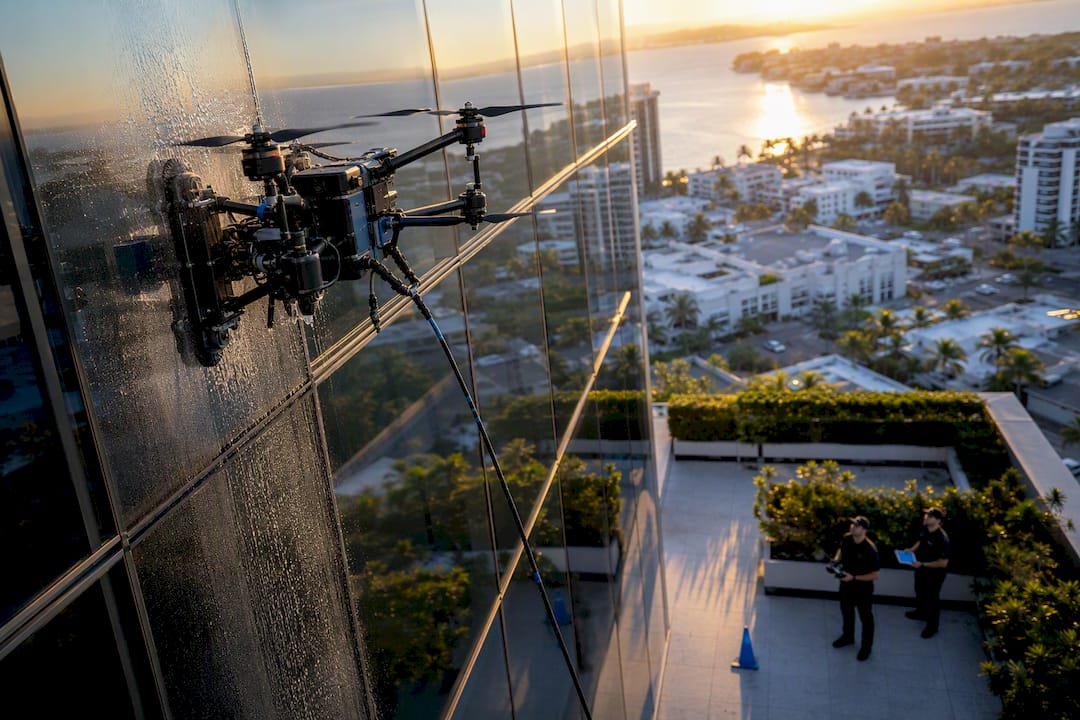
Drone-based cleaning earns its place on buildings where traditional access is slow, disruptive, or genuinely difficult to stage: high-rises up to 200 feet, tight urban footprints in Brickell or downtown Fort Lauderdale where a lift can’t get positioned, and properties that need service without shutting down a sidewalk or a lane of traffic. The operational upside is straightforward. Crews stay on the ground, most projects wrap in one to three days, and every job comes with 4K before-and-after documentation that gives property managers proof of the work, not just a verbal assurance.
Drone cleaning isn’t the right tool for every job, though. Heavy remediation work, paint overspray removal, or situations requiring specific permit access still call for rope access or lift crews in some cases. Matching the method to the task matters as much as matching the frequency to the property.
, Eliot
Get a Recurring Cleaning Schedule Built for Your Building
A drone cleaning service offers an alternative to scaffolding and boom lifts for commercial window and facade cleaning in South Florida. FAA Part 107-certified pilots can operate tethered drones to clean glass, facades, roofs, and solar arrays on high-rise buildings, often completing projects in a few days at lower cost than traditional scaffold or rope-access crews, with liability insurance and deionized water rinses.
If your building sits on the coast or in a high-traffic corridor and your current schedule keeps falling short between visits, a ground-based drone crew can usually hold a tighter cycle without the sidewalk closures and permitting delays that come with scaffolding. Our drone facade and building cleaning service covers high-rise glass, stucco, EIFS, and metal panels, while our high-rise window cleaning page details what a typical project looks like from quote to sign-off. Curious what a recurring contract would cost for your specific building? Check our pricing breakdown and request a free quote within 24 hours.
Sources
These frequency ranges draw on the IWCA glass cleaning matrix for method standards, National Window Cleaning Authority baselines for property-type frequency, and regional guidance on coastal high-rise cleaning cycles in South Florida.
- Recommended window cleaning frequency for commercial buildings: National Window Cleaning Authority
- Commercial window cleaning cost & frequency guide (2026): MegaSVS
FAQ
How Often Should Commercial Windows Be Professionally Cleaned?
It depends on property type: storefronts and restaurants generally need monthly to bi-weekly exterior cleaning, Class A office towers run quarterly, and industrial buildings typically schedule one to two cleans a year, with coastal properties moving toward the higher end of each range.
What Is the Going Rate for Commercial Window Cleaning?
Rates vary by building height, access method, and glass area, so there’s no single flat number; Vistadronecleaning prices drone window and facade cleaning at $0.12 to $0.25 per square foot of glass, which you can review on the pricing page.
What Is the Hourly Rate for a Window Cleaner?
Hourly rates for traditional window cleaning crews vary widely by market and access method, so most commercial vendors, including drone-based services, price by square footage or per project rather than by the hour.
What Month Is Best to Clean Windows in South Florida?
There’s no single best month, but scheduling around the spring pollen bloom and immediately after hurricane season’s peak (typically late fall) catches the two biggest buildup events on South Florida glass.
Why Do Interior and Exterior Windows Need Different Cleaning Schedules?
Exterior glass faces weather, salt spray, and pollution, while interior glass accumulates fingerprints, kitchen grease, or dust from foot traffic, so the two surfaces build up grime at different rates and rarely belong on the same cleaning cycle.