
How Bird Droppings Cut Your Solar Panel Output
Discover how bird droppings cut solar panel output by nearly 24%. Learn effective strategies to protect your investment and boost efficiency.
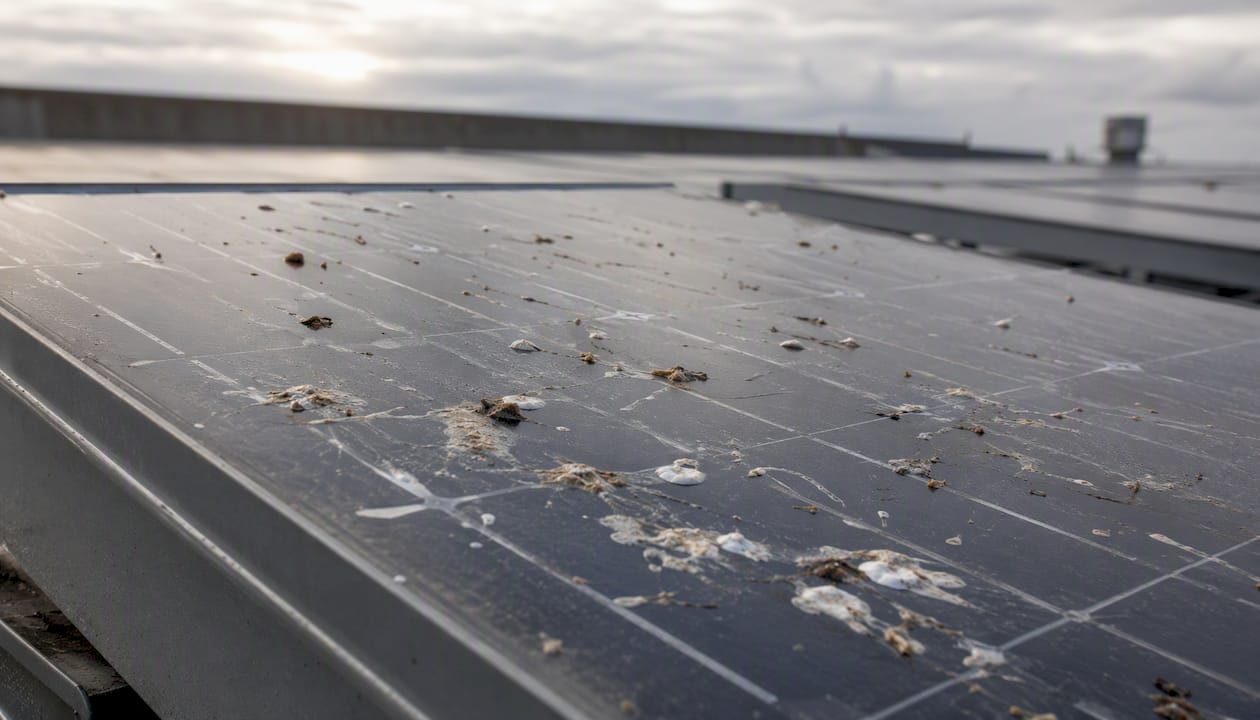
Bird droppings reduce solar panel output through three simultaneous mechanisms: blocking and scattering incoming sunlight, creating electrical hot spots that suppress current across entire cell strings, and chemically etching the glass and anti-reflective coatings over time, as confirmed by experimental studies. These aren’t theoretical risks. Lab-controlled experiments have measured power reductions of roughly 23.8% from bird waste on a single panel, with current dropping 36–38% when just four droppings were present. For commercial rooftop arrays in South Florida, where seagulls, ibis, and pigeons are year-round fixtures, the impact compounds fast.
Immediate actions for South Florida operators:
- Inspect arrays visually after any heavy bird activity, especially near parapets and inverter shade lines
- Flag any module with visible droppings covering more than a small patch for priority cleaning
- Schedule professional drone pure-water solar panel cleaning if droppings persist after the next rain cycle
Vistadronecleaning operates with FAA Part 107-certified pilots and tethered industrial drone systems, handling commercial arrays without scaffolding or roof access risk across South Florida.
Table of Contents
- Why bird droppings reduce solar panel output: the optical mechanism
- How partial shading from droppings creates hot spots and kills current
- How guano chemically damages glass and coatings over time
- What the numbers actually say: lab tests and field data
- What makes some arrays more vulnerable than others
- Short-term output loss versus long-term permanent damage
- Cleaning options compared: from rain to professional drone wash
- When should you schedule a cleaning?
- Field methods and why drone pure-water cleaning works for commercial arrays
- What we see on South Florida commercial rooftops
- South Florida commercial solar arrays deserve better than a garden hose
- What the evidence tells us about bird droppings and solar output
- Sources
- FAQ
Why bird droppings reduce solar panel output: the optical mechanism
Every solar cell needs direct, unobstructed photons. Bird droppings interfere at the first point of contact: the front glass.
Guano deposits are neither fully opaque nor fully transparent. Fresh droppings scatter incoming light at multiple angles, reducing the fraction that reaches the active cell layer. Dried, cemented deposits act more like a solid barrier, absorbing and reflecting photons that would otherwise generate current. Even a semi-transparent smear cuts transmittance measurably. A subtropical urban field study found that a small residual of bio-soiling produced roughly 2.5% optical loss and 15.5% PV output loss over a 108-day exposure period.
The geometry of solar cell strings makes localized shading worse than the covered area alone suggests. Cells in a string are wired in series. When one cell receives less light, it limits the current for the entire string, not just its own output. A dropping the size of a quarter can effectively throttle a row of cells far larger than the deposit itself. Module design matters here too: research on cell stringing and partial shading shows that half-cut cell modules and parallel sub-strings reduce worst-case losses from a single shaded strip, while older full-cell designs take the full hit.
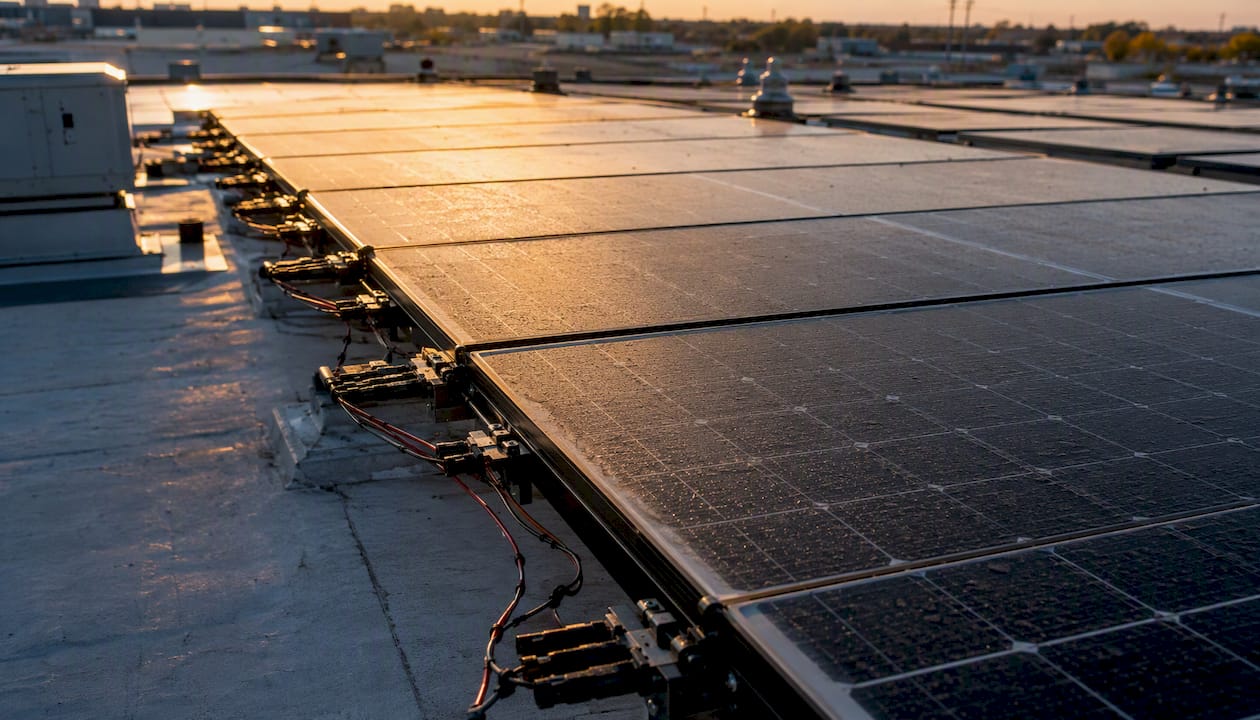
In South Florida, the most common culprits on commercial rooftops are laughing gulls near coastal Brickell and Miami Beach properties, white ibis across Broward County, and feral pigeons concentrated around Fort Lauderdale and Boca Raton warehouse districts. These species tend to perch on parapets and HVAC units directly above panel rows, creating predictable soiling lines rather than random scatter.
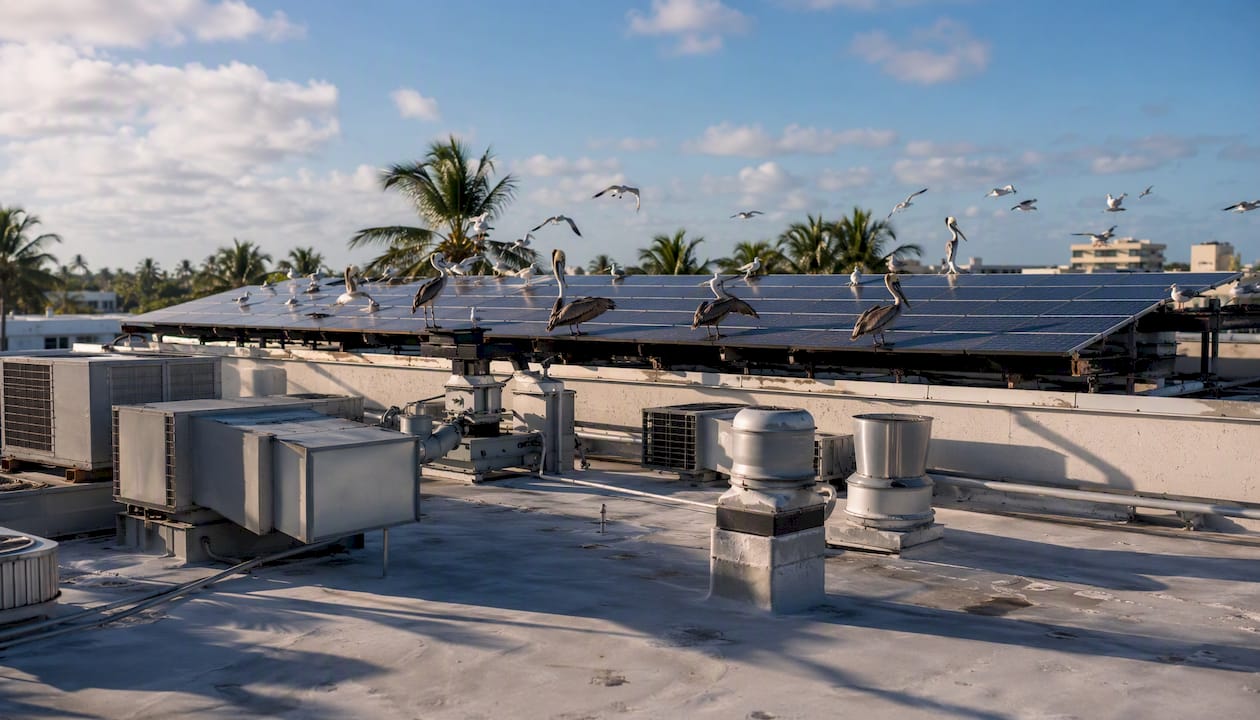
Pro Tip: Do a quick visual scan from ground level with binoculars before sending anyone to the roof. Concentrated droppings along one row almost always trace back to a perch point directly above, fix the perch, and you fix the pattern.
How partial shading from droppings creates hot spots and kills current
The electrical damage from bird waste goes well beyond simple shading. When a cell is partially blocked, it can no longer contribute its share of current to the string. In a series-wired string, that cell becomes a load rather than a source, dissipating energy as heat instead of passing it along. This is the hot-spot effect.
The Scientific Reports lab study measured hot-spot temperature increases of roughly 5% compared to clean modules when droppings were present, alongside the 36–38% current reduction from four drops. Sustained hot spots accelerate cell degradation, can damage encapsulant layers, and in severe cases cause delamination or cracking.
The chain runs like this:
- Bird dropping lands on a cell or cell boundary
- That cell’s photocurrent drops, creating a current mismatch within the string
- The string’s bypass diode may engage, cutting the shaded cell group out of the circuit entirely
- Array current falls by the contribution of that entire bypassed segment
- The shaded cell dissipates reverse-bias energy as localized heat
- Repeated thermal cycling weakens the cell’s solder bonds and encapsulant
Bypass diodes are designed to protect cells in exactly this scenario, but their engagement comes at a cost: the power from the bypassed segment is lost entirely. A comprehensive soiling review confirms that dew-enhanced adhesion and partial-shade-triggered bypass diode losses are among the primary mechanisms by which soiling translates into measurable production deficits at scale.
How guano chemically damages glass and coatings over time
The optical and electrical losses are immediate. The chemical damage is slower but potentially permanent.
Bird digestive fluids are acidic and enzymatic. When guano dries on glass, those compounds concentrate against the surface. Rainfall dilutes fresh deposits but rarely neutralizes or fully removes dried, cemented ones. Experimental cleaning research confirms that rain often fails to fully remove guano due to digestive-fluid residues, and that mechanical or water-based cleaning is required for complete recovery on many sites.
Anti-reflective (AR) coatings on modern solar glass are thin, precisely engineered layers. Repeated cycles of acid exposure from guano, followed by abrasive scrubbing to remove the deposit, gradually erode those coatings. Once the AR layer is compromised, the panel’s baseline transmittance drops permanently. Frame seals and edge encapsulants face a similar risk: acidic residue that pools at the module’s lower edge can degrade the seal over months, creating a path for moisture ingress.
Long-term risk for South Florida arrays: The combination of high humidity, salt-laden coastal air, and frequent dew cycles in Miami-Dade and Broward counties accelerates every chemical process described above. Guano that might take months to etch glass in a dry climate can cause measurable coating degradation in weeks here. Humidity also enhances adhesion: wetting and drying cycles cement particles to the glass surface, making deposits progressively harder to remove without abrasion. Operators who treat cleaning as optional are effectively choosing to accept permanent efficiency losses.
What the numbers actually say: lab tests and field data
The research on bird droppings and solar performance spans controlled lab tests and real-world field exposures. The numbers differ significantly between the two contexts, and understanding why matters for how you use them.
In the most extreme lab conditions, a ScienceDirect study on bird droppings and thermal performance reported efficiency reductions ranging from roughly 46% to nearly 89% under heavy contamination scenarios. These figures reflect controlled placement of defined weights and coverage areas, not typical rooftop conditions. They represent worst-case ceilings, not averages.
More operationally relevant are the mid-range findings. The Scientific Reports lab test measured approximately 23.8% power reduction and 36–38% current loss with four drops present. The City University subtropical urban field study found 15.5% output loss from residual bio-soiling over 108 days. A 25-day humid-environment experiment found that panels with roughly 30% of their area covered by soiling including bird droppings saw output drop by approximately 35%.
| Study context | Coverage / condition | Measured loss | Type |
|---|---|---|---|
| Lab (Scientific Reports) | 4 drops, controlled placement | ~36–38% current reduction | Controlled lab |
| Lab (ScienceDirect) | Heavy coverage, varied weights | ~46%–89% efficiency loss | Controlled lab |
| Field (City University) | Residual bio-soiling, 108 days | ~15.5% output loss | Subtropical urban field |
| Field (Sukkur IBA) | ~30% area covered, 25 days | ~35% output decrease | Humid/dusty field |
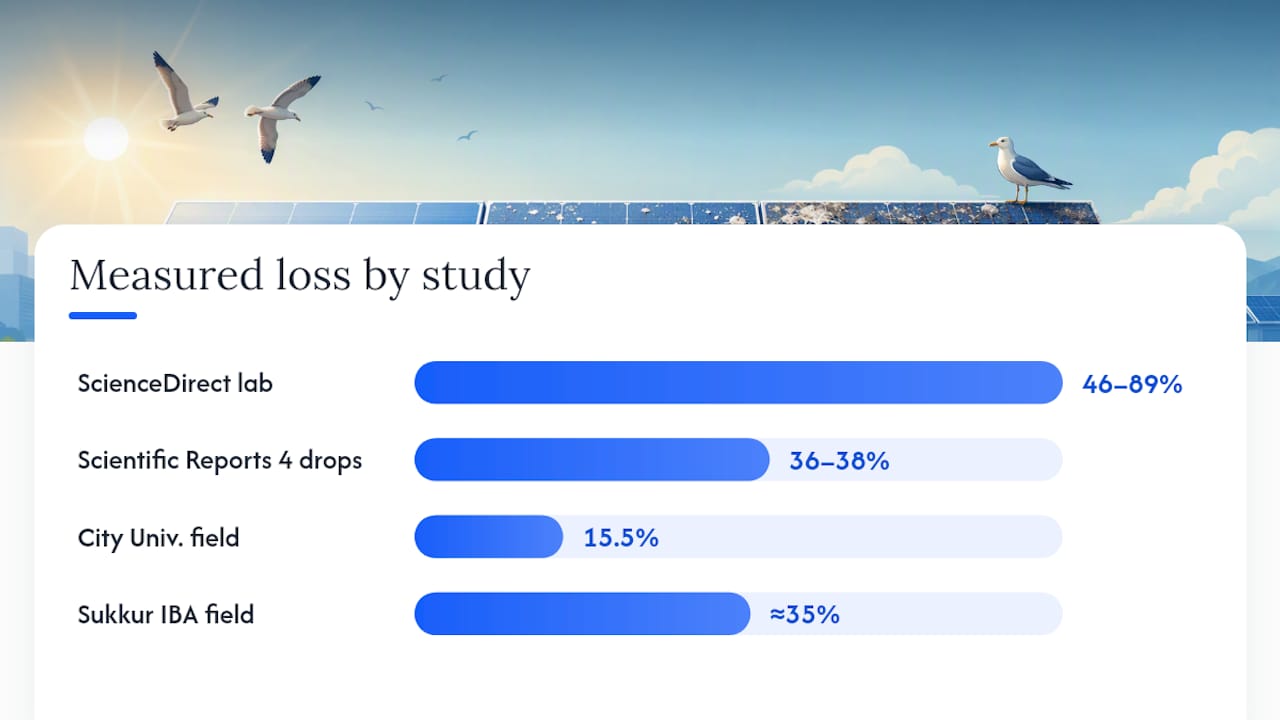
Lab tests often show higher percent losses than field studies because contamination levels and placement are designed to isolate the variable. On a real rooftop, panels are rarely uniformly covered. But the field numbers still represent serious production losses, and they accumulate quietly.
A global soiling review estimated that soiling reduced global solar production by at least 3%–4% in 2018. Bird droppings, among the most adhesive and optically dense contaminants, disproportionately contribute to soiling losses in urban and coastal environments.
Statistic to keep in mind: Even a small residual of bio-soiling produced 15.5% output loss in a subtropical urban field study over 108 days. That is not a catastrophic event. It is quiet, steady revenue loss that compounds across every module on your roof.
What makes some arrays more vulnerable than others
Not every rooftop faces the same risk level. Several factors determine how quickly bird droppings translate into meaningful losses.
Climate and location factors:
- South Florida’s high humidity and frequent dew cycles increase adhesion and cementation, making deposits harder to remove naturally
- Coastal salt exposure in Miami Beach, Boca Raton, and Fort Lauderdale adds a corrosive layer that interacts with guano chemistry
- Rainfall frequency matters less than rainfall intensity: light drizzle can actually cement particles further rather than washing them away
Panel and array design factors:
- Low-tilt arrays (common on flat commercial rooftops in Miami-Dade) allow droppings to accumulate rather than slide off
- Full-cell modules are more vulnerable to string-level losses from a single dropping than half-cut designs
- Panels without AR coatings have less to lose from coating erosion but also start at lower baseline transmittance
Bird behavior factors:
- Perching structures directly above panel rows create concentrated soiling lines
- Nesting under panel frames (a common behavior for pigeons on Broward County warehouse rooftops) deposits waste directly on the module surface repeatedly
- Seasonal breeding cycles in spring and early summer increase activity and droppings volume on South Florida commercial properties
Quick site-risk checklist for Miami-area rooftop operators:
- Are there parapets, HVAC units, or elevated structures within 10 feet of panel rows?
- Is the array tilt below 10 degrees?
- Have you observed nesting activity under or near modules?
- Does the site sit within a mile of a water body (bay, canal, retention pond)?
- Has the array gone more than 60 days without a visual inspection?
Three or more “yes” answers puts the array in a high-priority cleaning category.
Short-term output loss versus long-term permanent damage
The distinction between reversible and irreversible damage is what should drive your cleaning schedule.
Fresh droppings cause immediate optical and electrical losses that largely reverse after a thorough cleaning. Remove the deposit, restore transmittance, and the panel performs close to its original specification. That is the short-term story, and it is recoverable.
Pro Tip: If your monitoring system shows a sudden output dip on one string but not others, check that string’s modules for fresh droppings before assuming an inverter or wiring fault. A targeted cleaning often resolves what looks like an electrical problem.
The long-term story is different. Guano left in place for weeks or months in South Florida’s humid, salty environment begins etching the glass surface and degrading AR coatings. Once that coating is gone, the panel’s baseline efficiency drops permanently, regardless of how clean the surface is afterward. Repeated thermal cycling from hot spots accelerates micro-cracking in cell solder bonds. Moisture ingress from compromised edge seals can cause delamination that no cleaning will fix.
A 25-day field experiment in a humid, dusty environment projected that panels left uncleaned could reach complete surface opacity under sustained accumulation. South Florida’s combination of coastal humidity and active bird populations makes that trajectory realistic for neglected arrays.
Visible droppings on multiple modules warrant cleaning promptly, as deposits left longer than about a month in South Florida conditions risk shifting from recoverable loss to permanent damage.
Cleaning options compared: from rain to professional drone wash
Rain handles light dust reasonably well. It does not handle bird droppings. The digestive-fluid residues in guano bind to glass in ways that water alone rarely overcomes, a finding confirmed by experimental cleaning research. Operators who rely on rainfall for maintenance are accepting a baseline of chronic soiling loss.
Practical options, from lowest to highest efficacy:
- Rain/natural cleaning: Handles loose dust on tilted panels; largely ineffective on cemented guano or low-tilt commercial arrays
- Manual brushing (dry): Risks scratching AR coatings if bristles are too stiff; ineffective on dried deposits without water
- Telescoping pure-water pole systems: Effective for accessible single-story or low-rise arrays; requires trained staff on or near the roof, creating fall-risk exposure
- Rooftop robotic cleaners: Consistent for flat, uniform arrays; high upfront cost, limited to arrays with compatible geometry, and still requires human setup and retrieval
- Tethered industrial drone systems (Lucid Bots Sherpa): Purpose-built for commercial-scale cleaning at height; operators stay on the ground, eliminating roof access risk; effective on cemented deposits with appropriate brush and water delivery
- **The tethered drone pure-water wash service uses a ground-based crew with de-ionized pure water rinse and provides a streak-free finish with liability coverage.M liability coverage; suited for high-rise commercial arrays and multi-building properties in Miami-Dade and Broward
For commercial rooftop arrays in South Florida, particularly those on buildings above three stories or with restricted roof access, professional drone pure-water cleaning removes the fall-risk equation entirely. The drone solar panel cleaning process uses de-ionized water that leaves no mineral residue, which matters for AR-coated glass.
Pro Tip: Never use abrasive pads or high-pressure washers on solar glass. Both can scratch AR coatings or force water past frame seals. Pure water at low pressure with a soft brush is the standard that protects the panel while removing the deposit.
When should you schedule a cleaning?
Frequency guidance varies by site, but a few operational thresholds apply consistently to South Florida commercial arrays.
Trigger-based cleaning (act when you see these):
- More than four droppings per module on any string
- Visible coverage exceeding roughly 5% of a panel’s surface area
- Array output dropping more than 5% below your established baseline without a weather explanation
- Any evidence of nesting activity under or adjacent to modules
Scheduled maintenance cadence for South Florida:
- Post-breeding season inspection (May through June) to address spring nesting accumulation
- Pre-hurricane season check (before June 1) to document baseline condition and clear debris
- Post-storm inspection after any significant weather event that could have driven birds to shelter on rooftops
- Annual or semi-annual full cleaning for most commercial arrays; quarterly for high-soiling sites near water bodies or with known nesting activity
For scheduling recurring field-service maintenance on commercial properties, coordinating cleaning visits with existing facility maintenance windows reduces downtime and simplifies logistics.
Pro Tip: Establish a clean-panel baseline kWh reading immediately after a professional cleaning. That number becomes your reference point for every future inspection. A 10% drop from baseline is your trigger for the next service, regardless of how the panels look visually.
Monitoring options range from simple: visual inspection every 30 days, to more precise: string-level IV curve testing or production baselining through your inverter monitoring platform. The energy recovery measurement guide covers how to document before/after performance in a way that supports ROI calculations for your maintenance budget.
Field methods and why drone pure-water cleaning works for commercial arrays
Proving that a cleaning actually recovered output requires more than a visual check. Accepted field measurement protocols include baseline kWh logging before and after service, string-level IV curve testing to identify underperforming segments, front-glass transmittance checks, and photographic documentation. These protocols are standard practice for demonstrating measurable cleaning ROI to property owners and sustainability officers.
Vistadronecleaning applies this documentation approach on commercial jobs: 4K before/after imagery, production benchmarking where monitoring access is available, and written service records that support warranty compliance and insurance documentation.
The Lucid Bots Sherpa tethered drone system is designed for exactly the kind of commercial-scale, elevated cleaning that South Florida rooftop arrays require. It delivers controlled water flow and brush pressure at height without putting workers on the roof. For arrays on buildings above 40 feet in Miami-Dade and Broward, that operational model eliminates the primary safety liability of traditional cleaning methods.
**Operating a drone commercially over occupied commercial properties in South Florida requires compliance with FAA regulations for commercial drone operation. certification. Vistadronecleaning’s pilots hold that certification, and the company carries $2M liability insurance. For property managers and HOA boards, those two credentials are the minimum standard for any drone-based service operating above your tenants or guests. Ask any provider for both before signing a service agreement.
What we see on South Florida commercial rooftops
The patterns repeat across Miami-Dade and Broward. Parapets and HVAC equipment create predictable perch lines, and the modules directly below them accumulate the heaviest soiling. Inverter and combiner box shade lines attract birds seeking shelter, concentrating droppings in exactly the spots where partial shading does the most electrical damage.
Spring nesting season is the highest-risk period. Pigeons nesting under panel frames on Broward warehouse rooftops can deposit waste on the same modules daily for weeks. By the time a facility manager notices the output drop, the guano is cemented and the AR coating has been in contact with acidic residue for a month.
The before/after recovery rates the team documents on commercial jobs consistently reflect the field study numbers: arrays with moderate soiling typically recover meaningful output after a professional pure-water clean. Arrays with long-neglected, cemented deposits recover less, because some coating damage is already permanent.
The safety model matters as much as the cleaning result. Ground-based crews using FAA-registered drone systems mean no workers on rooftops, no scaffolding permits, and no liability exposure from fall incidents during the cleaning process.
South Florida commercial solar arrays deserve better than a garden hose
If you manage a commercial rooftop array in Miami, Fort Lauderdale, Boca Raton, or anywhere across Miami-Dade and Broward counties, bird droppings are not a cosmetic problem. They are a measurable revenue loss and a long-term asset risk.

Vistadronecleaning provides FAA Part 107-certified drone pure-water solar panel cleaning for commercial properties throughout South Florida, including Miami Beach, Coral Gables, Aventura, Coral Springs, Plantation, Hollywood, Pompano Beach, Delray Beach, and West Palm Beach. Every job includes a site assessment, 4K before/after documentation, and production benchmarking where monitoring access is available. The Lucid Bots Sherpa tethered system handles elevated arrays without scaffolding, permits, or road closures, and the crew stays on the ground throughout. Projects typically complete in 1–3 days at 30–60% lower cost than traditional scaffold methods, backed by $2M liability insurance.
Request a free quote within 24 hours at Vistadronecleaning.
What the evidence tells us about bird droppings and solar output
Bird droppings are the single most damaging soiling contaminant in subtropical urban environments, and South Florida’s coastal humidity makes every effect worse and faster.
| Point | Details |
|---|---|
| Optical losses start immediately | Even a small residual of bio-soiling caused 15.5% output loss over 108 days in a subtropical urban field study; heavy coverage in lab experiments has resulted in losses up to nearly 89% in worst-case scenarios, but typical rooftop conditions rarely reach these levels. |
| Electrical losses are disproportionate | Four droppings in a lab test reduced current by 36–38% due to string-level shading and bypass diode engagement. |
| Chemical damage is permanent | Acidic guano etches AR coatings and frame seals; South Florida humidity accelerates this process within weeks. |
| Clean within 30 days | Droppings left longer than 30 days in humid coastal conditions risk irreversible coating and seal damage. |
| Vistadronecleaning | FAA Part 107-certified drone pure-water cleaning for commercial arrays in Miami-Dade, Broward, and Palm Beach counties. |
Sources
- Improving solar PV performance under bird-dropping conditions with a dual-cooling approach | Scientific Reports
- Experimental analysis on the impacts of soil deposition and bird droppings on the thermal performance of photovoltaic panels (ScienceDirect)
- Experimental investigation of soiling losses on photovoltaic in high-density urban environments (City University study)
- Soiling review: impacts, mechanisms, and mitigation (Joule / DLR eLib paper)
- Experimental system cools PV panels while keeping them clean - pv magazine Global
- Experimental investigation of bird dropping and soiling on PV panel power output in a humid and dusty environment (Sukkur IBA Journal)
South Florida operators should ask any cleaning provider for site-specific before/after IV curves and production logs. Numbers from your own array, measured before and after a professional clean, are more actionable than any study average.
FAQ
Why do bird droppings hurt solar panels more than regular dust?
Bird droppings are denser, more adhesive, and chemically active in ways that dust is not. Their acidic and enzymatic components etch glass and AR coatings, and their opacity creates localized shading that triggers bypass diode losses across entire cell strings.
How do you stop birds from fouling solar panels?
Physical deterrents including mesh barriers under panel frames, anti-perch spikes on adjacent parapets, and reflective tape near array edges reduce nesting and perching activity. No deterrent eliminates the problem entirely, so regular inspection and cleaning remain necessary.
What is the best way to clean bird droppings off solar panels?
Pure water at low pressure with a soft brush is the standard method that removes deposits without scratching AR coatings or forcing water past frame seals. For commercial arrays in South Florida, professional drone pure-water cleaning from Vistadronecleaning eliminates roof access risk while delivering a streak-free, de-ionized water rinse.
What is the 33% rule for solar panels?
The “33% rule” is not a formally established industry standard. Some installers use it as a rough heuristic suggesting that shading or soiling covering a significant portion of a panel’s surface can reduce output by a comparable fraction, but actual losses depend on cell stringing, module design, and deposit distribution. Lab data shows losses can exceed that fraction with far less coverage under the right conditions.
How quickly do bird droppings cause permanent damage in South Florida?
In South Florida’s humid, salt-laden coastal environment, acidic guano residue can begin degrading AR coatings within weeks. Deposits left in place for more than 30 days carry a meaningful risk of permanent coating and seal damage, beyond what cleaning can fully reverse.