What Is a Biodegradable Exterior Cleaning Solution?
Discover how biodegradable exterior cleaning solutions work and their benefits. Learn why they're effective and safe for the environment.
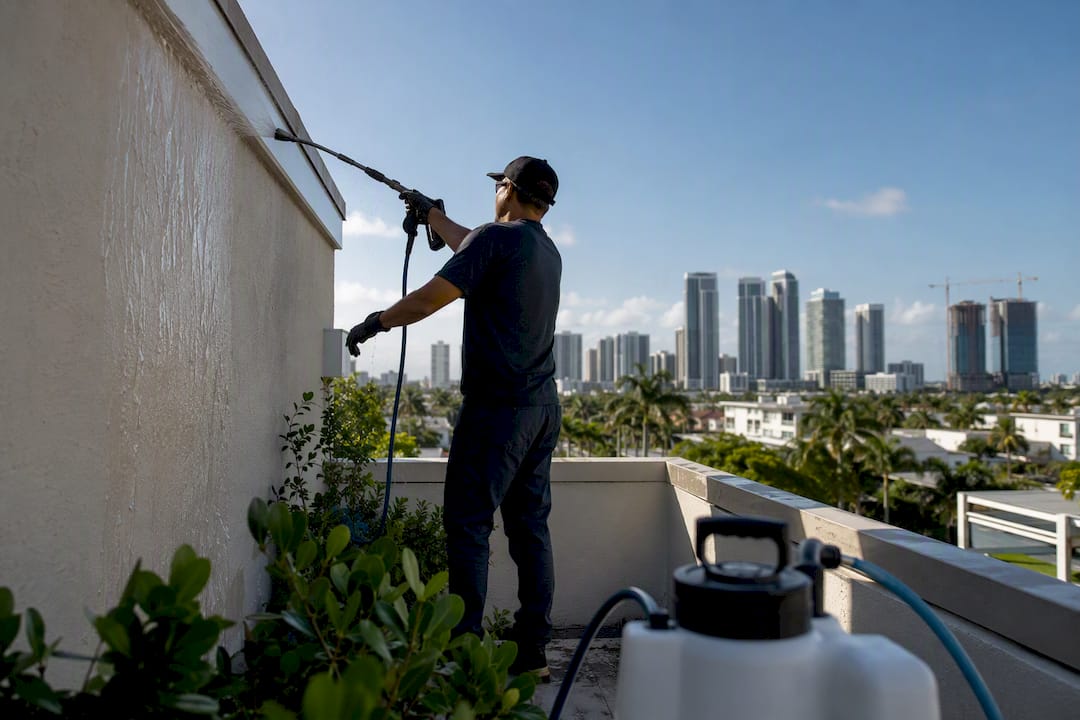
A biodegradable exterior cleaning solution is a cleaning product formulated so its active ingredients break down into water, carbon dioxide, and biomass through natural microbial action, rather than persisting in soil or waterways. The short verdict: these products work well and often match conventional bleach-based cleaners when property managers use professional-grade formulations and correct application methods, particularly on stucco, roofing, and glass in South Florida’s humid, algae-heavy climate.
Two anchors separate a real biodegradable cleaner from a marketing label. The OECD’s ready-biodegradability standard sets lab thresholds a product must clear, and the EPA Safer Choice program screens every intentionally added ingredient for human and environmental safety. Look for both before trusting a bottle’s claims.
- Breaks down through microbial action rather than lingering in soil or canals
- Verified through OECD lab thresholds, not vague “eco” wording on the label
- Backed by EPA Safer Choice as a practical shorthand for vetted formulations
- Performs comparably to bleach-based products when matched to the right substrate and dwell time
Table of Contents
- How Biodegradability Is Actually Measured
- Which Ingredients And Labels Actually Signal a Safer Product?
- Soft Washing Or Pressure Washing: Which Method Fits Your Building?
- What Happens To Runoff, and How Do You Contain It?
- How Do You Choose the Right Product or Contractor?
- Can You Safely DIY a Small Biodegradable Cleaning Job?
- Why Trained Professionals Handle Tall and Commercial Jobs Better
- Where to Verify These Standards Yourself
- What the Research Actually Tells Property Managers
- Get a Biodegradable Soft-Wash Quote for Your Building
- Sources
- FAQ
How Biodegradability Is Actually Measured
“Biodegradable” isn’t a vibe. It’s a lab result. The OECD’s Test No. 301 series defines “ready biodegradability” using two possible pass conditions: removal of dissolved organic carbon (DOC), or conversion to theoretical oxygen demand or carbon dioxide (ThOD/ThCO2). Most test methods require the product to hit that threshold within a specified window inside an observation period.
Statistic Callout: A cleaning product must remove a high proportion of its dissolved organic carbon or convert a substantial fraction of its theoretical oxygen demand to CO2 within a defined timeframe during testing to be called “readily biodegradable” under OECD standards.
That window matters because a product can technically degrade eventually and still fail the “ready” designation if it takes too long. Slow degradation means more time in canals, storm drains, or soil before microbes finish the job, which is exactly the persistence problem biodegradable formulations are supposed to avoid.
The mechanisms behind the label vary by chemistry:
- Enzymes target specific organic bonds in mold, algae, and biofilm, breaking them apart so they lift free of the surface.
- Bio-surfactants reduce surface tension using plant-derived or microbially produced compounds instead of petroleum-based detergents.
- Oxygen-based oxidizers (hydrogen peroxide, sodium percarbonate) release oxygen radicals that bleach out organic staining without leaving chlorine residue.
Lab biodegradability results also flag long-term risk. A surfactant that fails the 301 test may still clean glass or EIFS stucco effectively, but it sticks around in the environment longer, which raises the stakes on containment and runoff control covered later in this guide.
Which Ingredients And Labels Actually Signal a Safer Product?
Not every “green” cleaner on a shelf earns that reputation. Four ingredient classes dominate the biodegradable exterior cleaning space, and each comes with real tradeoffs.
- Enzymes: excellent on organic growth like algae and mildew, but slower acting and less effective on mineral staining or rust.
- Bio-surfactants: gentle on painted surfaces and landscaping, though they often require greater dilution volumes to match a synthetic surfactant’s cleaning power.
- Plant-based solvents (citrus terpenes, seed oil derivatives): strong on grease and sealant residue, but can discolor certain plastics and unsealed wood if overapplied.
- Oxygen bleach/hydrogen peroxide: fast-acting on black streaks and mold, without the chlorine runoff risk of sodium hypochlorite, though it degrades faster once mixed and needs fresher batches.
For verification, the EPA Safer Choice program reviews every intentionally added ingredient in a formula, not just the marketing headline ingredient, and only certifies products that clear its human health and environmental criteria. The USDA BioPreferred program offers a parallel check specifically for biobased content, useful if your HOA or building has a green procurement policy on file.
Pro Tip: If a product page can’t produce a Safety Data Sheet (SDS) or a biodegradability test result on request, treat every “eco-friendly” claim on the label as unverified marketing copy.
Red flags worth walking away from: labels that say “natural” or “green” with no test citation, missing SDS documentation, or ingredient lists that hide behind terms like “proprietary blend.”
Soft Washing Or Pressure Washing: Which Method Fits Your Building?
Soft washing uses low-pressure equipment, usually under 500 PSI, paired with a biodegradable chemical solution that does the actual cleaning work through dwell time rather than mechanical force. Pressure washing relies on high water pressure, often 2,000 to 4,000 PSI, to physically blast contaminants off a surface. The chemistry matters more than the pressure in soft washing, which is why it’s the preferred method for most South Florida exteriors.
- Roof shingles: soft wash only. High pressure strips protective granules and voids most manufacturer warranties.
- Vinyl siding: soft wash preferred; pressure washing can force water behind panels and trap moisture, a real problem in Miami-Dade humidity.
- EIFS and stucco: soft wash required. This is a porous synthetic finish, and high-pressure water drives moisture into the substrate, risking mold growth behind the wall.
- Wood decks: soft wash with enzyme cleaners for algae; light pressure washing only after wood has been sealed and inspected for rot.
- Concrete and pavers: pressure washing works here since the substrate is dense and non-porous, though a biodegradable pre-treatment still cuts chemical volume needed.
Dwell time is the part DIY cleaners rush most often. Enzyme and oxidizer chemistries typically need 5 to 15 minutes of contact time to break down organic staining before rinsing. Rinse too early and you waste the product. Blast with high pressure instead of waiting, and you risk driving contaminants and moisture deeper into stucco or wood rather than removing them. For a side-by-side breakdown of damage risk and cost between the two methods, see this comparison of drone soft-washing and traditional pressure washing.
What Happens To Runoff, and How Do You Contain It?
Biodegradable doesn’t mean harmless in concentrated form. A product that breaks down completely in 10 days can still kill fish or stress landscaping if it hits a canal or storm drain at full strength before it has time to degrade. South Florida’s dense canal network and shallow water tables make this a real operational concern, not a theoretical one.
- Use containment blankets or berms around drains and landscaping before starting any application.
- Pre-wet adjacent plants and hardscape to dilute incidental overspray.
- Apply in the lowest effective volume rather than flooding a surface.
- Follow the SDS-listed dilution ratio exactly. Doubling concentration doesn’t double cleaning power, it doubles runoff risk.
- Check Miami-Dade and Broward County stormwater discharge rules before any job that drains toward a canal, retention pond, or storm inlet.
Pro Tip: Photograph containment setup before and after each job. If a county inspector or HOA board ever questions a runoff incident, that documentation is the difference between a five-minute conversation and a liability claim.
Keeping a simple application log, product used, dilution ratio, date, and containment method, also protects property managers when insurers or building associations ask for proof of due diligence. For regional best practices tailored to canal-adjacent and coastal properties, see this guide on sustainable exterior cleaning in South Florida.
How Do You Choose the Right Product or Contractor?
Before buying a gallon or signing a contract, run through two short checklists.
Product checklist:
- Ask for the OECD biodegradability test result, not just a “biodegradable” claim on the bottle.
- Confirm EPA Safer Choice or USDA BioPreferred certification if compliance documentation matters for your building.
- Verify the chemistry is rated for your specific substrate (glass, stucco, EIFS, metal, tile).
- Request the SDS and dilution instructions before purchase, not after a problem shows up.
Contractor checklist:
- Ask what containment plan they use near drains, canals, and landscaping.
- Ask for specific dilution ratios and dwell times, not a vague “we use eco-friendly products.”
- Confirm the chemistry is matched to your building’s exterior material.
- Verify insurance coverage and applicable certifications.
- Request references or before/after documentation from similar commercial jobs.
Hiring a professional crew that already carries substrate-matched chemistry and containment gear usually costs less over a building’s lifetime than repeated DIY attempts that damage stucco or void a roof warranty; consider specialized job management software for pressure washing services to streamline operations and ensure compliance. This property manager’s guide to exterior cleaning types breaks down substrate-specific considerations in more depth.
Can You Safely DIY a Small Biodegradable Cleaning Job?
Small, ground-level jobs, a patio, a fence line, a single-story wall, are reasonable DIY territory if you follow a tight sequence.
- Read the label and SDS fully before opening the container.
- Test a small, hidden patch first and wait 24 hours to check for discoloration.
- Set up containment around drains, plants, and hardscape edges.
- Mix to the exact labeled dilution. Most enzyme and oxidizer cleaners run in the range of 1:10 to 1:20 (product to water), but the label overrides any general rule.
- Apply with a low-pressure pump sprayer, not a pressure washer wand.
- Let it sit for the labeled dwell time, typically 5 to 15 minutes.
- Rinse at low pressure, directing runoff away from drains, and clean up containment materials immediately.
Wear gloves and eye protection even with plant-based formulas, since concentrated enzymes and oxidizers can still irritate skin. Dispose of unused mixed solution per label instructions rather than pouring it into a storm drain. If the job involves height, a second story, a roofline, or anything requiring a ladder over 10 feet, stop and call a professional. That’s not a DIY-confidence issue. It’s a fall-risk and liability issue.
Why Trained Professionals Handle Tall and Commercial Jobs Better
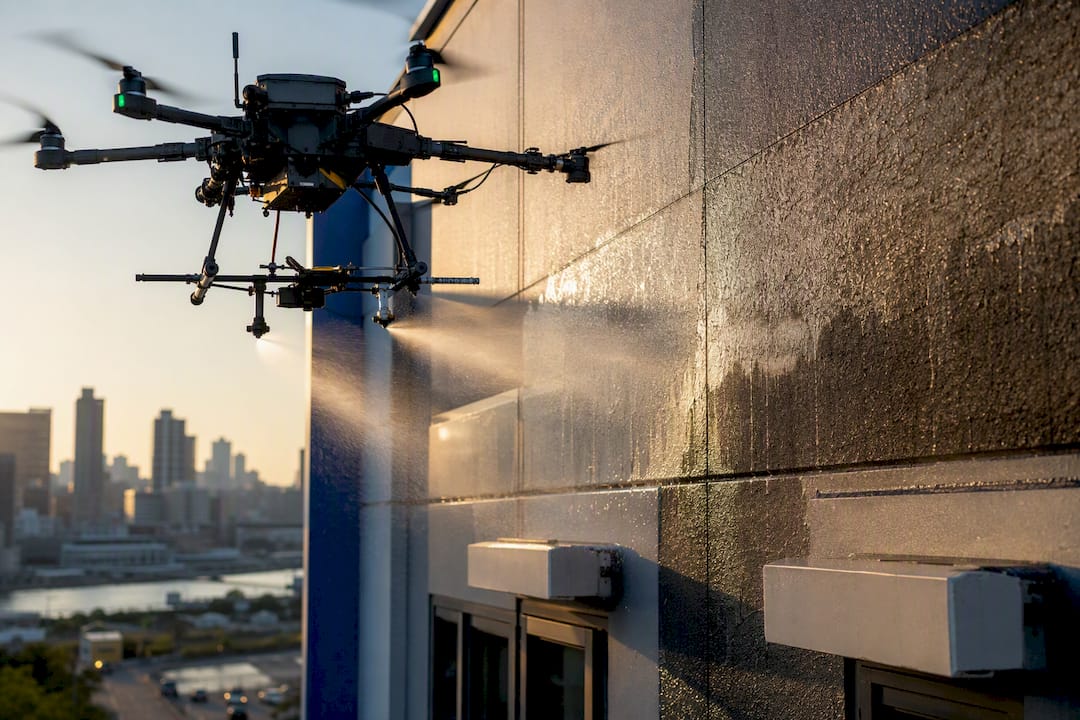
Ground-level DIY works fine for a patio. A twelve-story condo facade in Brickell is a different problem entirely, one where access risk and chemical volume both scale up fast. Vistadronecleaning approaches that gap using FAA Part 107-certified pilots operating tethered industrial drones, Lucid Bots Sherpa units, paired with substrate-matched soft-wash chemistry and a pure de-ionized water rinse for streak-free glass.
- Crews stay on the ground the entire job, eliminating fall risk on structures up to 200 feet tall.
- No scaffolding, boom lifts, road closures, or permits needed for most jobs.
- Chemical volume drops significantly compared to broad-area pressure washing, since drone application targets exactly where it’s needed.
- $2M liability coverage backs every project across Miami-Dade and Broward counties.
Drone-based soft washing lowers the volume of chemistry applied per square foot, keeps physical risk off the building entirely, and gives property managers tighter containment control than a rope-access crew working the same facade by hand.
That combination, less chemical, less human risk at height, more precise targeting, is exactly the profile a runoff-conscious property manager should want on a high-rise contract.
Vistadronecleaning’s substrate-matched approach, paired with OECD-verified biodegradable chemistry, cuts environmental risk while protecting building exteriors from repeated pressure-washing damage over their lifespan.
| Point | Details |
|---|---|
| Definition anchor | A biodegradable exterior cleaner breaks down via microbial action, verified by OECD ready-biodegradability thresholds. |
| Verification shortcut | EPA Safer Choice certification screens every intentionally added ingredient, not just the headline claim. |
| Method matters as much as chemistry | Soft washing with dwell time outperforms high-pressure blasting on porous substrates like stucco and roofing. |
| Containment prevents local harm | Berms, pre-wetting, and correct dilution stop biodegradable products from stressing canals before they break down. |
| Professional option for height | Vistadronecleaning’s drone soft-wash uses FAA Part 107 pilots and de-ionized rinse water to clean tall South Florida buildings with lower chemical volume and no ground-crew fall risk. |
Where to Verify These Standards Yourself
What the Research Actually Tells Property Managers
Most guidance on biodegradable cleaning stops at the ingredient label. That’s the easy part. The harder, more useful truth buried in the OECD and EPA standards is that biodegradability describes what happens eventually, not what happens the moment a chemical hits a canal, a storm drain, or a struggling patch of landscaping. Conventional advice treats “biodegradable” as a safety guarantee. It isn’t. It’s a persistence guarantee, and those are different problems with different mitigation strategies.
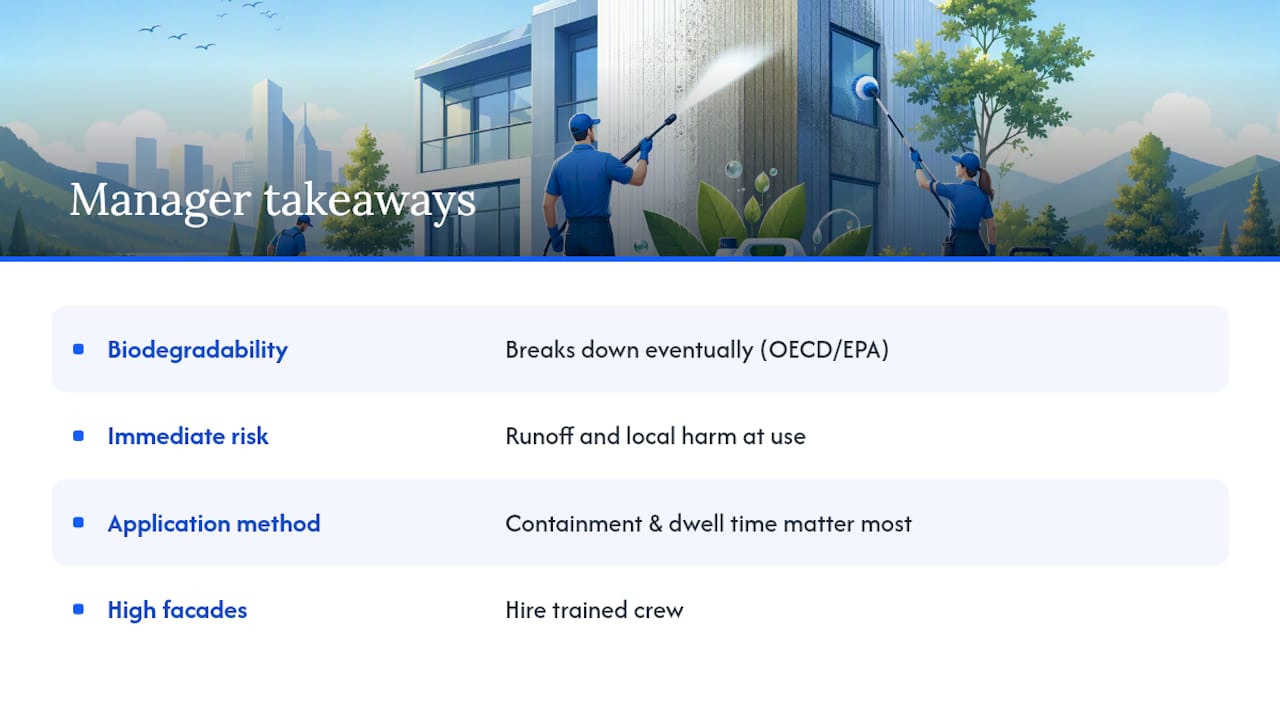
What gets underweighted is application method. A homeowner obsessing over which bottle to buy while blasting stucco with a 3,000 PSI wand is solving the wrong problem. The chemistry barely matters if the method drives water and contaminants into a porous substrate or floods a drain before dilution has a chance to work. Property managers should prioritize containment and dwell time first, ingredient sourcing second.
For anything above ground level or across a commercial facade, the math tips firmly toward hiring a trained crew. The access risk alone changes the calculation, before you even factor in chemical volume control.
Get a Biodegradable Soft-Wash Quote for Your Building
Buying the right bottle solves a patio. It doesn’t solve a twelve-story facade, a tile roof three stories up, or a solar array bolted to a warehouse roof in Fort Lauderdale. That’s where Vistadronecleaning fits: a South Florida-based commercial cleaning service that pairs FAA Part 107-certified drone pilots with substrate-matched, biodegradable soft-wash chemistry, so property managers get OECD-verified cleaning power without scaffolding, lifts, or rope-access crews on the clock.
Most commercial projects wrap in a few days, often at substantially lower cost than traditional scaffold or lift methods, with liability coverage backing every job across Miami-Dade, Broward, and Palm Beach counties. Glass gets a streak-free pure de-ionized water rinse. Facades, roofs, and solar arrays get chemistry matched to the actual material, not a one-size-fits-all bottle from a hardware store shelf. If your building needs professional-grade biodegradable cleaning above the ground floor, compare drone cleaning against traditional window washing and request a free quote within 24 hours.
Sources
- Safer Choice standard and program (EPA)
- Cleaning National Parks: Using Environmentally Preferable Janitorial Products at Yellowstone and Grand Teton National Parks (EPA)
FAQ
What is an eco-friendly exterior cleaner?
An eco-friendly exterior cleaner is a product formulated with biodegradable ingredients, typically verified against OECD ready-biodegradability thresholds, and often certified through programs like EPA Safer Choice to confirm every ingredient meets human and environmental safety standards.
What are biodegradable cleaning products?
Biodegradable cleaning products contain active ingredients, usually enzymes, bio-surfactants, or oxygen-based oxidizers, that break down into water, carbon dioxide, and biomass through microbial action rather than persisting in soil or waterways.
Is there anything better than wet and forget?
Performance depends more on matching the chemistry to your substrate and using correct dwell time than on any single brand name; enzyme and bio-surfactant formulations applied through professional soft-washing consistently outperform passive spray-and-wait products on heavy algae and mold buildup.
What is the best solution for washing exterior building surfaces?
For most South Florida substrates, soft washing with a biodegradable, substrate-matched chemistry outperforms high-pressure washing, since it cleans through dwell time rather than force, protecting stucco, roofing, and painted surfaces from damage. For buildings taller than a couple of stories, Vistadronecleaning’s drone soft-wash method delivers that same chemistry with none of the scaffolding or access risk.
How do biodegradable cleaners actually work on mold and algae?
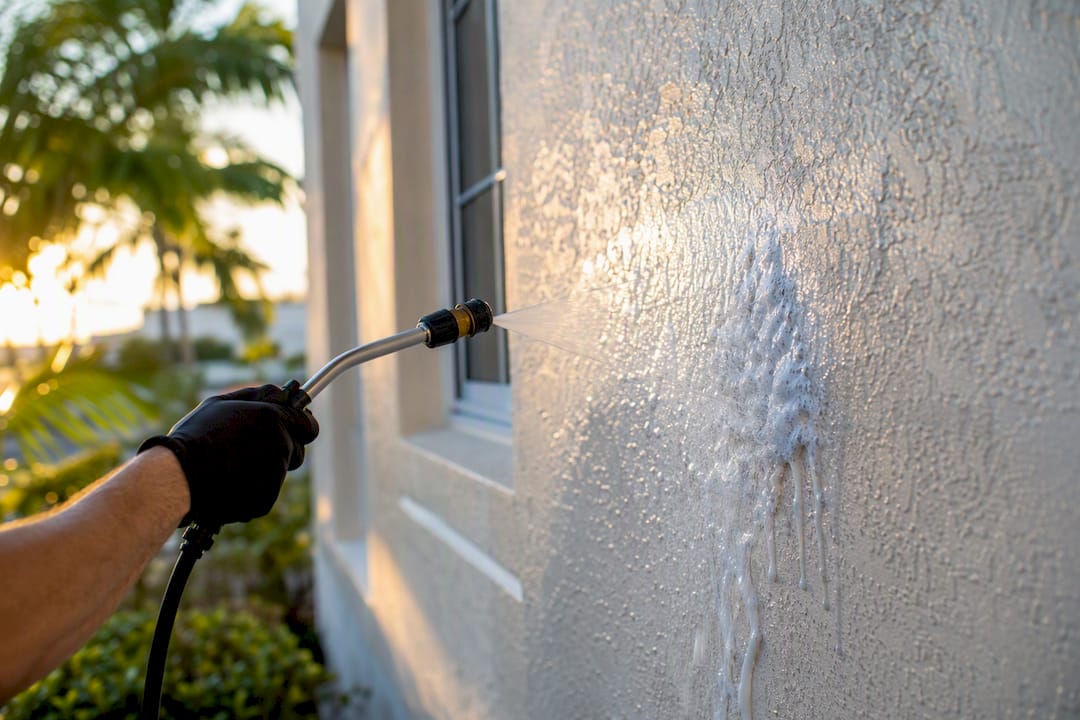
Enzymes break the organic bonds holding mold and algae to a surface, while bio-surfactants lift the loosened residue away, a process that typically needs 5 to 15 minutes of dwell time to work fully before rinsing.