Routine Drone Rinses for South Florida Salt Air Corrosion Cleaning
Turn salt removal into routine maintenance. South Florida managers get a checklist, rinse schedule, and drone rinses to avoid costly repairs.
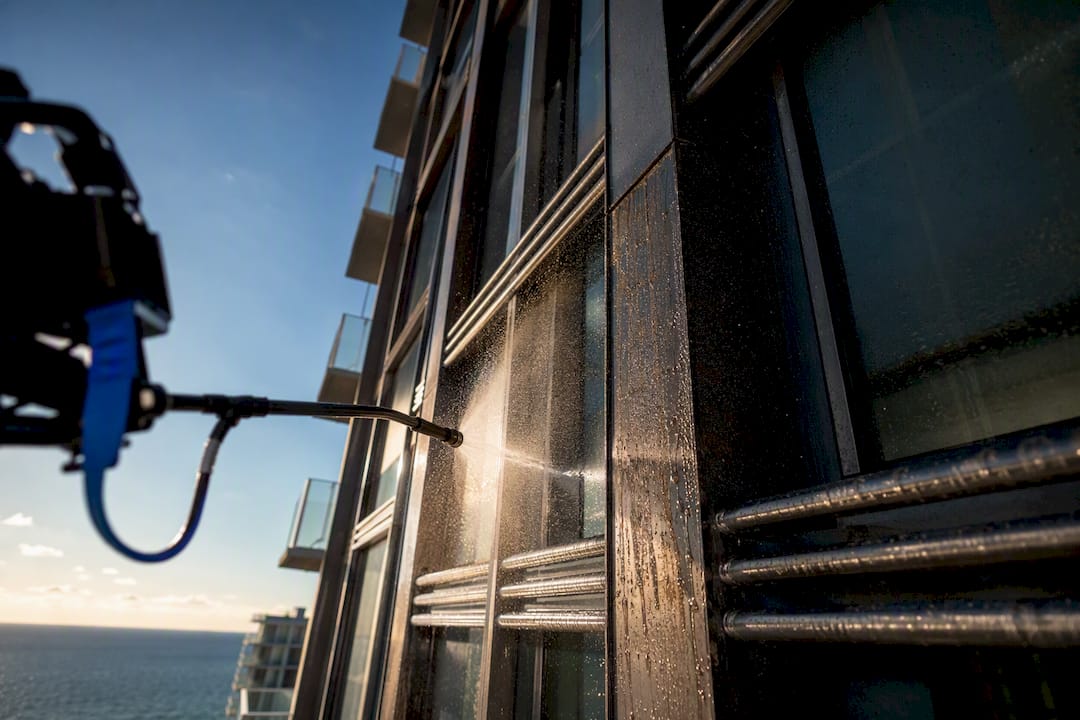
Rinse loose salt off metal, glass, and fasteners with low-pressure fresh or deionized water immediately, before it crystallizes and starts pitting the surface. If corrosion has already formed, mechanically remove the loose rust, neutralize the metal, then protect or replace the hardware with a marine-grade stainless alternative. After that, put every exposed surface on a recurring rinse and inspection schedule instead of waiting for visible damage.
TL; DR:
- Regular rinsing with fresh or deionized water is critical within days of salt exposure to prevent surface crusting and pitting on metal, glass, and fasteners.
- Upgrading to marine-grade stainless steel, especially 316-grade, offers the best long-term resistance for fasteners and structural components exposed to salt air.
- Applying epoxy primers and corrosion-inhibiting coatings can significantly slow salt-induced deterioration but require inspection every one to two years for coastal structures.
- Drone-assisted rinsing provides a cost-effective, safe, and efficient option for high-rise building maintenance, especially for facades, solar panels, and rooftops.
- Routine inspection frequency should be monthly to quarterly for oceanfront properties, with more frequent cleaning and assessment to catch early signs of reinforcement corrosion.
Table of Contents
- How Do You Clean Salt Deposits and Corrosion Off Coastal Buildings?
- Which Materials and Fasteners Actually Hold Up in Salt Air?
- What Coatings and Prevention Methods Actually Slow Salt Damage?
- How Often Should You Inspect for Salt Corrosion?
- When Should You Bring In a Drone Cleaning Crew for Salt Corrosion?
- Why Most Buildings Treat Salt Removal as an Emergency Instead of a Routine
- Get a Salt-Air Maintenance Quote for Your South Florida Property
- Sources
- FAQ
How Do You Clean Salt Deposits and Corrosion Off Coastal Buildings?
Salt air corrosion cleaning works best as a sequence, not a single scrub. Skip a step and you either leave salt behind to keep working or damage a coating that was supposed to protect the surface.
Start with a low-pressure rinse using fresh water or, ideally, deionized water. Deionized water leaves no mineral spotting behind, which matters on glass and solar glass where hard-water residue reads as a second layer of grime. Keep pressure low. A pressure washer aimed too close to caulking, window seals, or EIFS stucco can blow out sealant joints that took years to fail on their own.
From there, the cleaning sequence looks like this:
- Rinse all surfaces with fresh or deionized water to dissolve and carry off surface salt before it dries into a crust.
- Soak or apply detergent. Use a pH-neutral glass cleaner on windows and solar panels; a mild alkaline detergent works on painted metal and stucco.
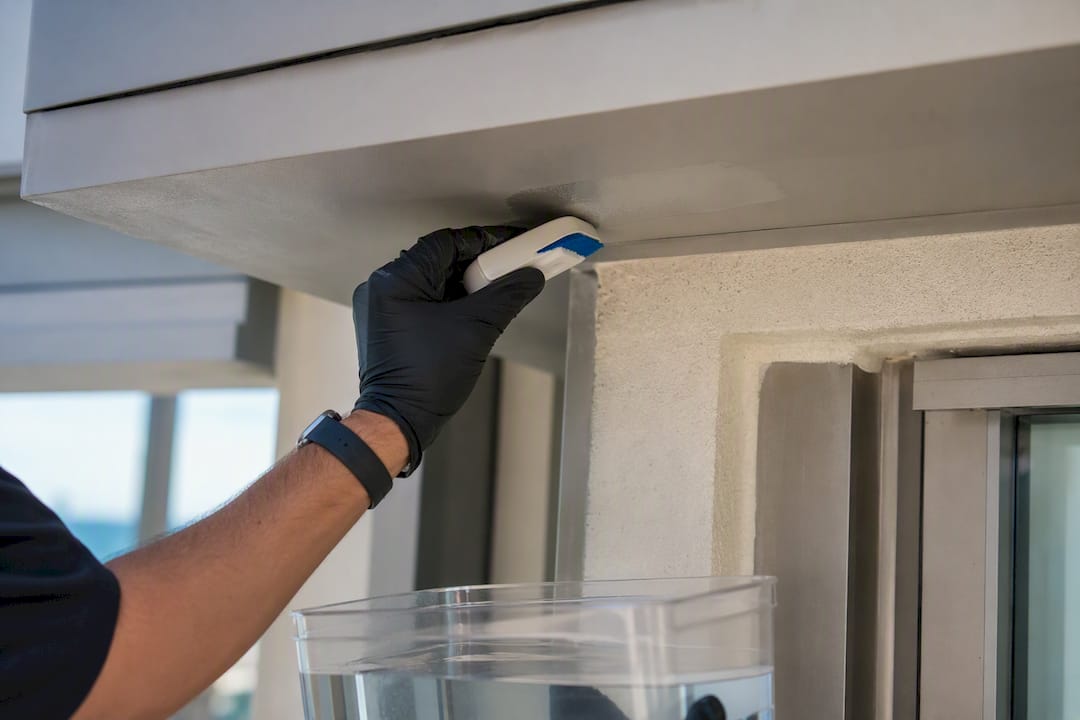
- Mechanically remove residue with a soft brush or non-abrasive pad. Never use steel wool or abrasive pads on glass, low-E coatings, or anodized aluminum.
- Neutralize and rinse again if any acidic or alkaline cleaner touched metal, since leftover residue restarts the corrosion cycle.
- Dry or apply a light protective coat on bare or newly cleaned metal to slow re-oxidation.
For active rust on metal railings, brackets, or fasteners, a wire brush handles light surface rust. Heavier pitting calls for a rust converter that chemically stabilizes what is left before painting. If rust has eaten through more than surface depth, that is no longer a cleaning job. It is a restoration job, and it needs a contractor.
On solar arrays and glass, stick to pH-neutral cleaners and pure water rinses; ammonia-based products can damage anti-reflective and low-E coatings and may void panel warranties outright. Always isolate electrical circuits on solar arrays before any wet cleaning.
Pro Tip: Test any cleaner or converter on a small hidden section first. Coastal buildings often mix substrates on one facade, and what is safe on painted aluminum can discolor an EIFS finish or anodized frame in minutes.
Which Materials and Fasteners Actually Hold Up in Salt Air?
Standard galvanized coatings are not built for oceanfront exposure. The Coastal Construction Manual notes that typical G-90 zinc galvanizing loses its protective layer in about 7 years near the shore, well before the rest of the fastener or bracket is due for replacement.
Stainless steel, specifically 316-grade, is the standard upgrade for coastal exposures because it resists chloride attack far longer than 304 stainless or galvanized alternatives. Use it anywhere metal is exposed directly to salt air: exterior fasteners, railing brackets, curtainwall clips, and rooftop equipment connectors.
If budget forces a phased approach, prioritize in this order:
- Exposed fasteners and screws on facades, railings, and rooftop equipment
- Flashings and drip edges where water pools after rain
- Visible structural connectors on balconies and walkways
- Decorative metal trim and louvers, which corrode more slowly but still stain facades
Upgrading these smaller components to marine-grade stainless delivers a disproportionate return on a coastal building’s lifecycle, since fasteners and connectors fail far more often than the structural members they hold.
Watch for rust staining running down stucco or concrete, hairline cracking near embedded metal, or any spalling concrete. These are signs that reinforcement behind the surface may already be corroding, not just the visible hardware.
What Coatings and Prevention Methods Actually Slow Salt Damage?
Cleaning buys time. Coatings extend it. An epoxy primer under a topcoat gives bare or freshly cleaned metal a real barrier against moisture and chloride penetration, and it holds up better than a single-coat paint job on anything exposed to direct salt spray.
Corrosion-inhibiting coatings work well on railings, structural steel, and rooftop equipment. Clear protective sealants suit glass frames and anodized aluminum where you want to preserve the existing finish rather than repaint it.
Paint alone will not fix advanced corrosion. If pitting has gone through the base metal, or if rust keeps reappearing within months of recoating, the underlying steel needs mechanical restoration or replacement first. Recoating over active corrosion just traps moisture under the new layer and accelerates failure.
- Epoxy primer plus topcoat for structural steel and exposed brackets
- Corrosion-inhibiting spray coatings for HVAC enclosures and rooftop hardware
- Clear sealants for window frames and decorative metal
- Engineered cathodic protection for embedded rebar in oceanfront concrete, when a structural engineer confirms active corrosion
Oceanfront properties generally need recoat inspections every 1 to 2 years; buildings set back from the water can often stretch that to 2 to 3 years.
Pro Tip: If a structural engineer mentions cathodic protection, treat it as a signal the corrosion has moved beyond cosmetic stages. That conversation belongs with a licensed engineer, not a maintenance crew.
How Often Should You Inspect for Salt Corrosion?
Salt exposure does not stop at the waterline. Research on coastal material effects shows salt-laden air remains a measurable risk for several thousand feet inland, with the worst concentration closest to the shore. Florida-specific research puts buildings within roughly 600 feet of the shoreline face meaningfully higher deterioration rates, which is most of Miami Beach, Fort Lauderdale beach, and Boca Raton’s oceanfront corridor.
That distance from the water should set your schedule:
- Oceanfront properties: inspect monthly to quarterly, and clean commercial glass every 60 to 90 days per industry guidance for Florida.
- Near-coast properties (roughly half a mile to a few miles inland): quarterly to biannual inspections are usually enough.
- Each visit should check: fasteners, flashings, sealant joints, glass edges, HVAC enclosure seams, and balcony railing connections.
Rust streaking on a facade is often the first visible sign of deeper reinforcement corrosion, a pattern maintenance groups tracking building envelope failures flag repeatedly. Spalling concrete, delamination, exposed rebar, or full-section metal loss are red flags that require a structural engineer, not a cleaning crew.
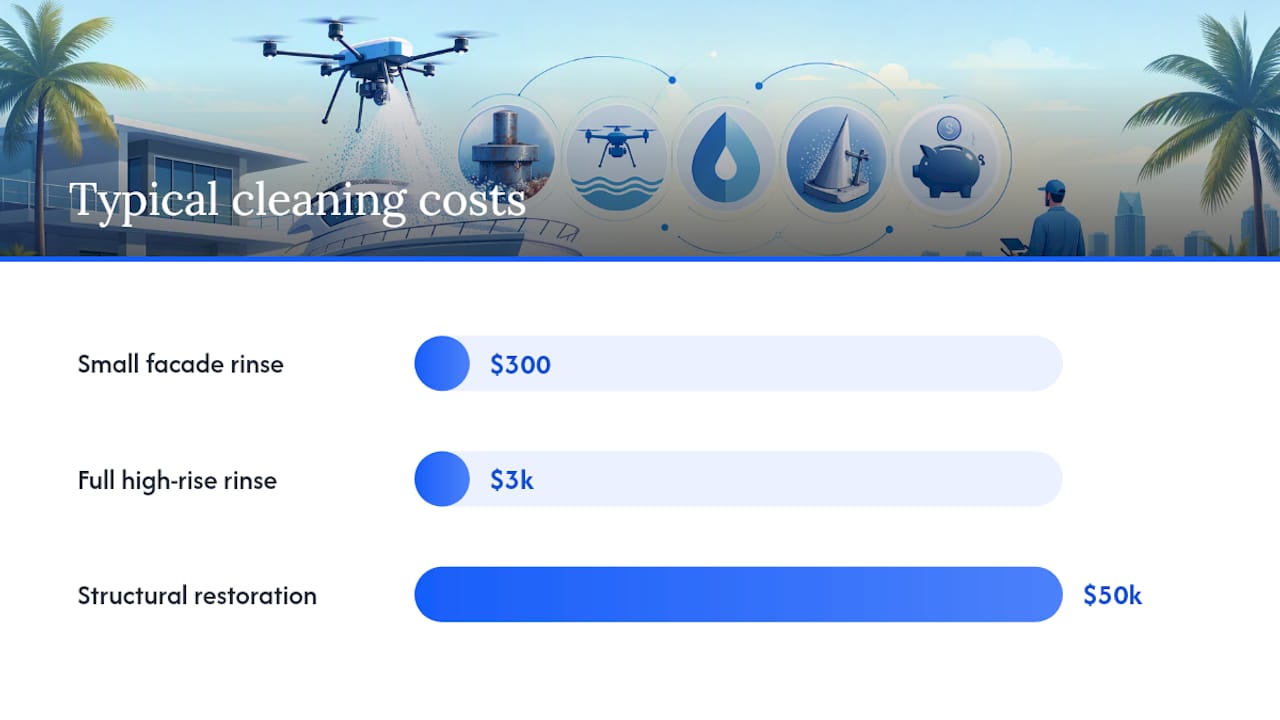
Routine rinsing runs from a few hundred dollars for a small facade to a few thousand for a full high-rise pass. Targeted fastener or bracket replacement is a modest line item; full restoration of corroded structural elements runs into tens of thousands and climbs fast once engineering and permitting are involved.
When Should You Bring In a Drone Cleaning Crew for Salt Corrosion?
Routine salt rinsing on a 15-story oceanfront tower is not a job for a ladder and a hose. Tethered industrial drones reach facades, solar arrays, and rooftop equipment up to 200 feet without scaffolding, boom lifts, or road closures, which matters on buildings where street access is tight, like along Brickell or Fort Lauderdale beach.
Drone-assisted rinsing works well for:
- Recurring salt removal on curtainwall and metal panel facades
- Solar array pure-water rinses that avoid streaking and warranty issues
- Rooftop metal equipment and railings that are otherwise hard to reach safely
Rope access or scaffolding still makes sense for hands-on rust removal, coating application, or any repair requiring direct contact with the surface. As Vista Drone Cleaning’s Eliot puts it, the goal is matching the tool to the task: drones for frequent, ground-controlled rinsing; hands-on crews for repair and restoration.
Why Most Buildings Treat Salt Removal as an Emergency Instead of a Routine
Most property managers only think about salt corrosion after they see rust bleeding down a facade or a board member asks why the railings look worse than last year. That reactive pattern is the real failure, not any single cleaning method.
The research is consistent on this point: rust streaking is usually a lagging indicator, not an early one. By the time it is visible, chloride has likely been working on embedded metal for a while. Waiting for visible damage before scheduling a rinse is like waiting for a check engine light instead of changing the oil.
The fix is not more aggressive cleaning. It is a boring, recurring schedule that matches your distance from the water, paired with smart material upgrades where they matter most: fasteners, flashings, and connectors, not entire facades. Spend the budget on 316 stainless hardware and a rinse calendar before spending it on emergency restoration. One of those costs hundreds of dollars a quarter. The other costs tens of thousands once concrete starts spalling.
, Eliot
Get a Salt-Air Maintenance Quote for Your South Florida Property
If your maintenance team is stretched between scaffolding logistics and a growing punch list, drone-assisted rinsing solves the access problem outright. A commercial drone cleaning service uses FAA Part 107 certified pilots and tethered drones to clean high-rise windows, facades, roofs, and solar arrays up to 200 feet tall, without scaffolding, boom lifts, or rope crews, in the South Florida region.

Crews operate safely from the ground, projects typically wrap in 1 to 3 days, and every job uses pure de-ionized water rinses for streak-free glass and panels, supported by liability insurance.
To get an accurate quote, have your building height, total facade or panel area, and service priorities ready (windows, facade, roof, or solar). Request a free quote for drone window cleaning in Miami and get a response within 24 hours.
Sources
- Coastal Construction Manual (corrosion guidance)
- Board members: be proactive, maintain your buildings’ exterior systems (FCAP)
- USGS: salt and coastal material effects
- Commercial glass cleaning and maintenance in Florida (ACG)
FAQ
What Removes Salt Corrosion From Metal?
A wire brush or abrasive pad removes loose surface rust, followed by a rust converter to stabilize remaining corrosion before repainting or applying a corrosion-inhibiting coating. Deep pitting or structural section loss requires mechanical restoration, not surface treatment.
Does Vinegar Dissolve Salt Buildup?
Vinegar can help dissolve light salt residue on some surfaces because it is mildly acidic, but it is not recommended for painted metal, stainless steel, or glass, since the acid can etch coatings and accelerate corrosion on exposed metal. Pure water rinses and pH-neutral cleaners are the safer default.
Will Vinegar Dissolve Corrosion?
Vinegar can loosen light rust on some metals but is too weak and unpredictable for structural corrosion, and its acidity risks damaging coatings, sealants, and anodized finishes. A proper rust converter or professional mechanical removal is more reliable for anything beyond surface staining.
How Long Does It Take for Salt to Corrode Metal?
It depends on distance from the shoreline and metal type. Unprotected fasteners near the water can show measurable corrosion within a year, while standard galvanized coatings often lose their protective zinc layer in roughly 7 years under coastal exposure, well before 316 stainless shows comparable wear.
How Often Should Coastal Buildings Rinse Salt Off Their Facades?
Oceanfront properties should rinse and inspect monthly to quarterly, with commercial glass cleaned every 60 to 90 days. Near-coast buildings can typically stretch to quarterly or biannual service.