
Predictive Maintenance with Drones: Miami's 2026 Guide
Discover how predictive maintenance with drones in Miami helps property managers prevent costly repairs, ensuring building safety and compliance.
TL; DR:
- Drone-based predictive maintenance enables Miami property managers to detect facade issues early using FAA-registered drones. It supports compliance with SB 4D laws, reduces repair costs, and provides data for better budgeting and engineering assessments. Regular drone inspections are essential in Miami’s harsh coastal environment to prevent significant structural damage.
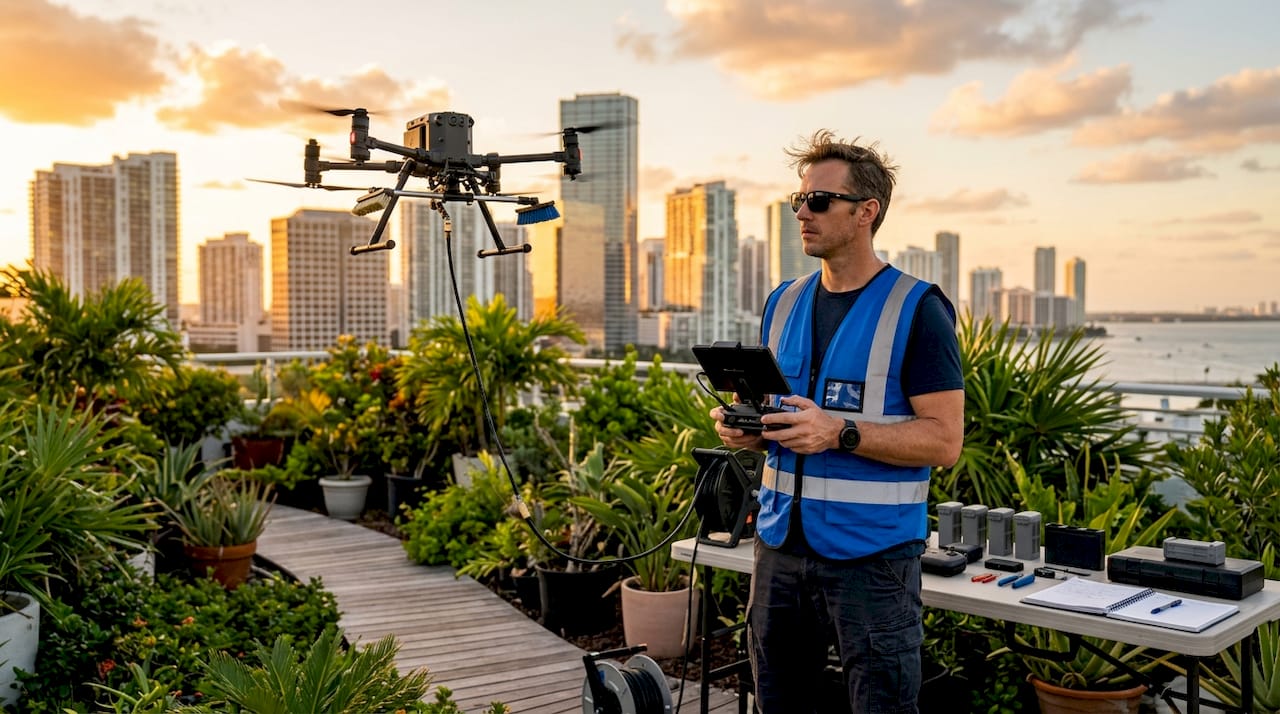
Drone-based predictive maintenance is the most practical tool Miami property managers have for staying ahead of building deterioration. It means scheduling regular aerial visual and thermal inspections using FAA Part 107-certified drones to catch cracks, moisture intrusion, and facade failures before they become emergencies. Florida’s SB 4D law makes this especially relevant: milestone inspections are now mandatory for condo buildings three stories or taller at 30 years of age, or 25 years if within 3 miles of the coastline. Drone documentation accelerates the engineer’s assessment without replacing it.
Core advantages for Miami property managers:
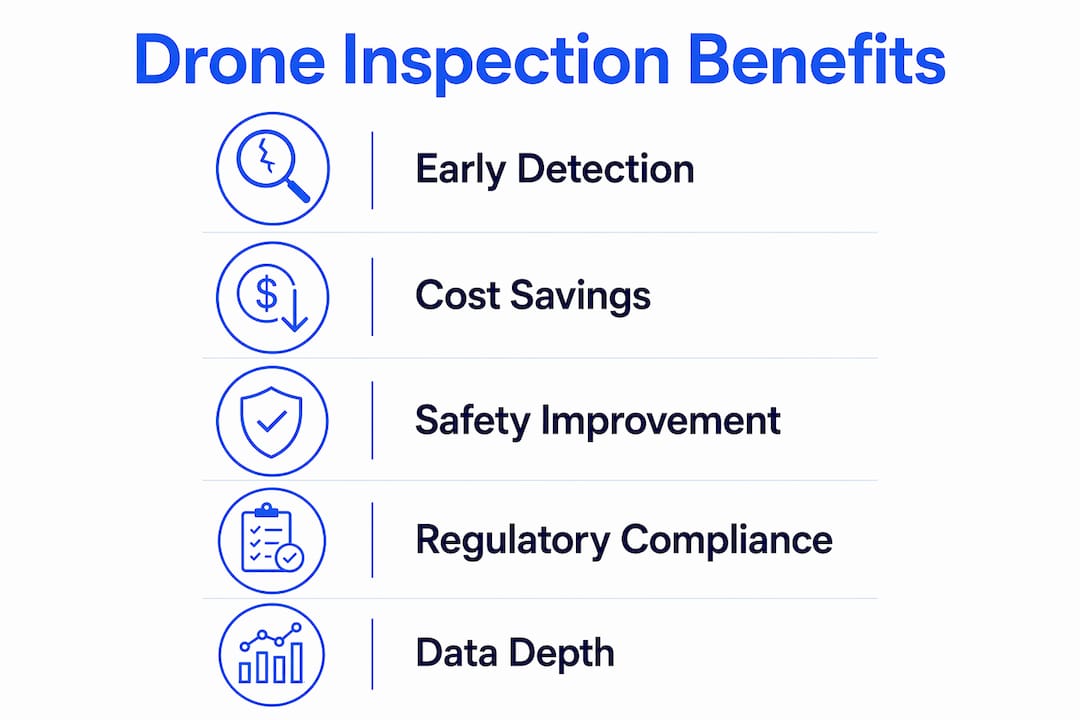
- Early detection of spalling concrete, cracked stucco, and sealant failures
- Thermal imaging reveals moisture intrusion invisible to the naked eye
- Supports SB 4D milestone inspection evidence requirements
- Eliminates scaffolding and boom lifts for exterior assessments
- Creates a permanent visual baseline for year-over-year comparisons
Vistadronecleaning operates FAA Part 107-certified, fully insured tethered industrial drones across Miami-Dade and Broward counties, serving high-rises, condominiums, hotels, and office towers up to 200 feet tall.
How regulatory compliance shapes drone inspections in Miami
FAA Part 107 sets the operational floor for every commercial drone flight in Florida. Pilots must hold a Remote Pilot Certificate, register each aircraft, maintain a 400-foot altitude ceiling, and comply with Remote ID broadcasting requirements effective since September 2023. Miami Beach restricts drone flights during major public events, and operators near Miami International Airport must obtain LAANC airspace authorization before flying.
Florida Statute section 330.41 preempts most local airspace ordinances but adds specific protections around critical infrastructure. Using a non-certified provider is not just a paperwork problem. Many commercial drone insurance policies in Florida include compliance clauses that void coverage if the pilot lacked proper certification at the time of the incident.
Compliance checklist for property managers selecting a drone provider:
- Verified FAA Part 107 Remote Pilot Certificate
- Current drone registration and Remote ID compliance
- LAANC authorization for controlled airspace near Miami airports
- Minimum $2M liability insurance coverage
- Documented flight records for every operation
Why Miami’s climate makes drone inspections a necessity
Salt air, humidity above 70% for much of the year, intense UV radiation, and annual hurricane exposure combine to degrade building exteriors in Miami-Dade and Broward faster than almost anywhere else in the country. Concrete spalling, corroded rebar, and stucco delamination often begin behind the surface, where a ground-level walk-around misses them entirely.
Thermal drone inspections detect moisture intrusion, insulation breakdown, and roof leaks that are invisible to the naked eye, often preventing six-figure repair bills. Scheduling a flight within 48 hours after a major storm is one of the highest-value uses of the technology. Trapped moisture caught early can be dried out; moisture discovered six months later has usually produced mold and structural damage.
Environmental stressors that drone inspections address directly:
- Salt air corrosion on metal flashings, railings, and window frames
- UV-driven sealant degradation on balconies and curtain walls
- Hurricane-driven water infiltration through facade gaps
- Humidity-induced mold growth behind cladding systems
Key benefits of drone-based predictive maintenance for Miami buildings
Drone inspections deliver a measurable shift in how property managers budget and plan. Instead of reacting to visible failures, you get a data-driven picture of the entire building exterior before problems escalate. Drone documentation prior to a licensed engineer’s site visit reduces on-site examination time and may lower the overall cost of the engineering inspection by making the physical review more targeted.
A thermal baseline established over multiple inspection cycles transforms sporadic emergency repairs into forecastable annual expenses. Without that baseline, an aging Miami high-rise can face a facade restoration costing millions in deferred-maintenance dollars. With consistent monitoring, owners spread those costs over time in a controlled way.
Operational advantages at a glance:
- No scaffolding, road closures, or rigging required
- Multi-angle, high-resolution imagery of every facade face and roof surface
- AI-powered defect detection flags priority zones for engineer review
- PE-certified engineering reports support SB 4D and reserve study requirements
- Predictable annual maintenance budgets replace surprise capital calls
Best practices for implementing a drone inspection program
Start drone documentation two to three years before a building’s milestone inspection deadline. That lead time gives engineers a comparison baseline and gives the association time to fund and schedule any required remediation before the deadline creates urgency.
Annual inspections work well for stable, recently restored buildings. Coastal properties in Brickell, Miami Beach, or Fort Lauderdale benefit from semi-annual flights, with an additional post-storm deployment after any named storm. Integrate the drone data with your existing maintenance management system so repair orders, cost tracking, and inspection records live in one place.
Pro Tip: Schedule your first thermal inspection immediately after a major facade restoration. That post-restoration baseline is the most accurate reference point you will ever have for tracking future deterioration.
- Select only FAA Part 107-certified, fully insured providers with Miami operational history
- Coordinate drone flights before the engineer’s site visit, not after
- Retain GPS-tagged, timestamped imagery in the association’s permanent files
- Use thermal scans before major repairs to locate hidden moisture and avoid cosmetic-only fixes
- Confirm deliverables include annotated PDF reports organized by building face
What drone hardware and sensors work best for Miami high-rises
Industrial tethered drones equipped with high-resolution RGB cameras and thermal sensors are the preferred configuration for Miami’s high-rise facade and roof inspections. A mechanical shutter camera, such as the 4/3 CMOS sensor on the DJI Mavic 3 Enterprise, eliminates rolling-shutter distortion and produces imagery sharp enough for engineering assessments. Thermal sensors operating in the 8–14 micrometer wavelength range detect temperature differentials that indicate moisture pockets and insulation gaps.
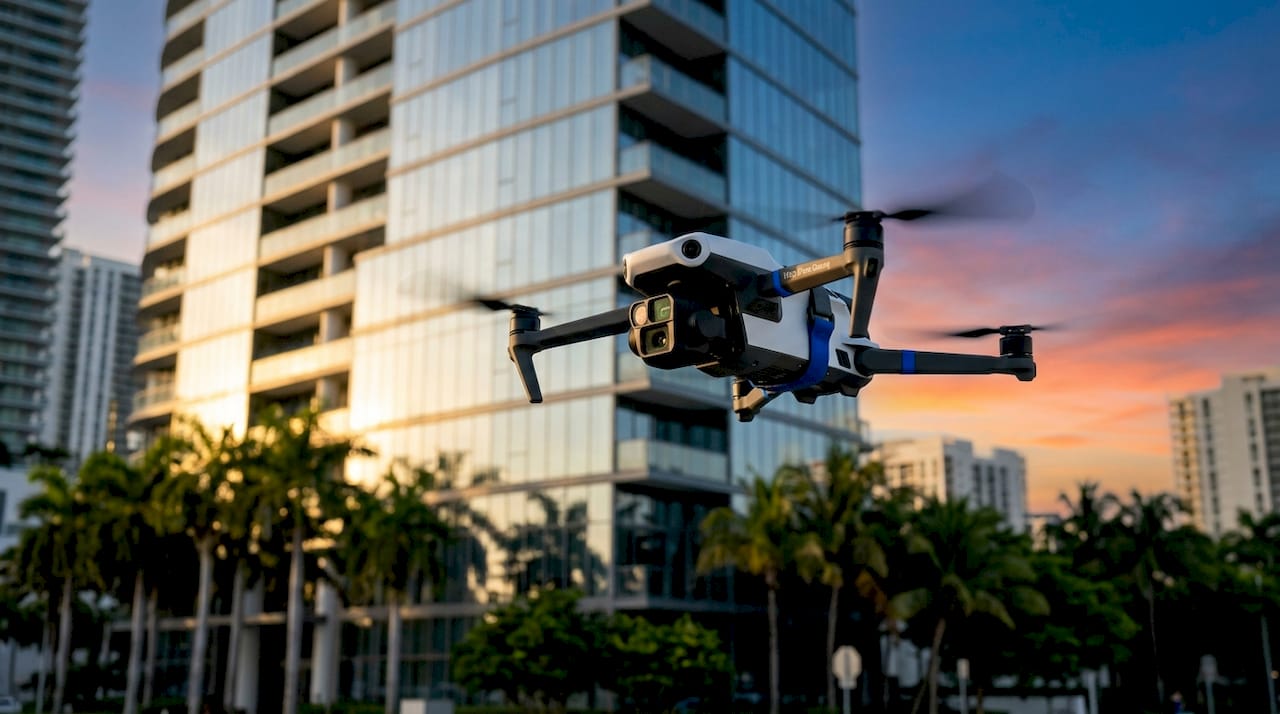
Tethered configurations matter in Miami’s coastal wind environment. A tethered drone maintains a stable hover even in gusty conditions, which is critical when capturing precise imagery at 150–200 feet on a building face. Vistadronecleaning uses Lucid Bots Sherpa tethered industrial drones, keeping crews safely on the ground while the aircraft covers every facade angle.
Sensor and equipment priorities for South Florida inspections:
- High-resolution RGB camera with mechanical shutter for engineering-grade imagery
- Thermal sensor for moisture, insulation, and roof leak detection
- Tethered configuration for stability in coastal wind conditions
- GPS tagging and timestamping on every captured frame
- AI-powered defect detection integrated into post-flight reporting
Real-world examples from South Florida properties
A Brickell condominium association approaching its 25-year coastal milestone deadline used drone documentation to give its structural engineer a complete visual record of all four building faces before the site visit. The engineer identified three areas of concern from the aerial imagery in advance, arrived on site with a focused examination plan, and completed the Phase 1 inspection in roughly half the time a traditional scaffolding-based survey would have required.
A Fort Lauderdale office tower scheduled a post-hurricane thermal flight after a Category 1 storm passed through Broward County. The scan revealed moisture intrusion behind a section of the east facade that showed no visible exterior damage. Catching it within 72 hours allowed the property manager to dry out the assembly before mold established, avoiding a remediation project that would have disrupted two floors of tenants.
What drone inspections actually cost and what they return
Drone documentation for a single mid-rise building typically starts at $500, with pricing varying based on height, footprint, and proximity to controlled airspace. Multi-building condo communities receive package pricing that reflects the efficiency of documenting several structures in one site visit. On-site flight time for a single building runs 30–90 minutes, with deliverables processed and delivered within 48 hours.
The return on that investment is most visible when compared against the alternative. Emergency facade repairs can easily cost in the six figures, and deferred maintenance on large high-rises may require multi-million-dollar restorations. Annual drone inspection costs are a fraction of one emergency repair, and the data they produce supports reserve studies, insurance claims, and SB 4D compliance simultaneously.
Certification and training requirements for drone operators
Every commercial drone operator in Florida must hold an FAA Remote Pilot Certificate earned by passing the Unmanned Aircraft General Small knowledge test. Registration is required for any drone weighing 0.55 pounds or more, and Remote ID broadcasting has been mandatory since September 2023. Operators flying near Miami’s Class B and Class C airspace must obtain LAANC authorization before each flight.
Beyond the federal baseline, operators conducting building inspections benefit from training in thermal imaging interpretation, photogrammetry, and structural defect identification. Reading a thermal image correctly requires understanding heat transfer patterns in concrete, stucco, and glass curtain wall systems. A pilot who can fly but cannot interpret the data produces imagery that an engineer still has to decode from scratch.
Common challenges drone operators face in Miami’s urban environment
Dense urban airspace is the first obstacle. Miami’s skyline sits under Class B airspace, and Brickell, Downtown, and Miami Beach all require LAANC authorization for flights above 400 feet or in controlled zones. Operators who skip this step face FAA enforcement and void their insurance coverage simultaneously.
Wind is the second challenge. Afternoon sea breezes along the Biscayne Bay corridor regularly exceed 15 mph, which degrades image sharpness on lighter consumer drones. Scheduling flights in the morning, before the sea breeze develops, and using tethered or heavier industrial platforms solves most of this. Coastal salt spray also accelerates sensor degradation, so operators working regularly in Miami-Dade need a maintenance schedule for their equipment that matches the environment.
Practical solutions for Miami-specific obstacles:
- Obtain LAANC authorization before every flight in controlled airspace
- Schedule flights in early morning to avoid afternoon sea breezes
- Use tethered industrial drones for stable hover in gusty coastal conditions
- Maintain sensor cleaning and calibration schedules suited to salt-air exposure
- Coordinate with building management to clear rooftop access and notify tenants
Vistadronecleaning provides FAA Part 107-certified drone facade inspections and exterior cleaning for commercial properties across Miami-Dade and Broward counties. Our tethered Lucid Bots Sherpa drones reach facades up to 200 feet with no scaffolding, no road closures, and no crew at height. Projects typically complete in 1–3 days at 30–60% lower cost than traditional lift methods, backed by $2M liability insurance.
Request a free quote within 24 hours and get a scope tailored to your building’s height, footprint, and inspection timeline.
Key Takeaways
Drone-based predictive maintenance in Miami combines FAA Part 107 compliance, thermal imaging, and multi-year visual baselines to convert reactive emergency repairs into predictable, budgeted maintenance programs.
| Point | Details |
|---|---|
| SB 4D compliance | Florida requires milestone inspections at 30 years (25 years coastal); drone documentation accelerates the engineer’s assessment. |
| Thermal imaging value | Thermal scans detect moisture intrusion and insulation failures invisible to the naked eye, preventing six-figure repair bills. |
| Inspection cost baseline | Single-building drone documentation typically starts at $500, with deliverables within 48 hours. |
| Start early | Begin drone documentation two to three years before a milestone deadline to allow time for remediation. |
| Provider requirements | Verify FAA Part 107 certification, Remote ID compliance, LAANC authorization, and minimum $2M liability insurance. |
FAQ
What is predictive maintenance with drones in Miami?
It is a program of scheduled aerial visual and thermal inspections using FAA Part 107-certified drones to detect building defects early, before they require emergency repairs. Miami’s coastal climate and SB 4D milestone inspection law make it a practical necessity for most commercial and condominium properties.
Does drone documentation replace a licensed engineer’s inspection under Florida SB 4D?
No. Drone imagery provides a comprehensive exterior visual record that helps the engineer identify areas of concern and focus the physical examination, but the structural assessment and professional judgment must come from a licensed engineer or architect.
How often should Miami buildings schedule drone inspections?
Stable buildings benefit from annual inspections; coastal properties in areas like Brickell or Miami Beach should schedule semi-annual flights, plus a post-storm deployment after any named storm to catch trapped moisture before mold develops.
What airspace rules apply to drone inspections in Miami?
Operators must hold an FAA Remote Pilot Certificate, register the drone, comply with Remote ID requirements, and obtain LAANC authorization for flights in Miami’s Class B and Class C controlled airspace zones.
How much does a drone building inspection cost in South Florida?
Single-building drone documentation typically starts at $500, varying by building height, footprint, and airspace complexity, with deliverables processed within 48 hours of the flight.