Miami Drone Washing for High-Rise Buildings: 2026 Guide
Discover the benefits of Miami drone washing for high-rise buildings in our 2026 guide. Cut cleaning time and improve safety today!
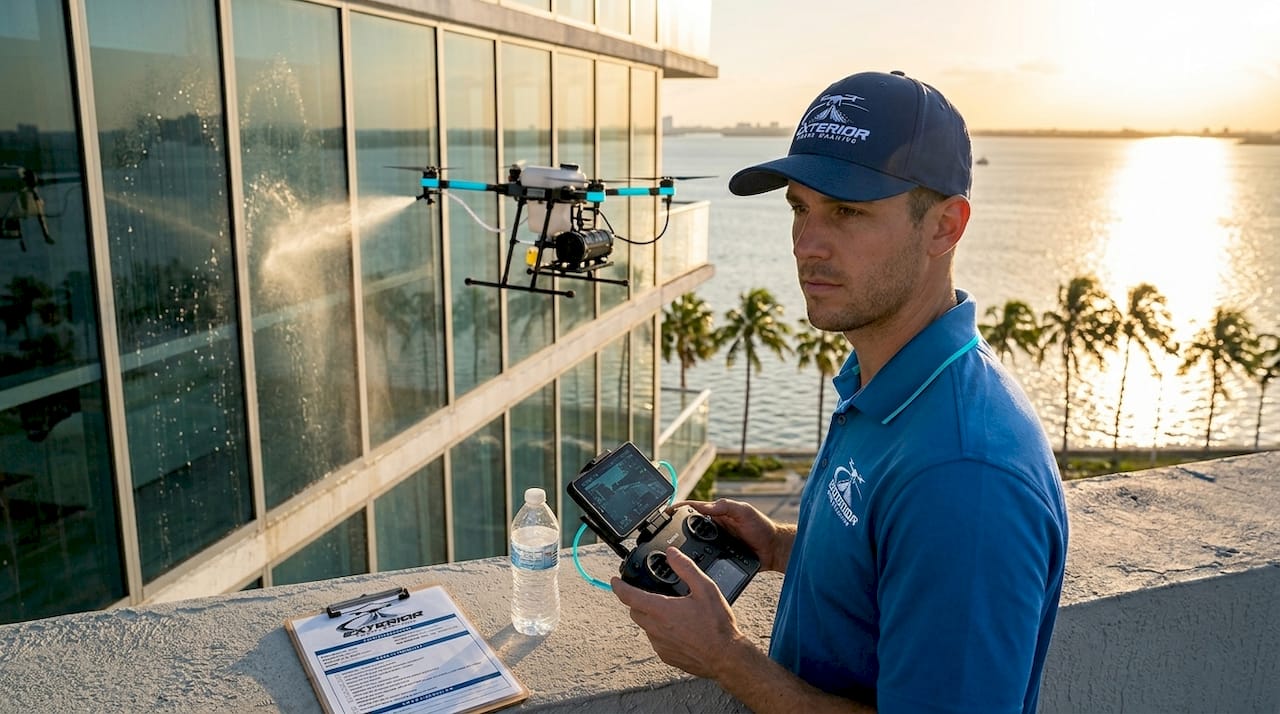
Miami property managers deal with high costs and slow timelines for high-rise exterior cleaning. Scaffolding permits add weeks to projects, rope-access introduces liability, and mechanical lifts block pedestrians. Aerial drone cleaning shifts the economics. This guide covers how to evaluate vendors, stay compliant, and integrate drone washing into your maintenance program.
Table of Contents
- Key takeaways
- How Miami drone washing technology actually works
- Regulatory and safety compliance in Miami
- Drone washing vs. traditional cleaning methods
- Best practices for managing drone washing projects
- Emerging technology trends shaping the industry
- My honest take on drone washing in Miami
- Take the next step with professional drone cleaning
- FAQ
Key takeaways
| Point | Details |
|---|---|
| Drone washing cuts project time | Clean most facade projects in a single day, versus multiple days for scaffolding. |
| Compliance is mandatory | Vendors must hold FAA Part 107 certification and comply with Miami Code § 37-12. |
| Water purity drives quality | RO/DI systems maintaining 0 TDS ensure spot-free results. |
| Cost savings reach 30–60% | Eliminate scaffolding rentals, permits, and large crews to reduce total costs. |
| Documentation protects contracts | GPS flight logs and 4K video provide proof of quality and coverage. |
How Miami drone washing technology actually works
Industrial-grade multirotor drones carry pump systems and custom nozzles, tethered to ground-based water supplies. This setup cleans surfaces at heights up to 200 feet.
- Pre-flight assessment. The crew surveys the facade to log surface types and contamination levels like salt residue and mold. This data informs the flight path.
- 3D flight path planning. Operators use LiDAR to map facades. The drone follows GPS-stabilized routes to keep the nozzle at a consistent distance from the surface.
- Water purification. On-site RO/DI filtration reduces dissolved solids to 0 TDS. This prevents the white mineral spots often left by tap water.
- Cleaning and monitoring. A certified pilot manages the flight via live video feed, supported by a ground spotter. Autonomous flight paths allow for precise coverage even in typical breezes.
- Post-job inspection. High-resolution video recorded during the wash provides a permanent record of the work.
Miami’s salt air and humidity accelerate biofilm growth on glass and concrete. Drone facade cleaning removes these contaminants quickly without the downtime of traditional methods.
Pro Tip: Ask to see water quality logs. TDS readings above 10 indicate exhausted DI resin, which will leave spots on your windows.
Regulatory and safety compliance in Miami
Compliance failures can halt a job or expose property owners to liability. Every vendor must provide:
- FAA Part 107 certification. All commercial pilots must hold an active FAA certificate. Verify the certificate number in the FAA DroneZone registry.
- Miami Code § 37-12. This ordinance bans drone flights within a half-mile of major arenas during events. Near Kaseya Center or Hard Rock Stadium, event schedules dictate project timing.
- FAA Section 927 waivers. For buildings near MIA or Miami Executive Airport, vendors need airspace authorization. These waivers can take weeks to process.
- Insurance. Operators should carry at least $1 million in general liability coverage and name your property as an additional insured.
- Site safety plan. Professional vendors provide written plans covering exclusion zones, pedestrian barriers, and emergency abort protocols.
Pro Tip: Review the compliance package two weeks before mobilization to avoid last-minute delays.
Drone washing vs. traditional cleaning methods
Scaffolding involves weeks of mobilization and significant tenant disruption. The comparison is direct.
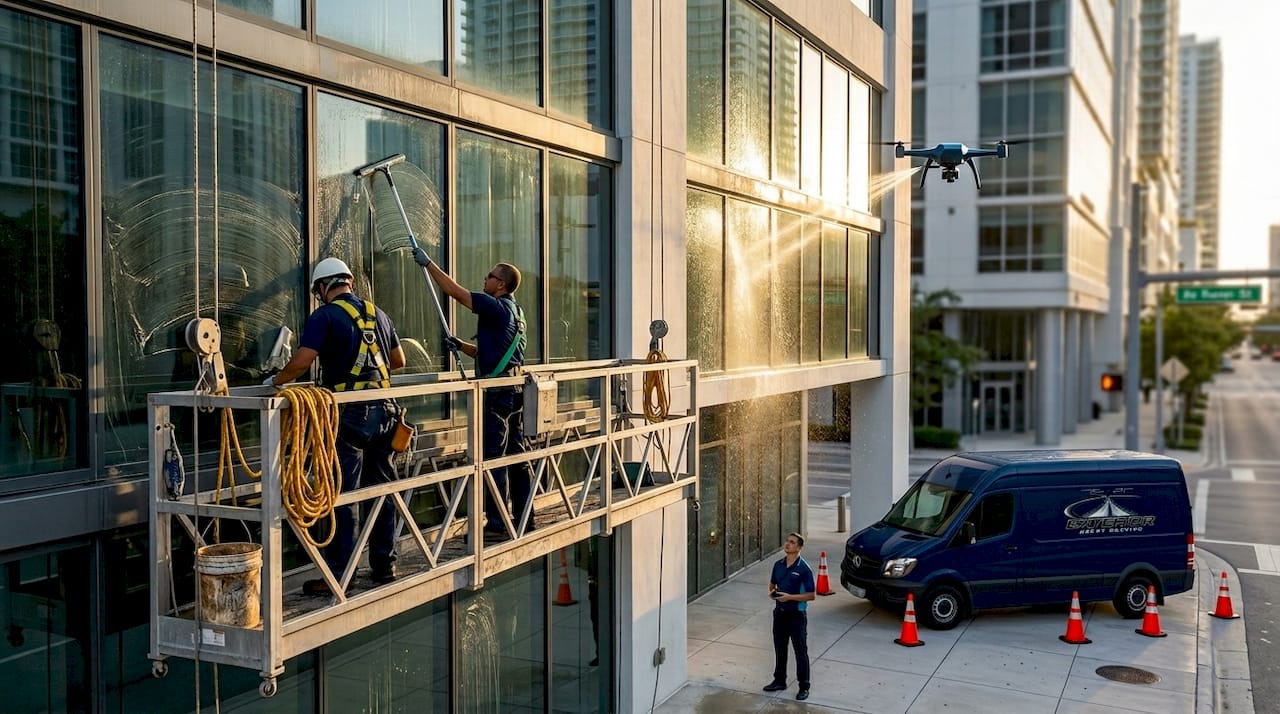
Swing stage scaffolding requires structural anchor certification and often blocks balconies. Personnel lifts are limited to lower floors and curved facades. Rope-access technicians face higher safety risks and require expensive insurance. Drone cleaning removes the worker-at-height variable, reducing fall liability for the building owner.
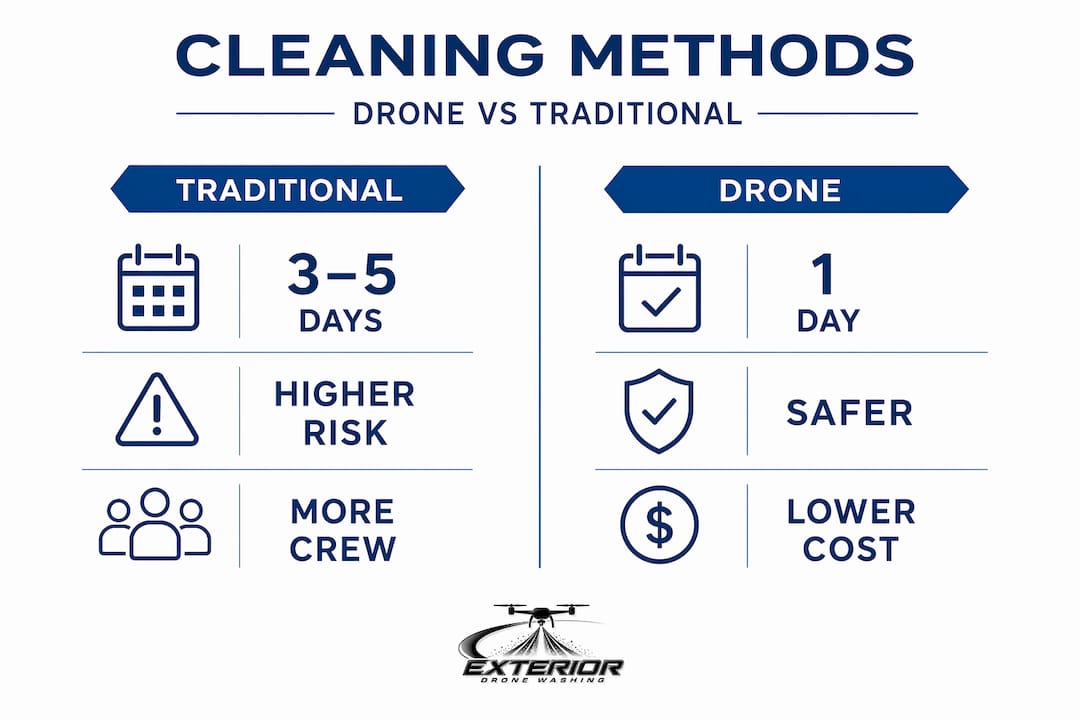
| Factor | Traditional methods | Drone washing |
|---|---|---|
| Project duration | 3–5 days (scaffolding) | 1 day for most towers |
| Worker-at-height risk | High | None |
| Permit and setup time | Days to weeks | Same day mobilization |
| Cleaning consistency | Manual/Variable | GPS-stabilized/Uniform |
| Cost savings | Baseline | 30–60% lower |
| Documentation | Crew report | Full video record |
| Tenant disruption | High | Minimal |
GPS tracking ensures the drone hits every square inch with uniform pressure. This repeatability is a major advantage for glass curtain walls where manual cleaning often leaves streaks or missed spots.
Best practices for managing drone washing projects
Use this framework to keep projects on track:
- Pre-project audit. Photograph current facade conditions to create a baseline.
- Tenant notification. Give 48-hour notice. While drone washing is quiet, visuals near windows can surprise residents.
- Runoff control. Ensure the vendor uses biodegradable solutions and follows Miami stormwater containment protocols. Specialist window washers include this in their standard setup.
- Exclusion zones. Assign pedestrian management in the contract. For Brickell or Downtown properties, this involves barrier deployment and security coordination.
- Video sign-off. Review the inspection footage before payment. Any streaking should be addressed immediately via a warranty visit.
Miami’s climate requires frequent maintenance. Biofilm returns in 3–6 months on south-facing or bay-facing facades. Plan for semi-annual cleaning to prevent permanent staining.
Pro Tip: Schedule work between 7 and 10 a.m. during the dry season to avoid afternoon storms and higher winds.
Emerging technology trends shaping the industry
- Autonomous AI cleaning. Systems use 3D building models to execute routes with minimal pilot input, increasing efficiency.
- Predictive maintenance. Connecting cleaning data to facility management software helps owners predict when a facade will reach a visible level of contamination.
- Resource efficiency. Tethered systems use less water than traditional pressure washing, supporting LEED and WELL certifications.
- Mid-size accessibility. Lower equipment costs make drones viable for 8-to-15 story buildings in areas like Wynwood and Coconut Grove.
- Insurance impact. Some insurers offer credits for buildings using drones to eliminate dangerous worker-at-height maintenance.
My honest take on drone washing in Miami
The managers getting the best results view drone washing as a maintenance system, not a one-off service. Avoid shopping purely on price. Vendors cutting costs often compromise on water filtration or insurance coverage. The difference becomes obvious when mineral deposits show up on your windows a week later.
I recommend a strict vetting process: verify the FAA compliance package, ask for water quality logs, and check high-rise references. If they cannot provide these, move on. Proactive tenant communication is the other critical factor; setting expectations prevents unnecessary service calls. Finally, treat the flight video as a required deliverable to ensure complete coverage.
, Eliot
Take the next step with professional drone cleaning
Scaffolding and rope-access are no longer the most efficient options for South Florida properties.
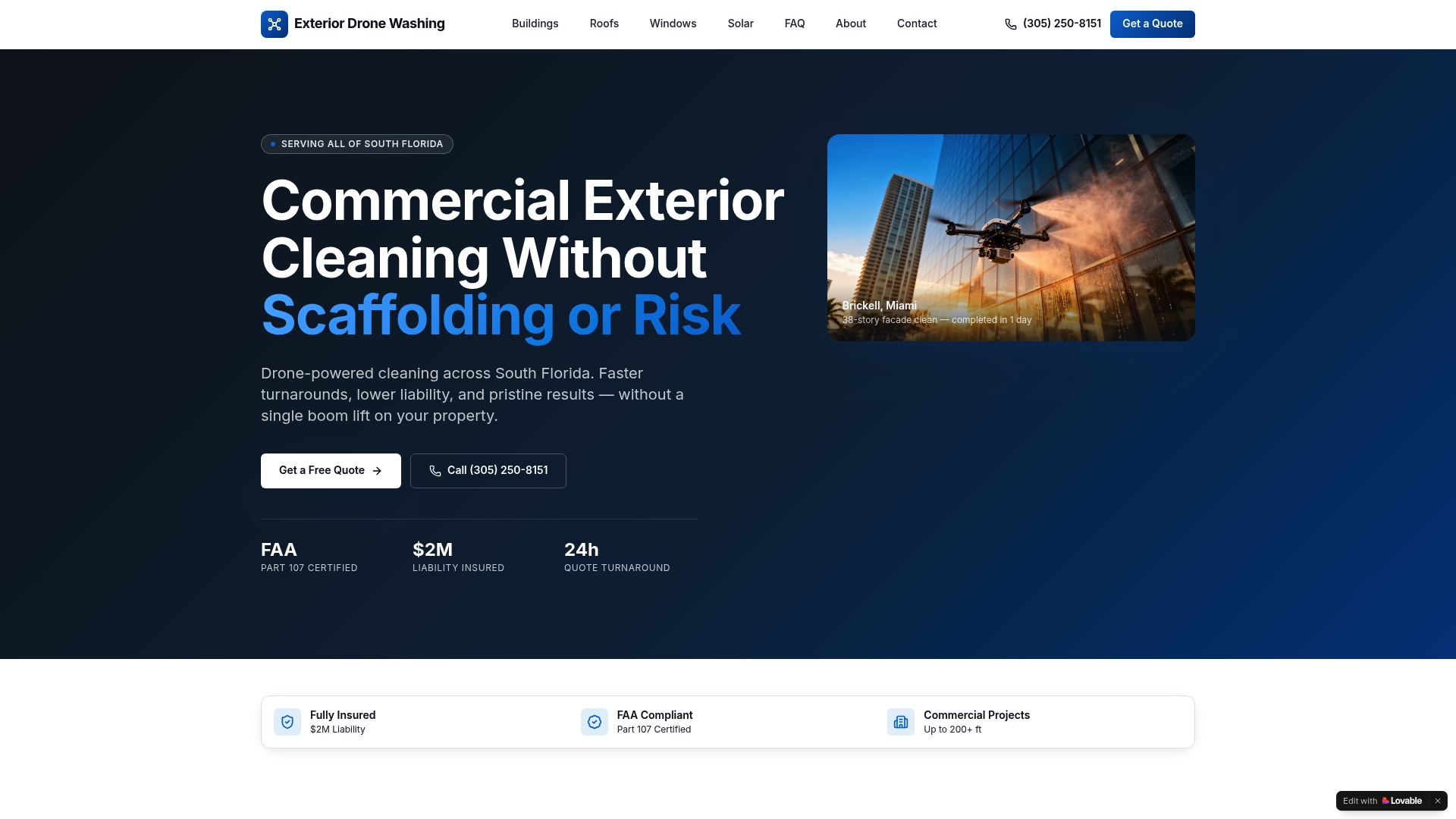
Vista Drone Cleaning provides aerial exterior cleaning for high-rises, office towers, and hotels. Services include facade washing, glass cleaning, and solar panel maintenance. All pilots are FAA Part 107 certified. For properties in the Brickell corridor and Downtown, we offer district-specific high-rise service. Contact our team for a site assessment and proposal.
FAQ
What is drone washing for commercial buildings?
Drone washing uses unmanned aircraft with high-pressure soft-wash systems and purified water to clean facades and windows without scaffolding or rope access.
How much does Miami drone washing cost compared to traditional methods?
It typically costs 30–60% less than scaffolding by eliminating rental fees and large labor crews.
Is drone washing legal in Miami?
Yes, provided the pilot is FAA Part 107 certified and complies with Miami Code § 37-12 event restrictions and airspace rules.
How often should Miami high-rise buildings be drone washed?
Most facades require cleaning twice per year. Buildings facing the bay may require quarterly service due to salt air.
What surfaces can drone washing clean on a high-rise?
Drones clean glass curtain walls, concrete, metal panels, and rooftops. RO/DI filtration ensures spot-free results on high-rise glass.