6 Non Negotiables for Facilities Managers: Lucid Bots Sherpa Cleaning
For facilities managers: Lucid Bots Sherpa cleaning with Sherpa HighLine. Learn hose/flow limits, preflight workflow, and six contract musts.

Lucid Bots Sherpa, paired with the new Sherpa HighLine rooftop pulley system, is built to handle high-elevation exterior cleaning that used to require scaffolding or rope access. The HighLine extends practical working height by supporting hose weight from the roof rather than the drone alone, which improves flow rates and job capacity. For facilities managers, this typically means faster, less disruptive access to tall facades, towers, and rooftop equipment.
TL; DR:
- Using HighLine support allows tethered drones to operate at heights up to 280 feet by offloading hose weight to rooftop anchors.
- Flow rate and hose diameter are the main constraints on height; thicker hoses increase capacity but require support systems like HighLine.
- Proper preflight preparation, including clear launch zones and FAA compliance, is essential for high-reach drone jobs.
- Sherpa is best suited for routine cleaning tasks on facades and solar arrays, but not for heavy restoration or delicate glass surfaces.
- Cost savings and faster turnaround are key advantages, with drone job duration shortened by larger hoses and optimized flow configurations.
Table of Contents
- What Sherpa and Sherpa HighLine are built to do
- How Sherpa cleaning actually works at height
- Preflight workflow and crew roles for a high-reach job
- FAA rules you need to verify before a high-elevation job
- When Sherpa is the right call and when it is not
- What the business case looks like for facilities teams
- Our field experience running Sherpa systems across South Florida
- The six non-negotiables before you sign a drone cleaning contract
- Get a South Florida site review for Sherpa-based cleaning
- FAQ
- Sources
What Sherpa and Sherpa HighLine are built to do
Sherpa is a purpose-built cleaning drone designed to carry interchangeable payloads for spraying, window washing, and soft-wash shield work on commercial facades, roofs, and solar arrays. Instead of a general-purpose aircraft adapted for cleaning, it ships configured for the specific mechanics of pumping water and detergent through a tethered hose while hovering against a vertical surface.
The Sherpa HighLine adds a rooftop pulley system that carries the weight of the hose and water column, rather than leaving the drone to lift that mass on its own. Because hose weight, not motor power, is usually what limits how high a tethered cleaning drone can realistically work, moving that load to a rooftop anchor point changes the math for building height and hose diameter together.
Lucid Bots demonstrated this setup at the Monarch Casino Resort Spa, reaching 280 feet, a height well beyond what earlier tethered configurations could manage reliably.
- Sherpa payloads cover spraying, window cleaning, and soft-wash shield attachments.
- Sherpa HighLine offloads hose weight to a rooftop pulley instead of the drone.
- The 280-foot demonstration points to a limited release planned for the fourth quarter of 2026.
How Sherpa cleaning actually works at height
A tethered cleaning drone pumps water and detergent through a hose that runs from a ground or rooftop source to the aircraft. The drone itself rarely runs out of lift before the hose does: as height increases, the combined weight of hose material and the water inside it grows faster than most operators expect, and that cumulative mass is the real ceiling on working height, not motor output.
Flow and pressure settings matter just as much as height. Lucid Bots’ own guidance on high pressure with Sherpa steers operators away from narrow hoses pushed to very high PSI, since that combination strains equipment without actually cleaning faster. Moderate pressure paired with higher flow tends to cut through grime more efficiently and finishes jobs sooner.
Hose mass, not motor power, is usually the binding constraint on tethered drone height. Lucid Bots addressed this directly with HighLine by supporting the hose from the rooftop rather than asking the drone to carry it.
Hose diameter is the trade-off facilities managers should ask vendors to explain. A thinner hose is lighter and easier for a drone to manage unsupported, but it restricts flow rate and slows large jobs. A thicker hose moves more water per minute but adds weight that the drone has to overcome.
- Thinner hoses favor unsupported height but cap flow and cleaning speed.
- Thicker hoses raise flow and job capacity but need HighLine-style support at height.
- Pump and flow configuration should match the facade size, not just the building height.
With HighLine’s rooftop support, operators can run larger-diameter hoses at heights that would have been impractical before, which is the main reason it expands which buildings a drone crew can realistically bid.
Preflight workflow and crew roles for a high-reach job
A Sherpa job at height runs on preparation as much as flight skill. Before launch, crews confirm the launch zone is clear, generator or pump power is staged and tested, the deionized water supply is sufficient for the job length, and rooftop access for HighLine anchoring has been cleared with building management as advised in security camera maintenance explained for homeowners.
- Confirm launch zone clearance, power source, and DI water volume for the full job.
- Assign a pilot, a dedicated hose manager, and a safety observer with clear radio protocols.
- Lay out hose using S-turns and manage slack to prevent snags during vertical passes.
- Run the window-cleaning cycle: DI pre-rinse, detergent dwell of roughly two minutes, then a final DI rinse.
The Sherpa user manual recommends a 3/8-inch Flexzilla hose with compression fittings for most window and facade work, along with active hose management so loops and tension are monitored throughout the pass rather than only at the start.
Pro Tip: Keep deionized water at or below 10 ppm total dissolved solids before the final rinse; that single control does more for a streak-free finish than any amount of extra dwell time.
Assigning one crew member solely to hose management, separate from the pilot, cuts down on snag-related delays and keeps the pilot focused on the facade rather than the tether.

FAA rules you need to verify before a high-elevation job
Every commercial Sherpa operation starts with a Part 107 certified pilot and a registered aircraft. That baseline covers most straightforward facade and rooftop jobs, but height, airspace, and crew configuration can trigger extra requirements.
- Confirm Part 107 certification and current aircraft registration for every pilot assigned.
- Check whether the site sits inside controlled airspace requiring LAANC authorization.
- Identify operations that need a formal waiver, including flights over people or beyond standard altitude limits.
The FAA’s waiver application instructions ask applicants to describe specific hazards and mitigations rather than submit a generic plan, and processing can take up to 90 days depending on complexity. Facilities managers scheduling jobs near controlled airspace or involving non-standard flight paths should build that lead time into procurement timelines rather than assuming next-week availability. Our guide to FAA certification and risk management walks through how vendors typically document this compliance.
When Sherpa is the right call and when it is not
Sherpa and Sherpa HighLine fit maintenance cleaning well: routine facade washing, skylights, solar arrays, and buildings where scaffolding or lift access is constrained by setbacks, landscaping, or tenant disruption concerns.
They are a poor match for heavy restoration work, surfaces that need mechanical agitation to remove buildup, or delicate glazing and etched glass where a pressurized rinse risks damage. Even when height is technically within reach, launch geometry can rule out a drone before flow rate ever becomes a question.
- Best fit: routine maintenance washing, skylights, solar panels, access-constrained facades.
- Poor fit: heavy restoration, mechanical scrubbing needs, delicate or etched glazing.
- Launch geometry, overhangs, and nearby structures can block a drone option regardless of height.
Our commercial drone cleaning guide covers job types in more depth for teams weighing drone cleaning against other methods.
What the business case looks like for facilities teams
The clearest advantage over scaffolding, boom lifts, or rope access is time on site. A drone crew typically sets up, cleans, and breaks down faster because there is no rigging, permitting for lifts, or road closure to coordinate, and the crew stays on the ground throughout.
- Crew size for a Sherpa job is usually smaller than a scaffold or rope-access team.
- Budget for DI water, pump or generator rental, trained crew time, and rooftop support hardware.
- HighLine’s support for larger hoses raises flow rate, which can shorten job length on tall buildings.
That last point matters most for procurement: a vendor quoting a tall building with a HighLine-equipped Sherpa should be able to explain how hose diameter and flow translate into fewer days on site, which affects both price and tenant disruption.
Our field experience running Sherpa systems across South Florida
We operate FAA Part 107 certified pilots cleaning high-rise windows, facades, roofs, and solar arrays on buildings without scaffolding or lifts. We carry liability insurance, and we document work with 4K before-and-after footage so property managers can verify results without climbing a roof themselves.
Our Lucid Bots Sherpa fleet covers window washing, facade cleaning, roof soft-wash, and solar panel pure-water cleaning, matched to the substrate on site, whether that is glass, stucco, concrete, EIFS, metal, or tile. Our window-cleaning workflow page breaks down the DI rinse cycle in more detail for property teams planning their first drone job.
The six non-negotiables before you sign a drone cleaning contract
Property teams often focus on price first and safety paperwork last, which is backward. Confirm current Part 107 certification and training records before anything else, then ask for a written safety plan and proof of liability coverage. A vendor should demonstrate a deionized-water rinse process and substrate-aware chemistry without being pressed, and should offer before-and-after documentation plus references from buildings similar to yours. Our contractor vetting checklist walks through each of these in order.
, Eliot
Get a South Florida site review for Sherpa-based cleaning
We serve commercial properties across South Florida, cleaning facades, windows, roofs, and solar arrays with FAA Part 107 certified pilots and tethered drones.
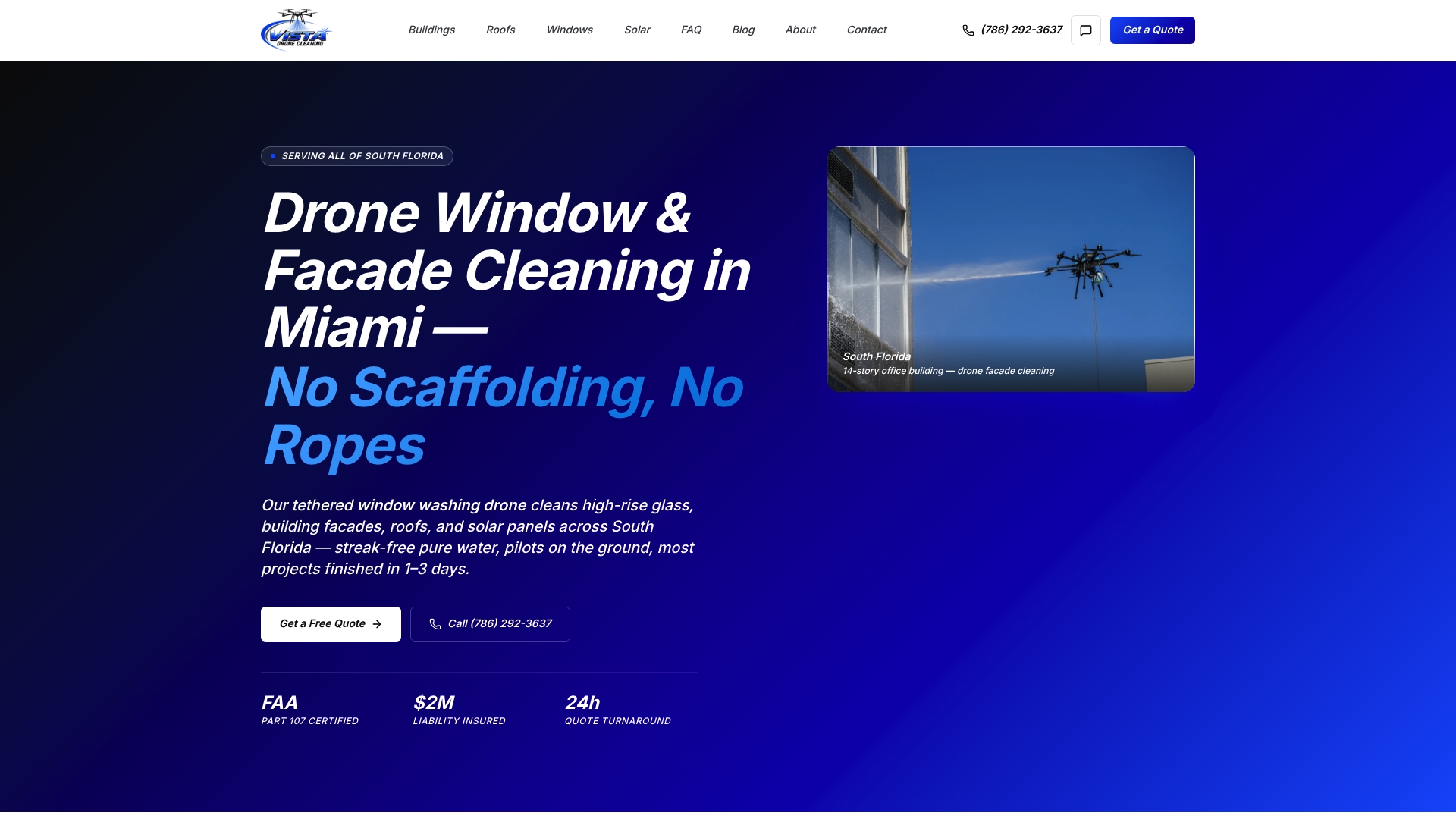
A site review includes an equipment and access assessment, 4K before-and-after documentation, and a written quote, usually turned around within 24 hours.
- Facade and building cleaning, window washing, roof soft-wash, and solar panel cleaning are all available.
- Quotes are priced by building area and service type, with no obligation to proceed.
- Crews stay on the ground throughout, reducing coordination with tenants and parking.
Request a free quote through our drone facade and building cleaning page to get a site review scheduled.
FAQ
How much does drone cleaning cost?
Pricing is typically quoted per square foot or per unit rather than as a flat fee. Our drone window cleaning runs $0.12 to $0.25 per square foot of glass, facade cleaning falls in the same $0.12 to $0.25 per square foot range, and solar panel cleaning runs $1 to $3 per panel.
Is drone window cleaning profitable?
Profitability depends on job volume, hose and flow configuration, and how much setup time a crew needs compared to scaffolding or lift rental. HighLine-equipped systems that support larger hoses at height can shorten time on site, which directly affects margin on taller buildings.
Is drone cleaning worth it for commercial buildings?
For routine maintenance washing of facades, windows, roofs, and solar arrays, drone cleaning usually finishes faster and causes less tenant disruption than scaffolding or rope access, since crews stay on the ground and there is no rigging to coordinate. It is a weaker fit for heavy restoration work or delicate glazing that needs mechanical agitation.
What is the best drone for high-elevation window cleaning?
Lucid Bots Sherpa, especially when paired with the Sherpa HighLine rooftop pulley system, is built specifically for tethered exterior cleaning at height, having demonstrated cleaning up to 280 feet at the Monarch Casino Resort Spa. The right configuration still depends on hose diameter, flow rate, and the facade’s substrate.
Do commercial drone cleaning crews need FAA approval?
Yes, commercial operators need a Part 107 certified pilot and a registered aircraft at minimum. Jobs near controlled airspace or involving non-standard flight paths may also need LAANC authorization or a formal waiver, which can take up to 90 days to process.
Sources
- Lucid Bots takes drone cleaning beyond 280 feet with new Sherpa HighLine rooftop pulley system
- Utilizing high pressure with your Sherpa
- FAA, Commercial operators (Part 107) guidance