Audit Ready 4K Cleaning Documentation in 1–3 Days for South Florida
Capture, tag, and archive 4K cleaning video so it meets GDP/ALCOA, SSOP/HACCP, and FDA Part 11 expectations. Includes South Florida drone workflows and...

High-resolution 4K video can serve as objective, audit-ready cleaning documentation, but only when it is captured, labeled, and stored to meet Good Documentation Practices (GDP/ALCOA), SSOP/HACCP recordkeeping rules, and FDA Part 11 expectations for electronic records. Footage alone proves nothing to an inspector: paired with validated cleaning-verification data and a defensible chain of custody, it becomes some of the strongest evidence a facility can produce.
TL; DR:
- 4K footage must include embedded metadata like timestamps and operator IDs, with a validated chain of custody, to meet regulatory documentation standards.
- Footage alone cannot quantify microbial load or pathogen presence, so it should be paired with laboratory testing results for comprehensive verification.
- Consistent shot lists, proper file naming, and metadata application are essential for creating defensible, audit-ready cleaning records.
- High-bitrate and stable recording conditions, including lighting and camera stability, are crucial for producing usable, detailed footage suitable for audits.
- Video records supporting regulatory decisions fall under FDA Part 11, requiring careful storage, validation, and retention matching the operational or audit cycle.
Table of Contents
- How 4K documentation maps to GMP, HACCP, SSOPs, and good documentation practices
- A practical capture checklist for audit-ready 4K footage
- Technical specs for sharp, defensible 4K capture
- Hygiene controls for cameras and imaging equipment in regulated zones
- How 4K footage supports cleaning verification and corrective actions
- Records, chain of custody, and Part 11 considerations
- How Vista Drone Cleaning documents exterior cleaning for South Florida high-rises
- When full 4K documentation is worth the investment
- Getting 4K audit-ready documentation for your South Florida property
- FAQ
- Sources
How 4K documentation maps to GMP, HACCP, SSOPs, and good documentation practices
Good documentation practices rest on the ALCOA attributes: attributable, legible, contemporaneous, original, and accurate. FDA’s GDP guidance ties these attributes to dating, initials, and retention of raw data, and video maps onto them more directly than most people expect. A timestamp and operator ID burned into the file or stored as metadata satisfies “attributable” and “contemporaneous.” The raw master file, untouched by editing, satisfies “original.” Clear 4K resolution without compression artifacts satisfies “legible.” The weak link is usually “accurate, ” which footage alone cannot establish; a sparkling-clean surface on camera says nothing about microbial load.
That’s where SSOP and HACCP recordkeeping touchpoints come in. Sanitation Standard Operating Procedure guidance from FSIS calls for written, signed, and dated records covering pre-operational checks, in-process monitoring, and corrective actions, all retained for inspection. Footage belongs at each of these checkpoints: a pre-op walkthrough clip establishing baseline conditions, a monitoring clip during the shift, and a post-corrective-action clip after a deviation is addressed. The same guidance confirms that records documenting monitoring and corrective actions must be available for agency verification, which means footage tied to those moments has to be retrievable on demand, not buried in an unsorted folder.

Visual evidence has real limits. It shows whether a surface was touched, how thoroughly a crew worked a corner, and whether contact time looked adequate. It cannot quantify ATP levels, detect pathogens, or replace a validated swab test. Treat 4K footage as the record of what happened and where, and treat laboratory or rapid-test results as the record of whether it worked. Audit-ready documentation uses both together.
A practical capture checklist for audit-ready 4K footage
Operations teams don’t need a production crew to generate defensible footage. They need a consistent shot list and a metadata habit applied every time.
- Overview shot: a wide establishing pass showing the full area before work begins, with any existing damage or soil visible.
- Entry and exit shots: timestamped footage of personnel entering and leaving the zone, useful for contamination tracing.
- Equipment close-ups: serial numbers or asset tags on cleaning tools and imaging devices, visible on camera.
- Critical surface passes: slow, steady footage of high-risk contact points named in the SSOP.
- Before and after sequences: matched camera angles so a reviewer can compare the same surface at both points in time.
Every clip needs metadata attached at capture, not reconstructed later: operator ID, device serial number, exact timestamp, location tag, the SSOP reference number the clip supports, and the test result ID it will eventually be matched to. File naming should follow a fixed pattern, something like date, location code, and SOP number, so a reviewer can locate a clip without opening it first. Folder structure should mirror the SSOP itself, with subfolders for each zone or line, and every clip should link back to its corresponding SSOP entry and test result rather than sitting as an orphaned file.
A before/after documentation framework built around these same principles makes the handoff between field crews and QA reviewers far faster, since nobody has to guess what a clip was meant to prove.
Pro Tip: Build the shot list directly into the SSOP document itself, so a new crew member captures the same six shots every time without needing separate training.
Technical specs for sharp, defensible 4K capture
Resolution is only the starting point. A 4K master shot at a low bitrate with heavy compression can look fine on a phone screen and still lose the fine detail an auditor wants to zoom into. Capture at the highest bitrate the storage budget allows, keep an uncompressed or lightly compressed master file, and generate a smaller deliverable copy for day-to-day review. Quantified cleaning verification depends on consistent, repeatable inputs, and footage is no different: a shaky, poorly lit clip is functionally useless even at 4K resolution.
- Resolution and codec: capture in true 4K, keep a high-bitrate master, and generate a compressed H.264 or H.265 deliverable for routine access.
- Camera stability: use a tripod, gimbal, or tethered drone platform rather than handheld passes, since motion blur destroys fine-surface detail.
- Lighting and white balance: set neutral white balance before each session and avoid blown highlights or deep shadows that hide residue.
- Reference scales: include a color chart or ruler in at least one frame per session so reviewers can judge true scale and color accuracy.
- Checksums: generate a checksum for every master file at the moment of capture, so any later alteration is detectable.
One checksum generated at capture and stored alongside the file is what lets an auditor confirm a video has not been edited since the day it was recorded, a basic but often-skipped step in FDA’s Part 11 guidance on electronic record integrity.
Store masters in a validated archive system rather than a general-purpose cloud drive, with access logs showing who viewed or exported a file. Deliverable copies can live in a more accessible shared folder for daily QA review, but the master stays locked down. This two-tier approach, a protected master and a working copy, keeps evidentiary value intact without slowing down the people who need quick access day to day.

Hygiene controls for cameras and imaging equipment in regulated zones
Bringing a camera, gimbal, or drone into a food production floor or cleanroom introduces a contamination risk that needs its own written procedure, not an afterthought bolted onto the cleaning SSOP.
- Pre-deployment disinfection: wipe housings, lenses, and handles with an agent compatible with the zone’s surface materials and approved for food-contact or pharmaceutical environments before every session.
- Protective covers: use disposable or washable equipment covers in direct-contact zones to prevent the device itself from becoming a contamination vector.
- Foreign-body checklist: inspect equipment for loose screws, dangling straps, or shedding materials before entry, and log the inspection.
- Post-session inspection: check equipment again on exit to confirm nothing was left behind in the work area.
- Sign-off: have a designated supervisor initial and date the equipment-cleaning log, the same way a surface-cleaning step would be signed under the SSOP.
This equipment-cleaning step should appear as its own line item inside the written SSOP, not as a verbal habit, because an inspector reviewing the sanitation program will ask who is responsible for keeping imaging tools from becoming the contamination source they were brought in to document. Teams managing safe building-washing operations for commercial clients in South Florida apply the same logic: equipment that touches or enters a controlled space gets its own documented hygiene protocol, separate from the cleaning task it records.
How 4K footage supports cleaning verification and corrective actions
Footage and lab testing do their best work together, following a sequence rather than running as two disconnected records.
- Capture first: record the cleaning pass on the critical surface with full metadata attached.
- Verify second: perform ATP, protein swab, ELISA, or PCR testing on the same surface immediately after, per Hygiena’s cleaning verification guidance.
- Attach the result: link the test result ID to the footage file and the SSOP entry it supports.
- Document corrective action: if the result fails threshold, record the re-clean on camera and attach the follow-up test result to the same chain.
This sequence pays off most clearly during a nonconformance investigation. When a swab result comes back high, footage showing exactly which pass missed a seam, corner, or equipment joint turns a vague “recleaning required” note into a specific, correctable finding. Root-cause analysis moves faster when a reviewer can watch the actual cleaning pass rather than relying on a crew member’s memory of what happened three shifts ago.
Trend charts built from repeated ATP or protein readings, combined with the footage library behind them, create the kind of narrative an auditor wants: not just “we passed, ” but “here is the cleaning pass, here is the number it produced, and here is the corrective action when it didn’t pass.” That combination, numbers plus visual context, is harder to dispute than either record alone.
Records, chain of custody, and Part 11 considerations
A video file is only as strong as the custody trail behind it. Define who captures the footage, who uploads it, who reviews it, and who has authority to export or delete it, and write those roles into the SSOP rather than leaving them informal.
- Chain of custody: assign a named role to each handoff point, from the person recording the clip to the person archiving the master.
- Retention: keep footage linked to the production run or cleaning cycle it documents for as long as that batch or period remains subject to audit.
- Part 11 triggers: footage used to support a regulatory decision, paired with metadata and an audit trail, generally falls under the same electronic-record expectations FDA describes for Part 11, including validation and the ability to produce a human-readable copy on request.
- Export-ready copies: maintain a format inspectors can open without specialized software, alongside the protected master.
FSIS and FDA guidance both allow electronic records in place of paper, provided the system preserves integrity and can produce a retrievable copy for inspection. That means a locked folder nobody can find during an audit defeats the purpose of keeping the footage at all.
Pro Tip: Keep a standing export template ready, so when an inspector asks for three months of footage tied to a specific line, your team can produce it the same day instead of scrambling through mismatched folders.
How Vista Drone Cleaning documents exterior cleaning for South Florida high-rises
For commercial exterior work, we operate with FAA Part 107-certified pilots and tethered industrial drones, backed by $2 million in liability insurance, and we deliver 4K before-and-after footage as a standard part of facade, window, roof, and solar panel cleaning projects across Miami-Dade and Broward counties. Deliverables typically include 4K master files, annotated clips highlighting specific surfaces or problem areas, and a project timeline property managers can hand directly to ownership, insurers, or compliance staff. This footage documents exterior cleaning quality and coverage. It supplements, but never replaces, laboratory microbiology testing for facilities with regulatory microbial requirements, since drone footage confirms visible condition, not microbial load.
When full 4K documentation is worth the investment
Full 4K documentation earns its cost in specific situations: disputed cleaning events, cleanroom validation, or any facility carrying real regulatory exposure where a verbal account won’t satisfy an auditor. For routine, low-risk areas, a photo and a test strip often cover the requirement without the overhead of a full capture and archival workflow. Procurement language should ask directly for footage with embedded timestamps, operator identification, and a named retention period, not just “video documentation, ” because vague specifications produce unusable files. The investment question isn’t whether video looks impressive. It’s whether the facility’s regulatory risk justifies the archival and chain-of-custody discipline that makes footage defensible in the first place.
, Eliot
Getting 4K audit-ready documentation for your South Florida property
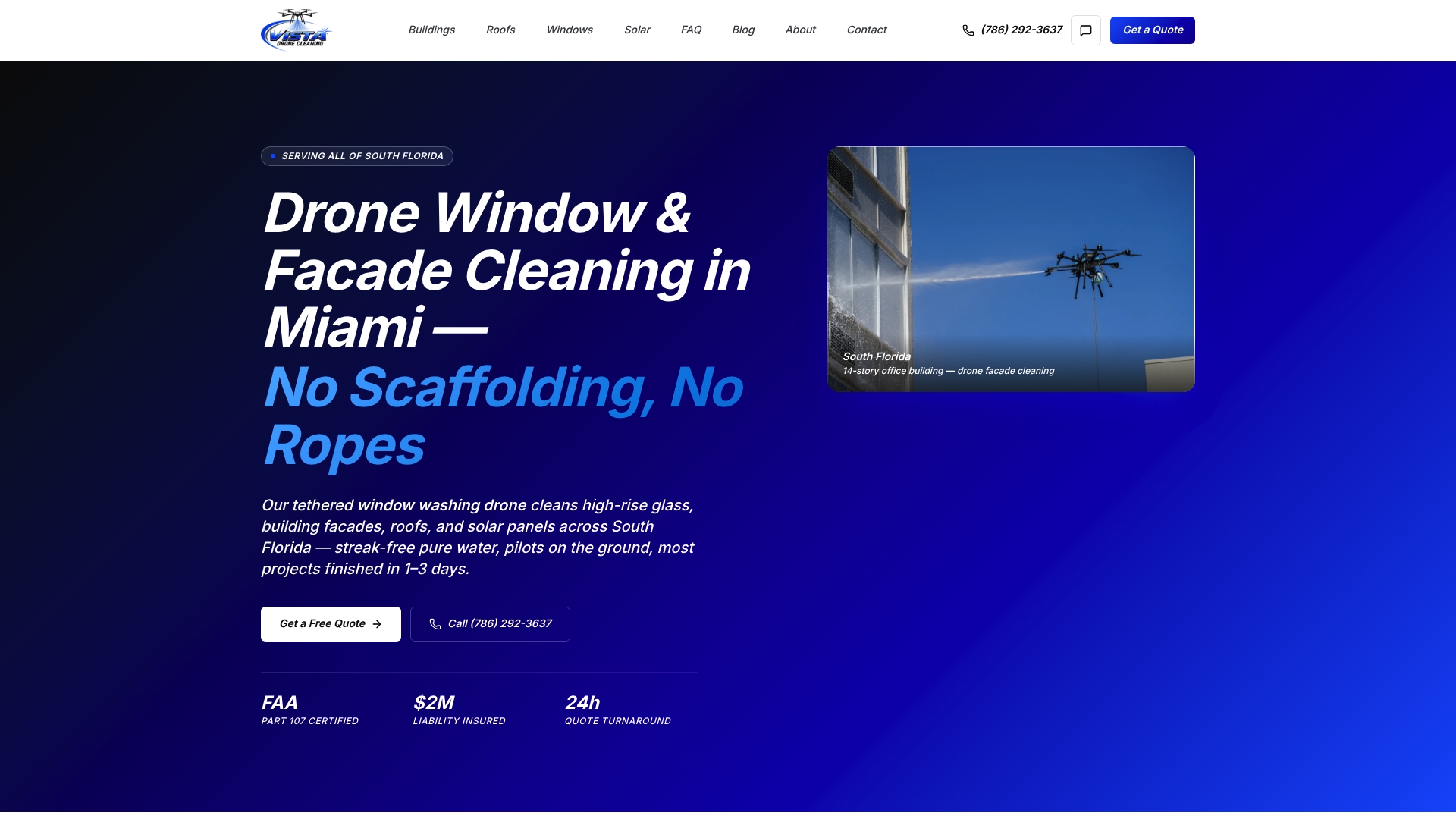
Property managers and facility operators who need documented proof of exterior cleaning work, not just a clean building, get a cleaner compliance trail when the footage is built into the service from day one. We bring FAA Part 107-certified pilots and tethered industrial drones to every facade, window, roof, and solar project across Miami-Dade and Broward counties, and 4K before-and-after footage comes standard, not as an add-on request after the fact.
- 4K master footage plus deliverable clips for every project, with timestamps and location tags intact.
- Most projects complete in 1 to 3 days, with no scaffolding, lifts, or rope access required.
- $2 million liability insurance and FAA Part 107-certified pilots on every job.
If your next cleaning project needs documentation your QA team or ownership group can actually use, start with a free quote on our drone facade and building cleaning page and we’ll walk you through what the footage package looks like for your property.
FAQ
What makes 4K video audit-ready instead of just a recording?
Audit-ready video combines clear 4K resolution with embedded metadata such as timestamp, operator ID, and an SSOP reference, plus a documented chain of custody. On its own, a video clip without that supporting data rarely satisfies GDP/ALCOA expectations for attributable, contemporaneous records.
Can video footage replace ATP or microbial testing?
No. Footage shows whether a surface was cleaned and where, but cleaning verification methods like ATP, protein swabs, ELISA, and PCR are what confirm whether the cleaning actually reduced microbial load. The strongest records combine both.
How long should cleaning documentation footage be retained?
Retention should match the production run, batch, or audit cycle the footage supports, and SSOP recordkeeping guidance expects records to stay retrievable for inspection throughout that period. Facilities with stricter regulatory exposure typically keep footage longer than low-risk operations.
Does video documentation fall under FDA Part 11?
Footage used to support a regulatory decision, combined with metadata and an audit trail, generally falls under the same expectations FDA describes for electronic records, including validation and a retrievable, human-readable copy. Whether a specific file qualifies depends on how it’s used and stored.
Does Vista Drone Cleaning provide documentation with every project?
Yes, 4K before-and-after footage is a standard deliverable on our facade, window, roof, and solar panel cleaning projects across South Florida. Pricing for facade and building cleaning in South Florida typically ranges at competitive industry rates per square foot, and free quotes are provided quickly.
Sources
- Good Documentation Practices (GDP): FDA
- Sanitation Standard Operating Procedures (SSOP): FSIS
- Cleaning and sanitation, the power of quantification, Hygiena