How does drone solar panel cleaning actually work?+
A tethered industrial drone carries twin pure-water nozzles fed by a ground pump pushing de-ionized water (0 TDS) up the tether. The drone flies row-by-row across the array, flood-rinsing every module with pure water. Because the water has zero dissolved solids, panels air-dry streak-free with no detergent residue — and no one walks the modules.
Why is pure water better than soap for solar panels?+
Detergents leave residue that attracts more dust and dims output between cleanings. Pure de-ionized water (0 TDS) carries no minerals, so it air-dries completely clear. It's also the only cleaning method that doesn't trigger panel-manufacturer warnings about chemical degradation of anti-reflective coatings.
Will drone cleaning void my solar panel warranty?+
No — and in many cases it's the only method that preserves warranty status. Major panel makers (LG, Q Cells, Canadian Solar, Trina, JinkoSolar) explicitly warn against foot traffic on modules because it causes microcracks that drop output and void warranties. Drone pure-water cleaning involves zero panel contact.
How much output can drone cleaning actually recover?+
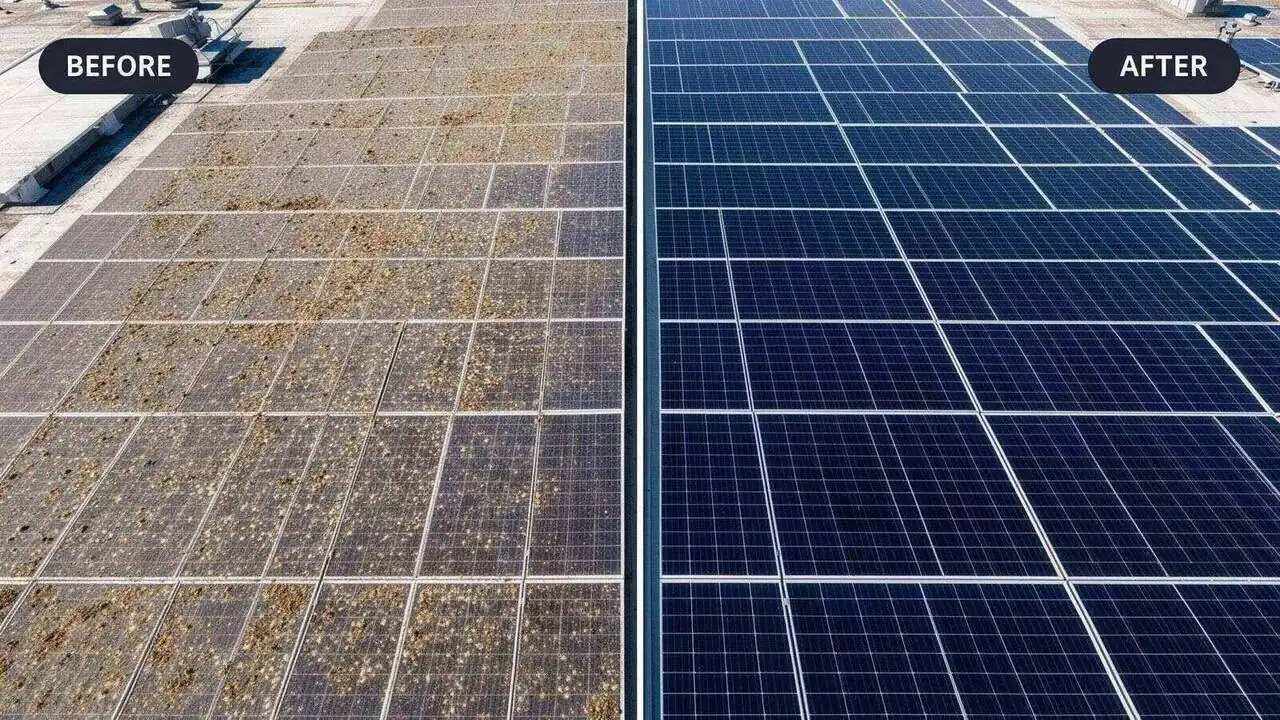
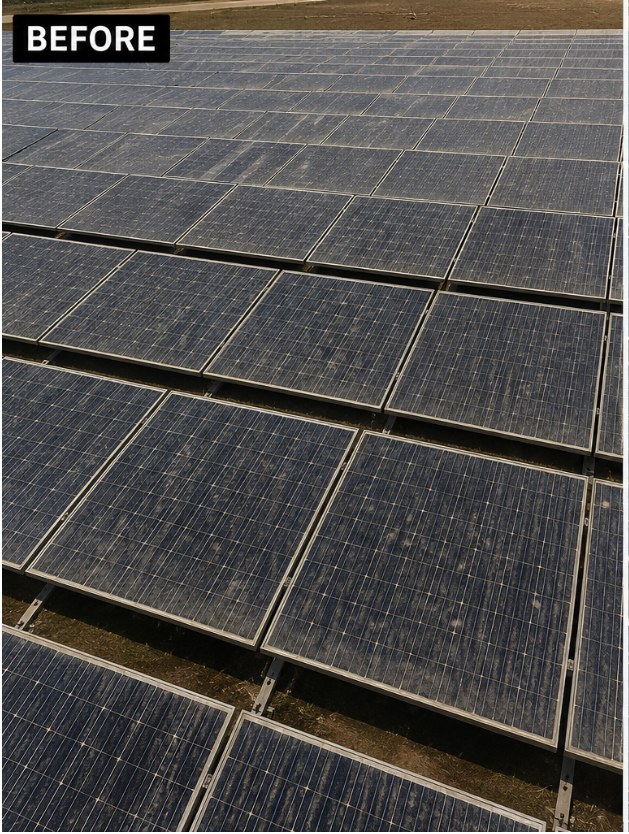
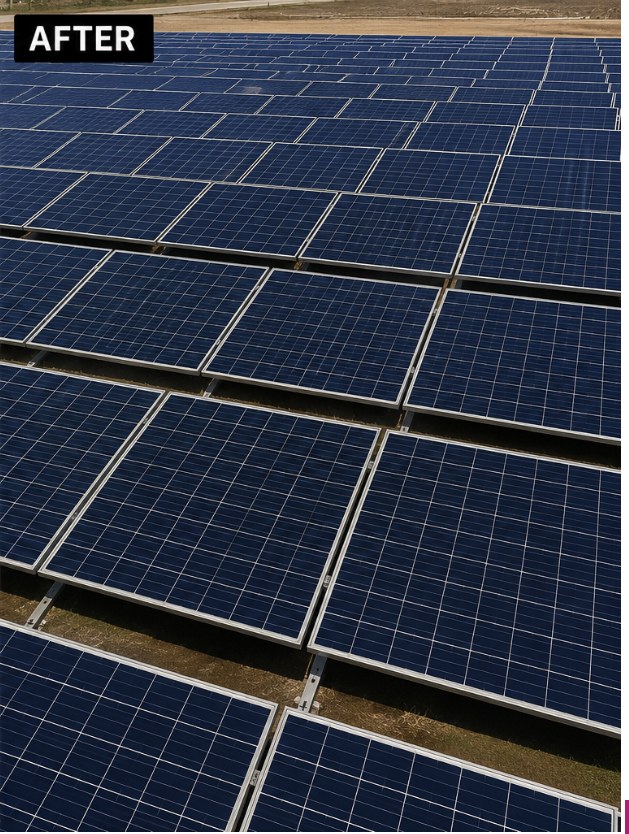
South Florida arrays typically lose 15–30% of output between cleanings to a combination of salt aerosols, Saharan dust events, pollen, and bird soiling. Drone pure-water cleaning recovers that lost output — measurable on the next billing cycle's production report.
How much does drone solar panel cleaning cost in Miami?+
Commercial cleaning runs $0.04–$0.08 per watt depending on array size, access, and frequency. A 250 kW Miami rooftop typically falls between $8,000 and $12,000. A 1 MW utility or warehouse array runs $25,000–$40,000. Quarterly contracts cut per-visit cost 20–30%.
How fast can a drone clean a megawatt array?+
Approximately 1 MW per day. Drone cleaning is dramatically faster than hand-cleaning crews because there's no ladder work, no walking the modules, no harness setup, and no need to clean panel-by-panel — the drone flood-rinses entire rows in continuous passes.
How often should Miami solar arrays be cleaned?+
Quarterly for coastal arrays in Miami-Dade, Broward, and Palm Beach because salt aerosols and Saharan dust build up fast. Twice yearly for inland sites in western Broward and Palm Beach. Bird and pollen seasons can warrant additional cleans on sensitive sites.
Do you need FAA permission to fly a solar cleaning drone in Miami?+
Yes. Every flight is conducted under FAA Part 107 by a licensed commercial pilot. In controlled airspace near MIA, FLL, and PBI we file LAANC airspace authorizations before mobilization and carry the certificate on every job site.
What insurance do you carry for drone solar cleaning?+
We carry $2M commercial general liability plus dedicated UAS (drone) liability and hull coverage. Certificates of insurance naming the array owner, EPC, asset manager, or off-taker are issued before mobilization on every project.
Can you clean carport, canopy, and ground-mount arrays?+
Yes — drone cleaning handles all three formats. Rooftop arrays where walking the modules is unsafe, carport and parking canopies where ladder access is awkward, and ground-mount or solar-farm arrays where speed is the main constraint. 1 MW per day applies across all formats.
Does pure-water cleaning work on bird droppings and Saharan dust?+
Yes. The pure-water flood rinse breaks surface tension on dried droppings and dust crusts and sheets them off the module surface. For heavily soiled panels, a low-pressure soft-wash dwell can precede the rinse — still no detergent residue, still no panel contact.
Do you provide before-and-after output documentation?+
Yes. We deliver 4K aerial footage of every section before and after cleaning, plus electroluminescence-style proof of pane-by-pane clean. Output recovery is verified against the next production report and shared back to the asset manager or owner.